A diagnostic connection combines a vehicle network, a way to carry messages, and services that define what a tester can ask for. The scan tool may also use a software interface to reach its vehicle communication adapter. Identify each layer before choosing a tool or interpreting a trace.
From the wire to the application
The OSI model gives each layer a job. Vehicle standards sometimes cover more than one layer. For example, UDS defines services, ISO-TP moves their payloads across CAN frames, and CAN defines frame delivery and signalling through the applicable parts of ISO 11898. UDS can also use DoIP over an IP network.
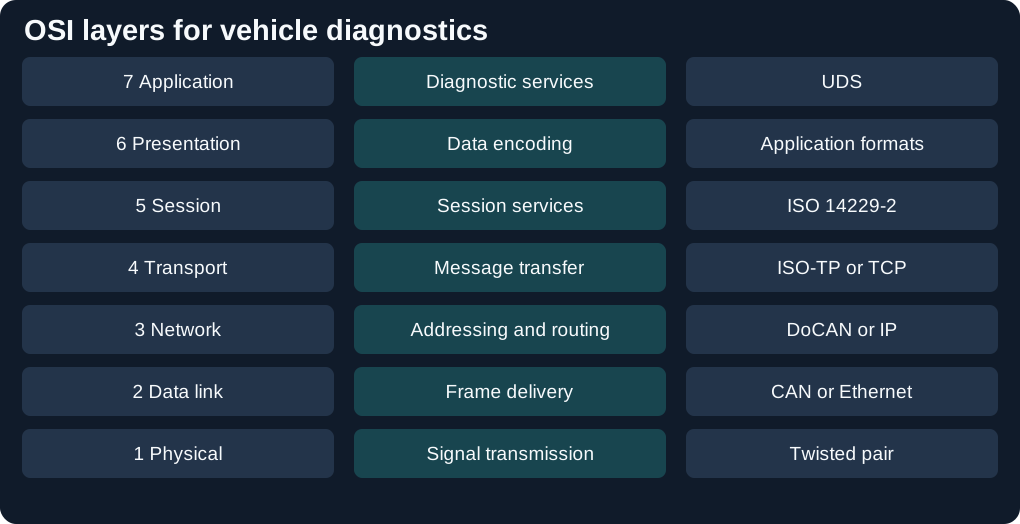
Interpreting a CAN diagnostic trace
First identify the network and CAN frame format, then the diagnostic addressing and transport format before interpreting the service bytes. A CAN identifier, an ISO-TP addressing byte and a diagnostic data identifier have different roles; similar numbers do not make them interchangeable. A short ISO-TP message can fit in a single frame. A longer message uses a first frame, flow control and consecutive frames, which must be reassembled before interpreting the complete diagnostic response. Addressing and frame capacities depend on the transport configuration and CAN format. CAN Newsletter: UDS on CAN and ISO-TP.
A CAN acknowledgement indicates that at least one receiver acknowledged a consistent frame; it does not identify the receiver or establish that the intended diagnostic service completed successfully. Examine the diagnostic response and its context separately. CAN in Automation: acknowledgement definition.
Vehicle networks
- K-Line diagnostics
- CAN bus in the car
- CAN FD
- CAN XL
- Automotive Ethernet and DoIP
- FlexRay
- ISOBUS
- LIN bus in the car
- The MOST optical bus
- SAE J1708 and J1587
- SAE J1850 vehicle diagnostics
Transport and diagnostic services
- Diagnostics over IP
- ISO-TP on CAN
- SAE J1939 CAN IDs and PGNs
- Volkswagen TP 1.6 and TP 2.0
- KWP 2000 on K-Line
- KWP 2000 on CAN
- UDS over CAN
- OBD-II emissions diagnostics
- WWH-OBD
Diagnostic software interfaces and test sequences
- D-PDU API
- Diagnostic D-Server
- Open Test Sequence Exchange (OTX)
- SAE J2534 PassThru
- RP1210 vehicle interface API
- Service-oriented vehicle diagnostics (SOVD)
Manufacturer-specific CAN
Use the CAN bus ID database to find platform-specific frame identifiers. BMW D-CAN, K-CAN and PT-CAN includes scoped examples of diagnostic requests and a body-network broadcast. Volkswagen TP 2.0 covers negotiated diagnostic channels.
Older manufacturer networks
These pages cover legacy body and infotainment networks and K-line diagnostics. Examples are chassis-specific; each page marks gaps where a sourced CAN ID or read-only frame is unavailable.
- Mercedes-Benz CAN-B and CAN-C
- Mercedes-Benz D2B optical bus
- Volkswagen convenience CAN
- VAG KWP1281
- BMW I-bus
- BMW K-bus
Off-highway and equipment CAN
These pages cover CANopen and J1939 applications in forklifts, construction machinery, municipal equipment, collision-avoidance systems, truck-trailer links and machine attachments.
- CANopen in forklift trucks
- CANopen profiles for construction machinery (CiA 415/436)
- CleANopen for municipal vehicles (CiA 422)
- J1939 collision-avoidance interface for earth-moving machinery
- ISO 11992 truck-trailer CAN
- MiC 4.0 BUS for construction attachments
Sources
Topic coverage follows the ACTIA IME vehicle diagnostics index. Individual pages credit their references and include original diagrams.