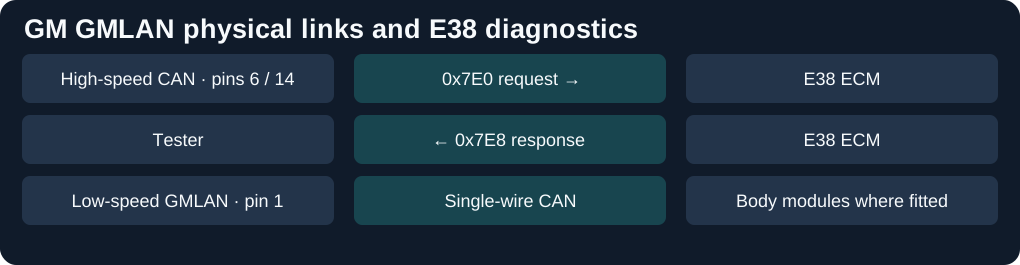
On GM applications with these links, high-speed GMLAN uses differential CAN at 500 kbit/s on diagnostic connector pins 6 and 14. Low-speed GMLAN is a separate single-wire body network, typically 33.3 kbit/s and available on pin 1 where fitted. Use the vehicle wiring to establish whether low-speed GMLAN is present.
CAN identifiers
| 11-bit CAN ID | High-speed example |
|---|---|
0x0C9 | Engine-status broadcast, including engine speed, from the published E38/T43 capture. |
0x7E0 | Physical request ID reported for E38 ECM diagnostics. |
0x7E8 | Physical reply ID reported for E38 ECM diagnostics. |
Example read-only diagnostic requests
For a GMLAN module that supports the VIN identifier, the request payload is 1A 90 and the positive payload starts with 5A 90. An illustrative normal-addressing ISO-TP Single Frame is 02 1A 90 before padding. The E38 CAN IDs and the GMLAN service definition are independently sourced. Confirm service support on the target calibration. A VIN reply is long enough to require multi-frame transport on Classic CAN.
On an emissions OBD implementation supporting VIN readout, 09 02 is the separate generic request and 49 02 starts the positive payload. Both examples read identification data. The IDs above describe the high-speed example.
Low-speed GMLAN body-module examples
GM’s body-builder documentation identifies DLC pin 1 as low-speed GMLAN on applicable vehicles, with a ground-referenced single wire operating at 33.3 kbit/s. This network can carry 29-bit application frames and 11-bit GMLAN diagnostics. The CAN identifier width and the diagnostic addressing scheme are separate fields to check in a capture.
29-bit BCM application traffic
| Extended CAN ID | Signal or message | Evidence |
|---|---|---|
0x1001E040 | BCM chime command | Named explicitly in the community GMLAN source definitions. |
0x10022040 | Dimmer | Community GMLAN source definition. The low byte is 0x40, consistent with the BCM source address. |
0x10042040 | Lighting status | Community GMLAN source definition with the same source byte. |
These IDs are examples to identify in a passive capture. The source definitions do not establish that all three occur on the same 2016 BCM described below.
DLC pin 1 capture: 2015 Chevrolet Trax
A published log for a 2015 Chevrolet Trax / Tracker 1.4L (LUV) identifies pin 1 at 33.3 kbit/s and shows a GMLAN 1A B0 read of the modules’ diagnostic addresses. The tester sends a functional request, so several modules can reply to the same frame. These are standard 11-bit CAN IDs on the single-wire link.
| Log time | Direction | CAN ID | Logged CAN data | Interpretation |
|---|---|---|---|---|
| 22:13:13.153 | Tester request | 0x101 | FE 02 1A B0 00 00 | FE addresses all nodes, 02 is the diagnostic payload length and 1A B0 requests the ECU diagnostic address. |
| 22:13:13.365 | A11 radio reply | 0x644 | 03 5A B0 80 AA AA AA AA | Positive reply returning module address 0x80. |
| 22:13:13.817 | BCM reply | 0x641 | 03 5A B0 40 00 00 00 00 | Positive reply returning module address 0x40. |
The table preserves the bytes shown by the logger, including padding. The capture author did not publish a BCM part number. The same thread identifies the radio as A11 with RPO UF7 and lists 42564316 in an SPS USB file transfer summary. That number is from the radio software summary, and its hardware part number is unverified.
Sources: 2015 Trax pin 1 capture and vehicle details and GMW3110, diagnostic-address discovery examples.
Evidence for a physically addressed Trax BCM read
The pin 1 log above records a functional request on 0x101 and a BCM reply on 0x641. It does not show a request sent directly to the BCM. A separate Trax post shows a 1A DF read using tester ID 0x241 and reply filter 0x641, with the adapter set to ATSP6 (11-bit CAN at 500 kbit/s). That exchange cannot establish a physically addressed read on the 33.3 kbit/s single-wire link. A full pin 1 request and reply for 1A DE or 1A 90, and the captured BCM’s part number, remain unverified.
Sources: 2015 Trax pin 1 log and Separate Trax BCM read using the ELM327 CAN profile.
Read-only diagnostic examples for a dual-bus 2016 BCM
A published trace identifies a 2016 BCM connected to both high- and low-speed GMLAN. The tester uses standard 11-bit ID 0x241 and the module replies on 0x641. The post does not identify the tapped bus, the vehicle model or the BCM part number. GMW3110 documents 11-bit USDT diagnostic IDs on low-speed CAN as well.
| Read | Request payload | Positive response | Evidence |
|---|---|---|---|
| GMLAN identification record | 1A DE | 5A DE followed by the record | Captured from the 2016 BCM. The first response frame was 10 0E 5A DE 00 03 00 10 on 0x641. The record reports network and database versions for two buses. |
| VIN | 1A 90 | 5A 90 followed by the VIN | GMW3110 section 8.4.5.1 gives this exchange on 0x241 and 0x641. This is a specification example and should be confirmed on the target BCM. |
In normal-addressing USDT, the 1A DE request is a Single Frame beginning 02 1A DE before padding. The response starts with 10 0E, a First Frame declaring a 14-byte diagnostic payload. The reassembled payload starts with 5A DE.
Low-speed sources
- GM Express/Savana Electrical Body Builder Manual, Data Communications
- Community GMLAN application frame definitions
- Published 2016 BCM identification trace
- GM GMW3110, tables 8–9 and 73
Related references
- GM GMLAN and Global A CAN ID tables
- OBD-II and UDS diagnostic CAN IDs
- Vehicle diagnostics protocols
- ISO-TP on CAN