What a supercharger does
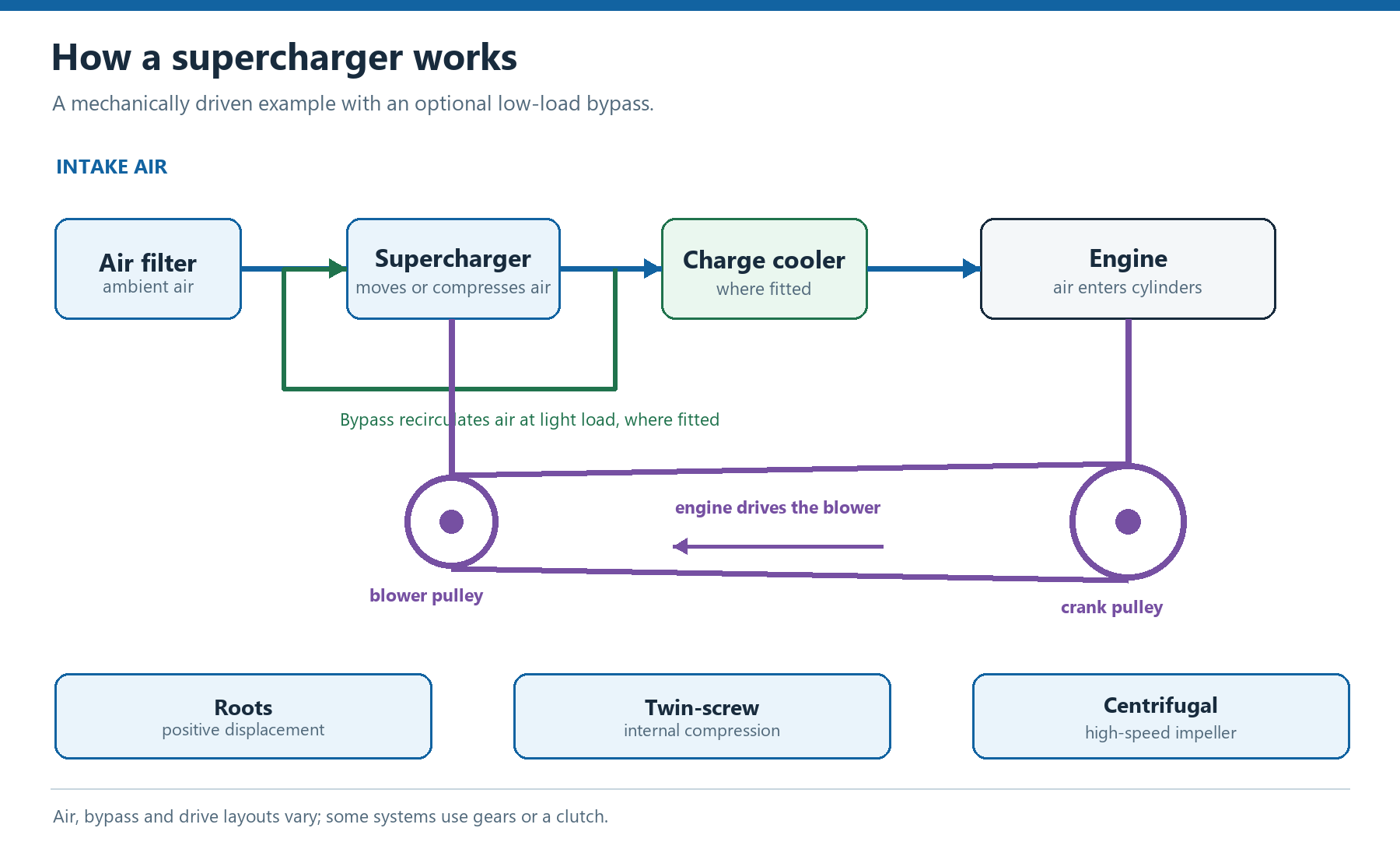
A mechanically driven supercharger moves or compresses intake air using power taken from the engine, commonly through a belt, gears or a traction drive. It can provide response without waiting for an exhaust turbine to accelerate, but the drive consumes crankshaft power and the compressed air becomes hot. The best choice depends on the engine's desired torque curve, available packaging, heat rejection and use.
Types, makes and trade-offs
These are representative examples, not a fitment list or a guarantee of a particular power gain. Output, temperature and response depend on the exact unit, pulley ratio, engine, intercooling and tune.
| Type | Example makes or units | Benefits | Drawbacks |
|---|---|---|---|
| Roots-type | Eaton TVS; Magnuson TVS2300 | Positive-displacement delivery supports strong low-speed response; many integrated kits are available. | Needs crankshaft drive power; compression heats the charge, and packaging and cooling can be demanding. |
| Twin-screw | Whipple Gen 6 3.0L; Kenne Bell twin-screw | Positive-displacement response with compression inside the casing; useful low-speed torque when matched. | Close-tolerance rotors and housings add manufacturing complexity and cost; drive power, charge heat and fitment still matter. |
| Centrifugal | Rotrex C30-94; Vortech V-3 Si; ProCharger i-1 | Compact compressor can suit remote mounting and an intercooler; often strong at high engine speed. | Fixed-ratio designs usually make less boost at low rpm; brackets, piping, lubrication and speed limits need attention. |
| Scroll / G-Lader | Volkswagen G40; G60 | Positive-displacement layout can provide useful low-speed response; historically used in production cars. | Less common today; the condition of the scrolls, seals and drive and access to specialist service are important. |
| Vane-type, historic | Shorrock | Positive-displacement response; a period-correct option for certain classic builds. | Older units need model-specific lubrication, parts and specialist inspection; wear affects performance. |
| Electric compressor (related) | BorgWarner eBooster | Motor speed can be controlled independently of engine and exhaust speed, assisting response. | Requires sufficient electrical power, control electronics and suitable integration; it is not a simple pulley swap. |
The first five rows describe mechanically driven devices. An electric compressor is included for comparison; an electric turbocharger also has an exhaust turbine and is a different arrangement.
Roots-type
A Roots blower is a positive-displacement air mover. Lobed rotors carry air from inlet to outlet; pressure builds principally against the resistance downstream. Modern examples can have twisted lobes, as in Eaton's TVS. Air delivery per revolution is related to the displacement of the rotor set, although leakage and efficiency change with speed and pressure. It can deliver useful low-speed response when correctly sized, while heat, drive power and the engine's airflow still limit the system.
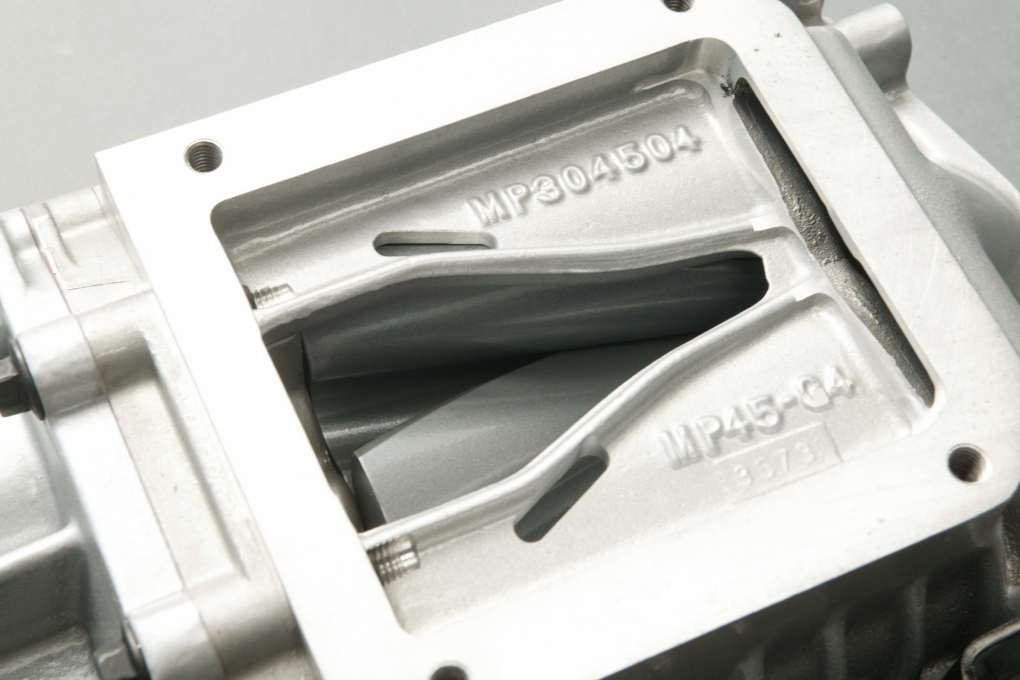

Makes and examples: Eaton's TVS is a Roots-derived rotor family; Magnuson offers systems using Eaton TVS rotor technology in its own housings. BMW described an enhanced Eaton unit in its 2003 John Cooper Works package for the MINI Cooper S. A kit supplier and the company making its rotating group can therefore be different.
Best suited to: builds that value a prompt, broad torque response. Limitations: the blower still takes power to drive, creates heat and must be matched to an intercooler and bypass where required. A Roots device does not automatically provide the same efficiency or output as every other Roots unit.
Eaton supercharger models, cars and engines
Eaton's Roots-type and TVS superchargers are used in many different original and aftermarket installations. The table links to individual model guides with source-backed engine and vehicle examples. These examples are not a complete fitment list: market, model year, engine code and complete part number matter.
Read the two sizes separately: the figures in this table are nominal supercharger rotor displacement in litres per rotor revolution. The engine sizes in the examples are the engines' cylinder displacement. For common M-series names such as M45 and M90, the number denotes nominal cubic inches per turn; TVS R-series names typically use cubic centimetres. M65 is used inconsistently in some Mercedes parts listings, so its rotor displacement is not assumed here.
| Eaton model guide | Blower volume (L / rotor rev) | Example vehicle and engine | Application |
|---|---|---|---|
| M24 | 0.393 | 2002 Brazilian Ford Fiesta 1.0 | Factory |
| M45 / MP45 | 0.737 | MINI Cooper S R53 1.6; Lotus Elise SC 1.8 | Factory, specified versions |
| M62 / MP62 | 1.016 | 2005 Cobalt SS 2.0 LSJ; Lotus Exige 240R 1.8 | Factory, specified versions |
| M65 (Mercedes designation) | Unconfirmed | Mercedes C 180 Kompressor M271.946, 1.8 | Likely pairing; confirm part number |
| M90 | 1.475 | Ford Thunderbird Super Coupe 3.8; Jaguar XJR AJ16 4.0 | Factory, specified versions |
| M112 | 1.835 | 2003–04 Mustang Cobra 4.6; Jaguar XKR 4.0 and XJR 4.2 | Factory, specified versions |
| M122 | 1.999 | 2007–12 Shelby GT500 5.4 | Factory |
| TVS R410 | 0.410 | Nissan Micra DIG-S 1.2 and Volvo Drive-E T6 2.0 use Eaton; exact R410 identification unconfirmed | Candidate; confirm unit |
| TVS R900 | 0.900 | 2016–18 Mazda MX-5 2.0; MINI Cooper S R53 1.6 | Aftermarket kits |
| TVS R1040 | 1.040 | No named production-car fitment verified | Eaton catalogue model |
| TVS R1320 | 1.320 | Audi 3.0 TFSI V6; Toyota 4Runner / FJ Cruiser 4.0 | Audi factory; Toyota aftermarket |
| TVS R1740 | 1.740 | GM LT4 6.2 V8: Camaro ZL1 and C7 Corvette Z06 | Factory, LT4 variants |
| TVS R1900 | 1.900 | GM LSA 6.2 V8; Jaguar F-Type / Range Rover 5.0 V8 | Factory, specified versions |
| TVS R2300 | 2.300 | 2013 Shelby GT500 5.8; Corvette ZR1 LS9 6.2 | Factory, specified versions |
| TVS R2650 | 2.650 | 2020 Shelby GT500 5.2 V8 | Factory |
| TVS R3100 | ≈ 3.1 | Custom LS3/LSA-style hot-rod installations | Aftermarket |
| TVS V-series and other designs | V180: 0.180; others vary | VW Golf GT 1.4 twincharged; compact/compound and development examples | Vehicle fitments not verified |
Factory and aftermarket housings, inlet, pulley offset, bypass, drive and charge-cooler interfaces can differ even when rotor size is the same. Do not use the table as a bolt-on interchange list. The model pages include the evidence and identify where an application or designation still needs confirmation.
Twin-screw
A twin-screw is also a positive-displacement machine, but its meshing rotors progressively reduce the volume of trapped air inside the case. Whipple describes that internal compression before discharge into the manifold. Rotor shape and porting distinguish the design; the presence of a helical or twisted rotor by itself does not prove a blower has the same internal compression. Roots and twin-screw units are both often described as positive displacement, but they are not mechanically identical.
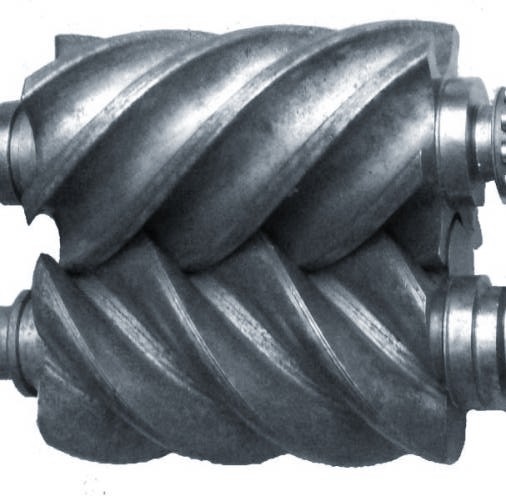

Makes and examples: Whipple and Kenne Bell offer twin-screw superchargers. Whipple's Gen 6 3.0-litre kit for the specified 2022–2023 Mustang GT is one application, not a universal fitment. The pictured rotors illustrate the principle and are not identified as that particular kit.
Benefits: positive displacement can provide strong response at lower engine speeds, and the decreasing pocket volume compresses air inside the unit. Limitations: manufacturing requires close clearances; cost, drive load, inlet temperature and physical clearance remain considerations. Efficiency depends on operating point and design, so no type is always coolest or most efficient.
Centrifugal
A centrifugal supercharger uses an impeller and compressor housing rather like the compressor side of a turbo. A belt and internal step-up drive turn the impeller at high speed. With a fixed drive ratio, its boost usually rises strongly with engine speed, so its torque delivery can differ from a positive-displacement unit. Rotrex uses a planetary traction drive and a specified fluid circuit; other makes use different drives and lubrication. Match the unit by its compressor map and speed limits, not by a generic boost number.
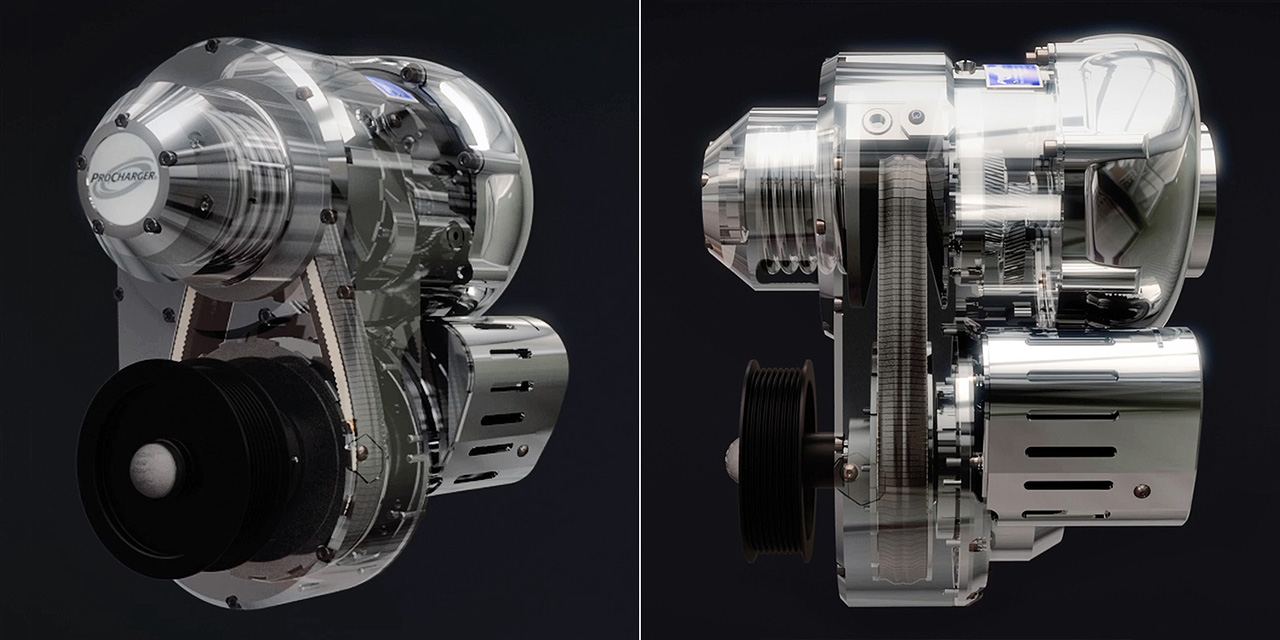

Makes and examples: Rotrex C30 uses a traction drive and its specified separate fluid circuit; Vortech's V-3 Si uses a geared step-up and self-contained lubrication; ProCharger offers centrifugal units including the variable-ratio i-1. The i-1 illustrates why the usual fixed-pulley boost curve is not universal.
Benefits: the head unit can often be mounted away from the intake manifold, leaving scope for charge piping and intercooling, and it can support strong upper-rpm airflow. Limitations: with a fixed ratio, response at low rpm is usually less immediate than a similarly matched positive-displacement system; it also needs appropriate brackets, drive, piping, lubrication and compressor-speed control.
Scroll-type: Volkswagen G-Lader
A scroll supercharger uses an orbiting scroll and a fixed scroll to move and compress pockets of air. Volkswagen's G-Lader is a production example: the G40 appeared with the 1.3-litre Polo engine, and the larger G60 was used in the Corrado 1.8-litre engine described in Volkswagen's SSP 103. These are historical application examples, not interchangeability claims.


Benefits: its positive-displacement action can support useful low-speed response. Drawbacks: the exact unit's scroll surfaces, sealing strips, bearings, internal drive and lubrication need to be assessed; replacement parts and specialist rebuilding are considerations for an older installation. Do not use a generic service interval or overspeed limit from another unit.
Vane-type superchargers
Some historic superchargers use an eccentric rotor and vanes to form moving air chambers. Shorrock's original technical description is an example of a vane-type positive-displacement unit; individual vane designs do not all use the same sealing or lubrication method.
Benefits: a mechanically driven, positive-displacement response and potential period-correct fit for a classic vehicle. Drawbacks: unit condition, correct lubrication, wear and the availability of knowledgeable service and parts are particularly relevant to older equipment.
Electric compressors and electric turbochargers
BorgWarner's eBooster is an example of an electrically driven compressor: an electric motor turns the compressor wheel independently of exhaust flow and engine speed. It can support low-speed response, including alongside a turbocharger. Benefits: controllable compressor speed without a mechanical belt. Drawbacks: it needs sufficient electrical power, appropriate voltage, wiring, cooling and integrated control. An electrically assisted turbocharger has a turbine in the exhaust path as well; it is not the same layout as a standalone electric compressor.
Drive ratio and pulleys
At a fixed crank pulley diameter and engine speed, fitting a smaller pulley to the supercharger makes its input turn faster. For a belt drive with negligible slip, input speed is approximately engine speed multiplied by crank pulley diameter divided by supercharger pulley diameter. Where there is an internal step-up, multiply input speed by that ratio to estimate impeller speed. Check the manufacturer's definition of each limit: input and impeller speed are not interchangeable.
Calculate speed at the highest engine speed the engine can reach, and stay within the exact model's limit. A pulley change also changes heat and drive load and can require a different calibration, fuel system or cooling. Belt wrap, tension, alignment, brackets and pulley compatibility matter; belt slip or a damaged drive can make actual speed different from the calculation. Rotrex's handbook gives its own model-specific procedure and ratios; they are not universal.
Bypass and twincharging
Many positive-displacement installations have a bypass that opens at light load to reduce the pressure difference across the blower and associated losses, then closes when boost is requested. Whipple's Mustang instructions describe that function for its kit; valve control and plumbing differ by installation. A supercharger bypass is not the same device as the exhaust wastegate on a turbo.
Twincharging combines a supercharger and a turbocharger. The mechanical unit can assist response while the turbo builds its contribution; valves and sometimes a clutch coordinate the paths. Volkswagen's 1.4-litre dual-charged TSI is one production example. See the forced-induction overview for the series arrangement and the documented operating ranges.
Upgrades, supporting systems and maintenance
- Cooling and fuel: More delivered air requires a matched fuel and ignition calibration and an assessment of knock, charge temperature and intercooling. See charge cooling and fuel system upgrades.
- Engine and driveline: Verify that the pistons, rods, head sealing, clutch and transmission suit the intended torque and duty. A pulley or blower rating does not establish the engine's safe limit.
- Lubrication: Follow the specific supercharger's oil, reservoir, cooling and maintenance instructions. Some have a self-contained gear case; others use an external fluid circuit. Do not substitute fluids between designs.
- Verification: Check the drive, bypass and intake for correct operation and leaks; monitor pressure, intake temperature, fuel pressure and appropriate mixture and knock data under controlled load. Investigate unexpected noise, belt dust or rising temperature before increasing load.
Sources
- Supercharger technical information. Weiand/Holley. Roots, screw and centrifugal operating principles. Accessed 2026-11-14.
- TVS technology overview. Eaton. Roots-derived TVS rotor families. Accessed 2026-11-14.
- Twin-screw operating principles. Whipple Superchargers. Internal compression. Accessed 2026-11-14.
- Rotrex technical handbook. Rotrex, revision 1.7. Selection, pulley ratios, speed limits, belt and fluid circuit. Accessed 2026-11-14.
- Ford Mustang supercharger installation manual. Whipple Superchargers. Example bypass operation. Accessed 2026-11-14.
- Self-Study Programme 359: 1.4l TSI engine with dual-charging. Volkswagen, independent mirror. Twincharger layout and control. Accessed 2026-11-14.
- TVS2300 hot-rod kit. Magnuson. Roots-derived kit using Eaton TVS rotor technology. Accessed 2026-11-14.
- John Cooper Works package for the MINI Cooper S. BMW Group, 2003. Example enhanced Eaton supercharger and supporting changes. Accessed 2026-11-14.
- Gen 6 3.0L Mustang GT kit. Whipple Superchargers. Example twin-screw application. Accessed 2026-11-14.
- Kenne Bell Superchargers. Kenne Bell. Twin-screw product examples. Accessed 2026-11-14.
- V-3 Si-Trim supercharger. Vortech. Geared centrifugal unit and self-contained lubrication. Accessed 2026-11-14.
- ProCharger i-1. ProCharger. Example variable-ratio centrifugal drive. Accessed 2026-11-14.
- Development of Volkswagen's supercharger G-Lader. Volkswagen authors, SAE Technical Paper 860101, 1986. Scroll principle. Accessed 2026-11-14.
- Self-Study Programme 103: Corrado G60 1.8-litre engine. Volkswagen, independent mirror. G60 application. Accessed 2026-11-14.
- Principles of the Shorrock supercharger. Shorrock technical document, independent mirror. Eccentric rotor and vane construction. Accessed 2026-11-14.
- eBooster and the motor generator unit. BorgWarner. Electrically driven compressor and 48-volt system context. Accessed 2026-11-14.