A hub dynamometer tests a vehicle with its driven road wheels removed and dynamometer units attached to the wheel hubs using vehicle-specific adapters. The engine, transmission and final drive remain in the vehicle. The units resist hub rotation and measure or infer the resulting torque and speed. This avoids the tyre-to-roller contact of a rolling road, while transmission and differential losses remain in the measurement boundary. Hub output is not direct crankshaft output.

See Compare hydraulic, eddy-current and electric hub dynamometers for a side-by-side guide to their principles, advantages, limitations and models.
Principle of operation
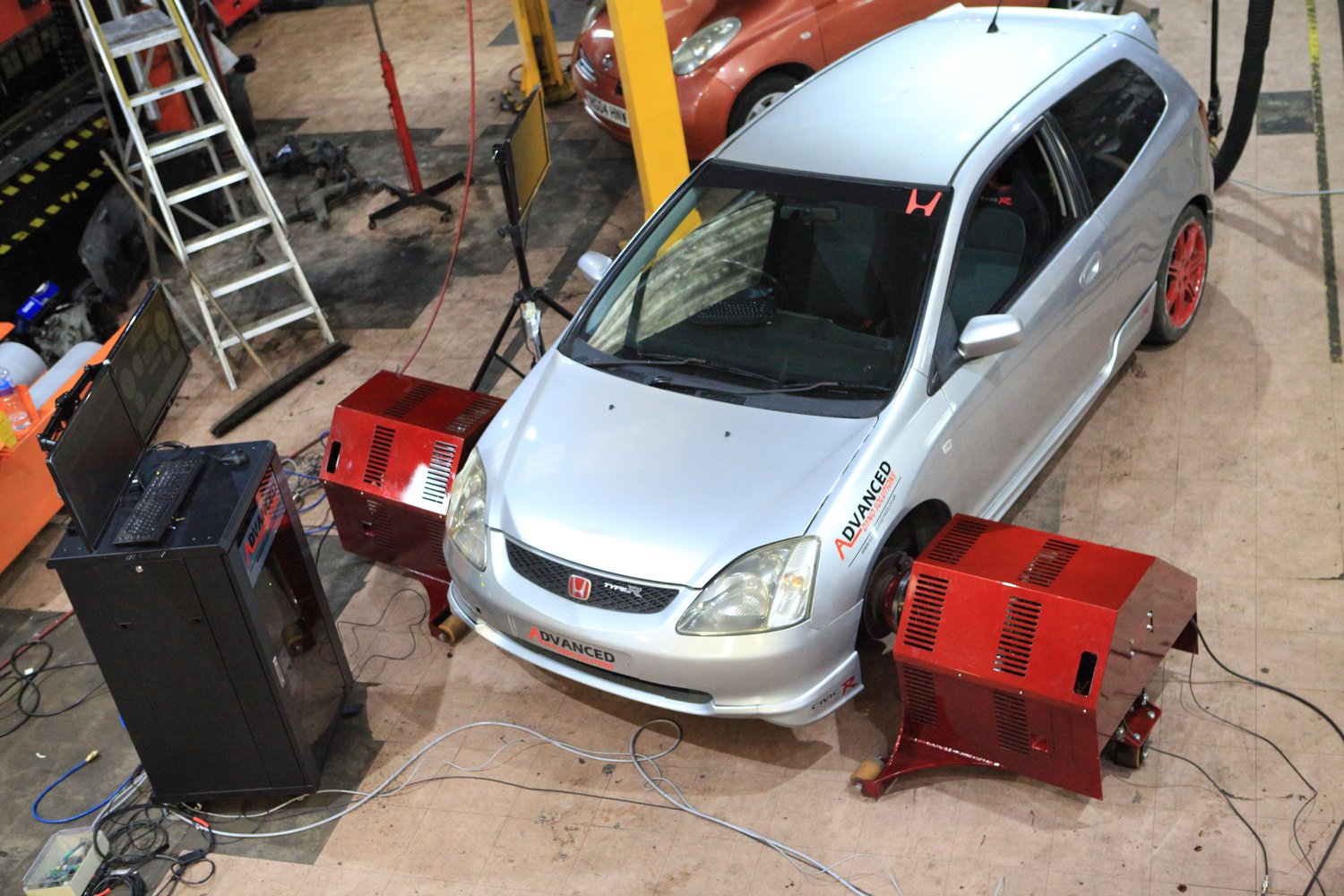
Each driven hub turns a coupling and absorber. Depending on the design, braking may be hydraulic, eddy-current or electrical. Torque can be measured with a calibrated reaction arm and load cell or an inline torque sensor, and shaft speed with an encoder. Power for each measured shaft is torque multiplied by angular speed; total output is the sum of the shaft powers, with the correct sign and any applicable correction. A controller changes absorber demand to hold speed, regulate load or run an acceleration test.
Hub-coupled dynamometers also appear in development rigs with separate control of each axle or wheel. The method can simulate drivetrain loads and wheel-speed differences when the machine and control strategy support them; it should not be assumed that all workshop hub dynos can do this. SAE 2011-26-0045: dynamic drivetrain testing; SAE 881736: four independent axle dynamometers.
For an illustrated guide to electromagnetic hub systems, see Eddy-current hub dynamometers.
For electric motor/generator hub systems, see Electric motor and regenerative hub dynamometers.
Hydraulic hub dynos
For a detailed explanation, diagrams and examples of hydraulic models, see Hydraulic hub dynamometers.
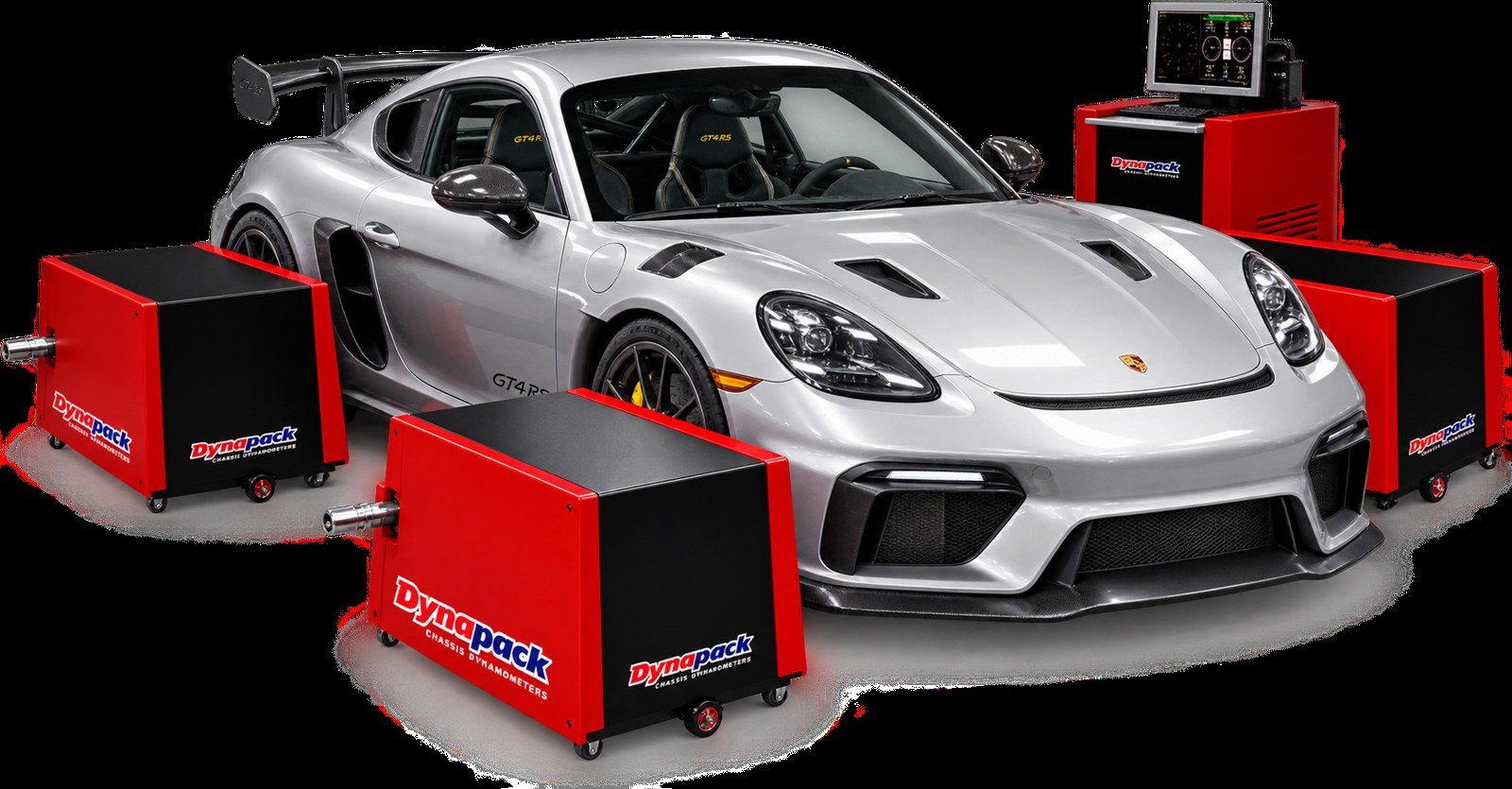
In a hydraulic-pump hub dyno, the hub turns a pump through its adapter. The pump moves oil against a controlled hydraulic load; the resistance produces torque at the hub and the energy is ultimately removed as heat. The controller adjusts the hydraulic load and uses speed and the system's torque or pressure measurements to calculate output. Implementations differ: some use hydraulic pressure in their measurement model; other designs use a separate torque transducer. The circuit, cooling and calibration must match the specific system.
Dynapack is a documented hydraulic example: Nicholson McLaren's Dynapack installation describes hub-driven hydraulic pumps, pressure measurement and speed sensing. Earlier ROTOTEST VPA-RX equipment also used a hydraulic system and direct torque measurement, as shown in this manufacturer VPA-RX88 datasheet. This does not imply that every ROTOTEST model is hydraulic: the newer Energy system is an electric motor/generator system.
Hydraulic pump loading is distinct from a water-brake absorber, in which water circulates between a rotor and stator. A hydraulic-oil circuit can itself be water-cooled; the cooling water is not necessarily the working fluid. Oil temperature, cooling capacity, pressure, shaft speed and torque limits govern the test. A hydraulic absorber does not necessarily motor the vehicle; that requires a suitably designed powered system. See water and oil hydraulic brakes.
Advantages and limitations
There is no tyre slipping, changing tyre pressure or tyre deformation against rollers during the measurement. This helps when a high-torque vehicle is difficult to run consistently on tyres. Removing wheels and fitting adapters takes time, and compatible adapters, mounting hardware, hub loads, driveline angles and speed/torque ratings must be checked. The vehicle and units must be supported and restrained as the equipment maker specifies. The exact result also depends on coupling losses, sensor calibration, control response and the inertia being accelerated.
Four-wheel-drive and control
Use the required number of units and the configuration prescribed for the particular vehicle and dyno. All-wheel-drive couplings, differentials, traction control and electric axles can respond to unexpected wheel-speed differences. Four independent channels can emulate different wheel loads only within the capabilities of their software, absorbers and vehicle installation. Consult both manufacturer's procedures.
Reporting and comparison
Identify measured hubs, gear, speed source, calibration, temperatures, applied correction and whether the result includes any estimated drivetrain loss. A direct comparison with roller wheel power must allow for the tyre/roller interface that a hub system omits. Repeat a baseline on the same installation and conditions when assessing a calibration change.
Hub dynamometer manufacturers and examples
These are selected hub-coupled systems rather than a complete market list. Some manufacturers supply vehicle-development test rigs as well as workshop dynos. Brake type, load-control capability and measurement method belong to the named system; they should not be assumed for every product made by that company. Confirm current sales, service and compatibility with the supplier. Sources checked 17 November 2026.
| Manufacturer and example | Absorber and configuration | Notes |
|---|---|---|
| Dynapack DAQ3 / DAQ4 / DAQ5 and 4WD combinations | Hydraulic pump pods; 2WD units can be combined in 4WD configurations. | Hub-driven pumps apply controlled load; pressure and speed form part of the measurement method. Model range; installation explanation. |
| ROTOTEST VPA-RX and Energy | Earlier VPA-RX series: hydraulic; Energy series: electric four-quadrant. | Identify generation: the VPA-RX88 datasheet specifies hydraulic pumps and torque transducers; the Energy datasheet describes an electric system. Historic model availability is not established. |
| Advanced Dyno Solutions 2WD / 4WD Hub | Eddy-current absorbers; 2WD and 4WD versions listed. | ADS lists interchangeable adapters and its own hub systems. 2WD product; 4WD product. |
| Dynocom AWD 4500 | Four eddy-current pods. | The AWD 4500 listing identifies four absorber units and electronic load control. |
| Rotronics Hubscan / Hubscan Plus | Two or four eddy-current pods. | Rotronics describes standard and higher-capacity variants and Dynascan software. Hubscan range; technical brochure. |
| Dynolyze Small / Small Plus / Medium | Eddy-current brake hubs; the manufacturer lists 2WD and 4WD combinations. | Model comparison; the operating manual describes the brake and control equipment. |
| Dynojet Vector-X4000 | Hub system with eddy-current brakes. | Product information and the installation guide document this model. Confirm axle layout and supported upgrades for the unit quoted. |
| Mainline DynoLog ProHub | Portable 2WD and AWD hub systems; the published AWD CCS models use four eddy-current retarders. | ProHub AWD specification describes the absorbers and CCS controls. |
| Magicmotorsport Dynomag Hub | Eddy-current units offered for 2WD and 4WD configurations. | The supplier product page describes the hub system; check the installed model and control options. |
| Mustang Advanced Engineering axle-hub systems | AC electric machines; manufacturer describes 2WD, 4WD, 6WD and 8WD systems. | Some configurations can return power through regenerative drives. This is a configurable development system; motor and drive capability depend on the installation. Manufacturer information. |
| Dyno One AccuHD | Hub-coupled powertrain test systems; exact machine configuration should be specified. | Describes independently controlled or synchronised hubs and optional flat-track tyre interfaces. AccuHD information. |
| RaceTech Dynamics RTD Hub 2000 | Eddy-current hub dyno offered as a self-assembly kit, with 2WD and 4WD options. | Manufacturer information; establish exactly which fabrication, brakes, electronics, calibration and commissioning are included. |
| Kamuto Productions hub dyno | 2WD and AWD systems with retarder packages. | The manufacturer describes two braking-capacity configurations and SportDevices SP6 control. Confirm brake and electrical details for the selected package. |
Do not compare peak horsepower alone: ask for the torque–speed curve at the hub, peak versus continuous duty, cooling requirements, compatible adapters, permitted hub loads and the measurement and correction method. For AWD, establish how each axle is controlled and whether the specific vehicle can be tested safely on that arrangement.
See also: Dynamometers overview · Rolling roads · Engine dynamometers · Hub dynamometers · On-car and portable systems · Inertia dynamometers.
Related company profiles
Dynapack · Dynocom · ROTOTEST · Advanced Dyno Solutions · Dyno Dynamics.
See dyno graphs explained for the difference between hub, wheel and estimated engine output on a printout.