On-car dyno is used for more than one type of equipment. A portable hub-mounted dynamometer is a physical machine coupled to a vehicle's driven hub. An on-road electronic or virtual dyno estimates power from the moving vehicle's recorded speed and acceleration. A portable rolling road is a further physical chassis dyno that can be moved between sites. These systems do not all measure at the same boundary or impose the same load.

Portable hub-mounted machines
A portable unit may bolt to a wheel hub through an adapter and transmit rotation to a controlled absorber or to a known rotating inertia. The physical device resists rotation and measures or calculates torque and power from shaft speed and its calibrated load or inertia. The wheels on the measured hubs are normally removed; check the exact equipment design. A published portable on-vehicle dynamometer patent application illustrates a hub-coupled drum and adapter; it is one design example, not evidence that all portable units operate identically.
Correct adapters, supports, restraints, guards and clearance are necessary. The vehicle remains subject to the unit's speed, torque, power, cooling and drivetrain compatibility limits. Hub output is downstream of drivetrain losses. See Hub dynamometers.
On-road or virtual dyno
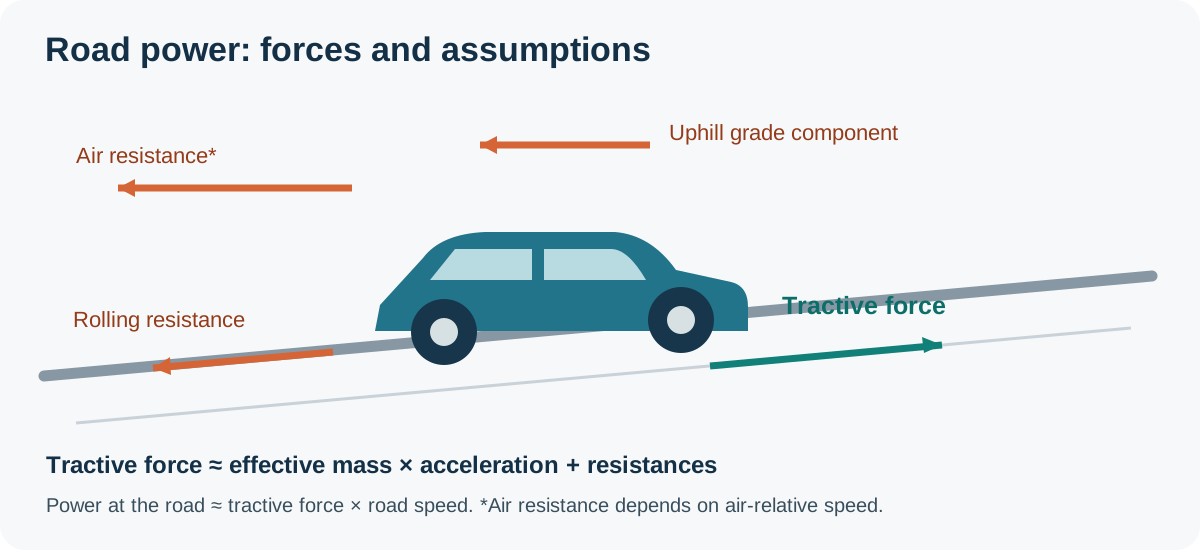
A GPS/GNSS logger, accelerometer, wheel-speed or engine-speed signal records vehicle motion during an acceleration run. Software combines speed, acceleration and actual vehicle mass with estimates of forces opposing motion. In simplified form tractive force is approximately mass times acceleration plus rolling resistance, aerodynamic drag and the component of weight on a slope; tractive power is force times road speed. Corrections or effective mass may be needed for rotating wheels and drivetrain inertia. The assumptions, sensor calibration and processing are part of the result.
Vehicle mass must include fuel, occupants and equipment. Grade, headwind or tailwind, road surface, tyre slip, gear selection, shifting and changing weather can materially affect the estimate. RPM or gear ratio is needed to plot against engine speed or estimate torque at a specified shaft. Racelogic's power and torque calculation guide calls for accurate loaded mass and a suitable level test location.
A virtual dyno uses the vehicle and road as the load; it cannot itself hold a selected engine speed or independently control load. Its output is an estimate dependent on the road-load model, not an independently measured crankshaft figure. Use repeatable, lawful testing in a suitable controlled location, and compare consistent runs rather than assuming equivalence with a stationary dyno.
Portable roller installations
A trailer or transportable roller dyno works on the same physical principles as a fixed rolling road. Portability does not remove the need for proper anchoring, restraint, airflow, exhaust extraction, electrical supply, level installation and calibration checks. Follow its own installation instructions. Rolling road chassis dynamometers.
How an on-road power estimate is calculated
A basic motion calculation multiplies loaded mass m by measured longitudinal acceleration a and road speed v: P = m × a × v. This is the rate of change of translational kinetic energy; by itself it does not add aerodynamic drag, rolling resistance, grade or rotating inertia. Racelogic’s VBOX power-calculation guide shows this kind of mass, speed and acceleration calculation. Different products and settings may use different calculations.
For a more complete simplified force balance on an uphill run, tractive power at the road can be estimated as P ≈ [meffa + mg sin(θ) + Crrmg cos(θ) + ½ρCdA vair|vair|]v. Here meff includes any consistently modelled rotating inertia, θ is road angle, Crr is rolling-resistance coefficient, ρ is air density, CdA is frontal drag area, and vair is signed relative air speed along the road. The drag expression assumes the coefficient applies to that wind direction; crosswinds complicate it. Power is in watts with SI units. A particular device may omit, estimate or measure these terms differently; acceleration sensor outputs may already include a gravity component, so processing must avoid counting grade twice.
As an indication of sensitivity, a 1,500 kg loaded vehicle climbing a 1% gradient needs roughly 147 N simply to overcome grade. At 100 km/h (27.78 m/s), that is about 4.1 kW before rolling resistance, aerodynamic drag and acceleration. On a similar downhill the grade contribution changes sign. Vehicle mass, slope, wind, tyre condition, gear and filtering should be recorded when comparing runs; a coastdown can inform resistance estimates only if the software and test procedure support it.
Choosing and comparing portable approaches
- Hub pods: portable hardware coupled to the hubs for a stationary test; no tyre-to-roller contact at the measured hubs. A compatible controlled absorber can hold speed within its limits, but its setup, cooling and drivetrain compatibility matter.
- Transportable rolling road: a vehicle drives rollers at a stationary site. It retains tyre-to-roller effects and can use inertia, a brake, or both depending on the machine. Its power and thermal ratings and anchoring determine appropriate use.
- On-road logger or virtual dyno: the moving car encounters actual road loads; software estimates output from motion and its chosen model. It does not independently apply or hold a selected load. Road, weather, mass, sensors and assumptions affect comparisons.
Wheel, hub and estimated engine outputs have different measurement boundaries. A manufacturer’s crankshaft estimate depends on its drivetrain-loss assumptions, so compare the reported method and conditions as well as the number.
Examples
Dynocom’s AWD 2000 POD is a portable four-pod eddy-current hub system and illustrates the physical, load-absorbing approach. Racelogic’s VBOX calculation illustrates the distinct road-measurement approach, using logged motion and vehicle information. See also the wiki’s DynoRoad page. These examples do not imply that the systems measure at the same boundary or use identical calculations.

Another road-measurement example

Magicmotorsport DynoRoad is another portable road-performance measurement system used with a mobile app. The app listing identifies a device and phone used together. Check the specific device documentation for its sensors and calculations; a mobile estimate is not a direct crankshaft measurement.
See also: Dynamometers overview · Rolling roads · Engine dynamometers · Hub dynamometers · On-car and portable systems · Inertia dynamometers.