Dyno One is a United States supplier of dynamometers, test-cell systems, controls and refurbishment services. Its work spans engine, vehicle driveline, electric motor and component testing. The company says its dynamometer work dates to 1983, and identifies its Edinburgh, Indiana facility for repair and manufacturing and Owosso, Michigan facility for test solutions and engineering. In 2024 it announced the purchase of SAKOR Technologies' assets; the Owosso operation became part of Dyno One. Dyno One: about; company news.
Representative product families
The following are product families, not interchangeable fixed specifications. Machines are engineered for their test duty, so power, torque, speed, shaft, cooling and drive details must be confirmed for the individual installation.
| Family | Arrangement and use | Manufacturer information |
|---|---|---|
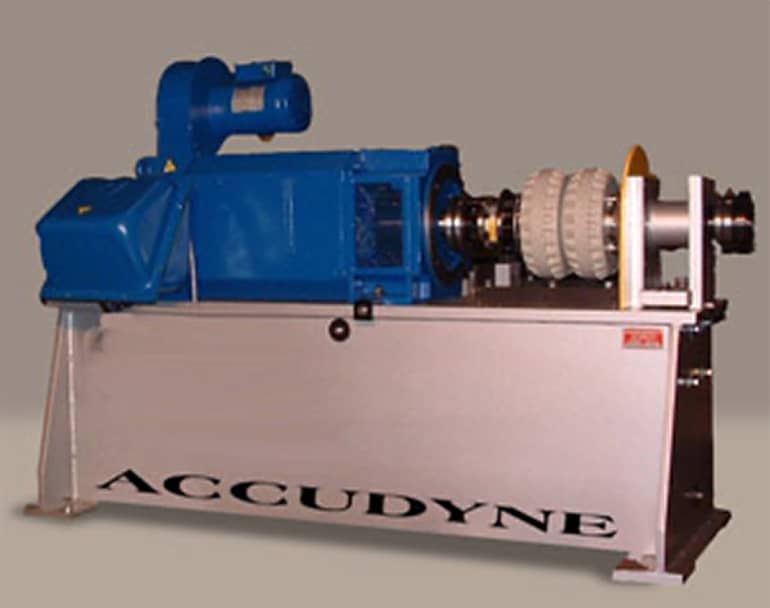
| AccuDyne | Four-quadrant AC motor dynamometer for motoring and loading engines, motors, transmissions and other components. The product page describes systems from 5 kW to 20 MW, with project-specific torque and speed. | AccuDyne product page |
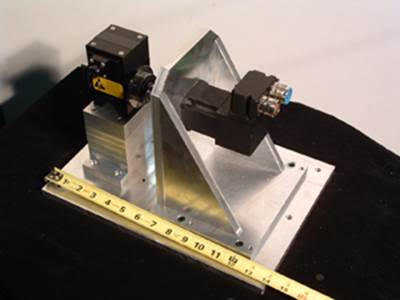
| MicroDyne | Smaller four-quadrant AC systems for small motors and components, up to about 6 kW maximum; options can include a power analyser or battery emulator. | MicroDyne product page |
| AccuBrake | Absorption-only range: configurations can use hysteresis, eddy-current, water-brake or hydraulic-shear/friction brakes. | AccuBrake product page |
| AccuHD | Hub-coupled vehicle dynamometer family with in-line hub torque and speed measurement; units may be controlled independently or in coordination. | AccuHD product page |
| HEViDyne | Configured hybrid and electric vehicle powertrain test systems covering electrical and mechanical components. | HEViDyne product page |
How the systems work
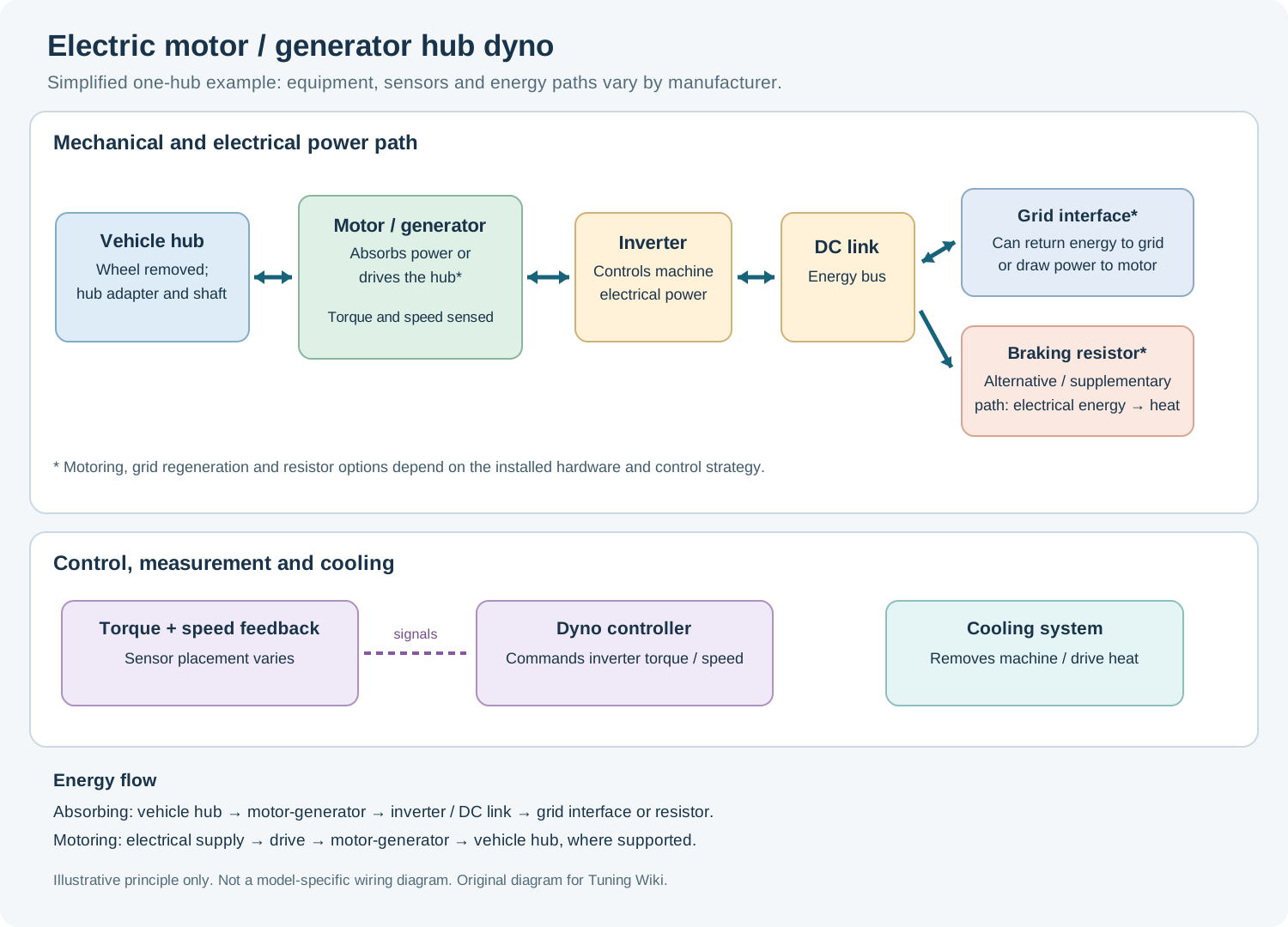
An AC dynamometer is an electrical machine linked to the test shaft and controlled through a drive. In motoring operation it supplies mechanical power to the test piece; in absorption the test piece drives it and the drive controls the opposing torque. A four-quadrant arrangement supports both modes in both rotation directions. AccuDyne configurations may return electrical energy to the supply or dissipate it resistively; regeneration is an installation option, not an automatic property of every electric dyno. Dyno One: AccuDyne.
A brake-only AccuBrake installation absorbs shaft work and generally converts it into heat; the precise mechanism depends on the chosen brake. A water brake transfers energy to moving fluid, whereas an eddy-current brake uses electromagnetic induction. A passive brake does not independently motor the test shaft. Couplings, sensing, absorber torque/speed envelope and cooling all need to be matched to the test.
Controls and test-cell integration
DynoLAB 4.6 is the company's test automation and data-acquisition system. Dyno One describes graphical sequences and integration of sensors and instruments using interfaces including Ethernet, USB, CAN and Modbus, with analog and digital I/O; interfaces and features are configuration-dependent. The controller can coordinate dyno load and supporting equipment in a test cell, and can operate under a higher-level controller. It should not be assumed to connect directly to an arbitrary brake without the correct drive, I/O and engineering. DynoLAB 4.6.
As an example of integration, Dyno One describes a multi-cell installation using DynoLAB with remote I/O on various eddy-current and water-brake units, with suitable eddy-current drivers and throttle actuators. This documents a project-specific retrofit, not a universal compatibility list. Engine-test-facility project.
Service and choosing an installation
Dyno One advertises repair and remanufacturing for eddy-current, AC, DC and water-brake dynos from multiple manufacturers, alongside inspection and other field services. Exact coverage, parts and whether a particular conversion is feasible should be confirmed with the supplier. Repair and upgrades.
For a prospective machine, obtain the continuous torque–speed envelope and permitted overload duration, maximum speed and inertia, accuracy, cooling and electrical requirements, safety system, supported test modes, integration interfaces and calibration procedure. Hub output is measured at a different boundary from engine crankshaft or tyre-on-roller output.
See also dynamometer control systems, electric dyno operation, hub dynamometers and calibration.