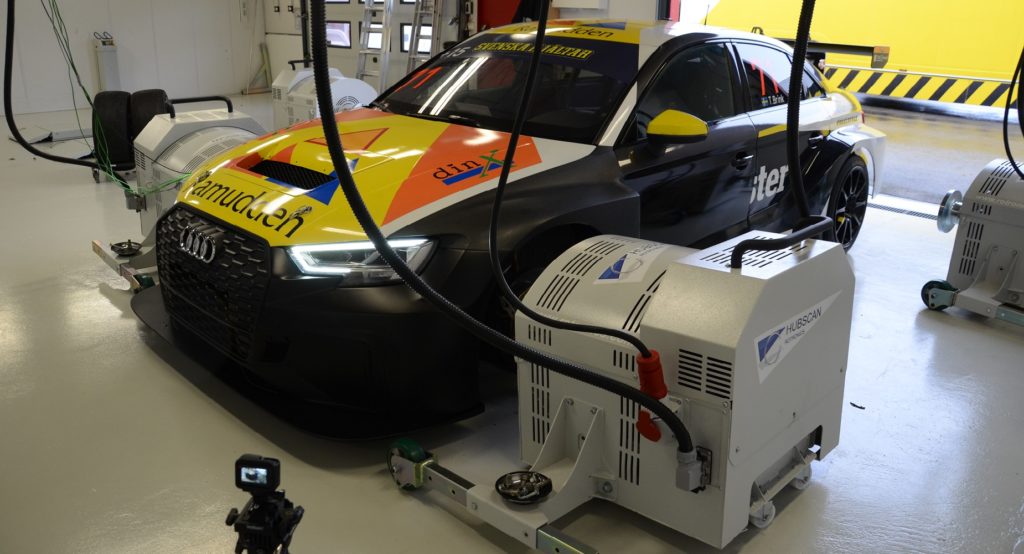
Rotronics designs and manufactures engine and vehicle test equipment in France. Its Hubscan range applies load directly at the driven hubs rather than through the tyres. The manufacturer offers two- and four-pod configurations. See Hub dynamometers and the manufacturers directory.
Company background
Rotronics' company history states that Yves and Christian Rosnoblet founded the business in 1990 in La Roche-sur-Foron, France, initially developing engine-test systems associated with motorcycle racing. A separate historical brochure gives 1991, so the founding year is not resolved here. Rotronics says it later developed roller and agricultural dynos and, in 2021, separated its performance and industrial activities. Company overview.
Hubscan equipment and operation
The Hubscan product page describes a standard Hubscan and a higher-capacity Hubscan Plus, with two hubs for 2WD or four for 4WD. The manufacturer's technical brochure identifies an eddy-current brake in each pod: each vehicle hub drives a brake, and the controller adjusts its excitation to apply load. The drivetrain remains in the power path but the driven tyre-to-roller contact is removed.
The company describes different braking capacities for the standard and Plus systems, while brake capacity varies with hub speed, temperature and test duration. Check the exact model and axle-specific ratings rather than comparing one advertised peak with engine horsepower.
Controls and test use
Rotronics identifies Dynascan Essential software with standard Hubscan and Dynascan Advanced with Plus; optional environmental, lambda and OBD acquisition depends on the package. Its brochure describes different control settings for standard and self-locking differentials. These are functions of the specific software and dyno installation and should be confirmed for the vehicle's differential and AWD system.
Determine adapter fitment, supported axle torque and speed, capacity at the required speed and duty, cooling, calibration and electrical requirements before specifying a system. Brand, product range and availability were checked against the linked manufacturer materials on 17 November 2026.
Related guide: Electric motor and regenerative hub dynamometers — operation, energy recovery and manufacturer examples.