Hub dynamometers couple to a vehicle at its driven wheel hubs and apply a controlled load. The three designs compared here use different mechanisms: a hydraulic pump, an eddy-current brake, or an electric motor/generator. Each can be useful for vehicle testing, but its control system, sensors, cooling and installed specification are as important as the absorber type.
The usual hub installation removes the driven wheels and uses adapters. Gearbox and differential losses remain between the engine and the measurement point, while the driven tyre-to-roller contact is removed. A hub power result is not a direct crankshaft measurement. See hub dynamometers.
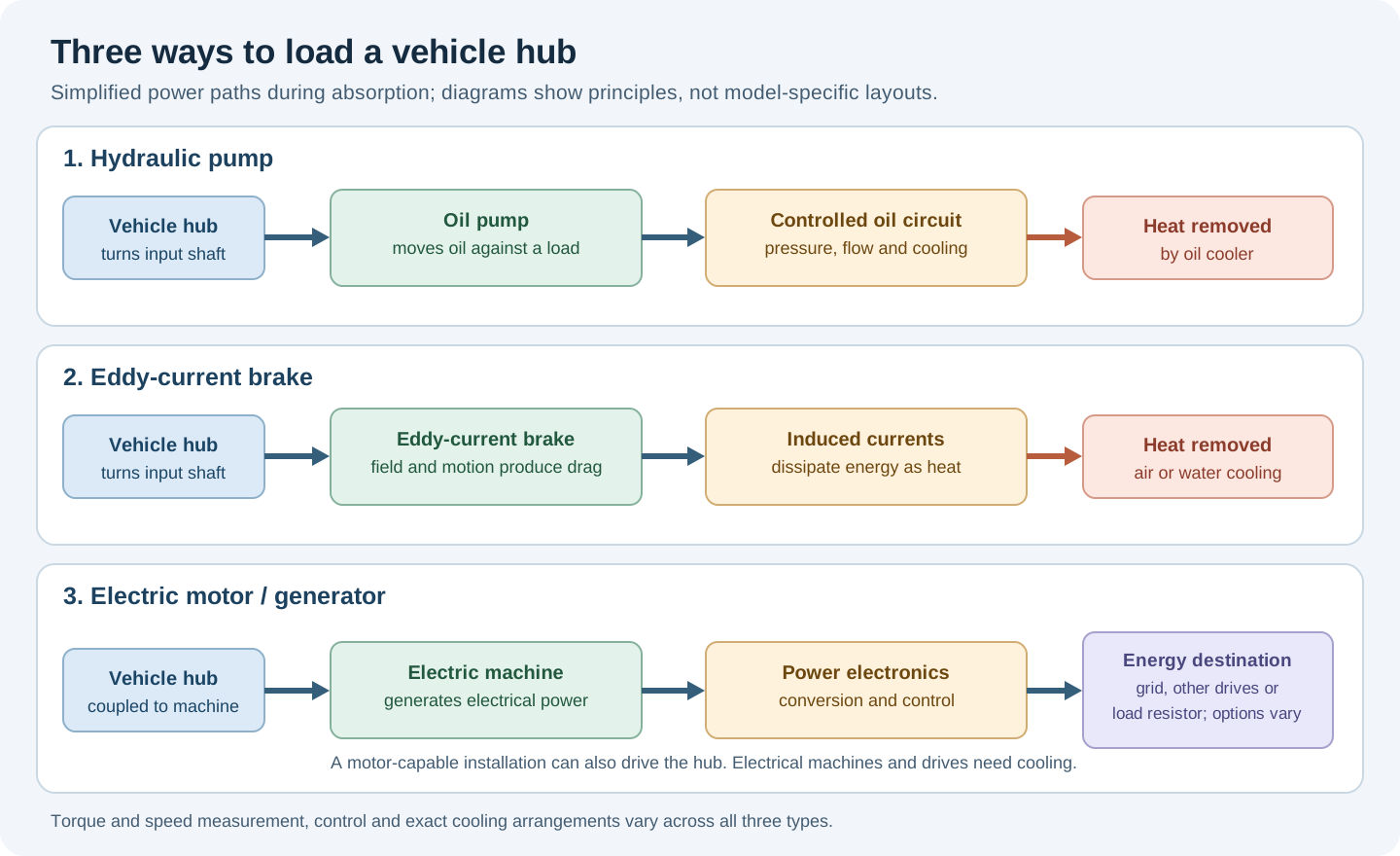
At a glance
| Question | Hydraulic pump | Eddy current | Electric motor/generator |
|---|---|---|---|
| How load is made | The hub drives an oil pump against a controlled pressure difference. | Relative motion through a magnetic field induces currents; their reaction resists rotation. | A controlled electric machine produces torque against or, where configured, with shaft rotation. |
| Where absorbed energy goes | Mostly heat in the oil and hydraulic system, removed by a cooler. | Mostly heat in the brake, removed by air or another cooling system. | Electrical energy can be dissipated, shared or returned to the supply depending on the drive; losses also produce heat. |
| Steady-state tuning and sweeps | Possible with suitable control within pressure, speed and cooling limits. | Possible with suitable control within torque, speed and cooling limits. | Possible with suitable drive and control within the machine and facility ratings. |
| Can drive the hubs? | A passive pump absorber cannot; active powered capability requires an appropriately designed system. | A passive eddy brake cannot. | Yes, if the machine and drive support motoring; not every electric dyno does. |
| Can return energy? | Not normally in a passive dissipative pump system. | Not normally; the brake dissipates the load as heat. | Possible with a compatible regenerative converter and facility connection or a suitable shared electrical link. |
| At or near zero speed | Depends on pump, pressure, leakage and controls; ask for the operating envelope. | Braking torque falls to zero at standstill and is reduced near it. | Some rated machines can hold torque at standstill; shaft power is zero. |
| Typical infrastructure to consider | Oil circuit, filtration, hoses, cooling and controls. | Excitation supply, electronics, brake cooling and ventilation. | Machine drives, suitable supply and protection, cooling and optionally grid recovery or a load bank. |
The table describes representative equipment, not guaranteed capabilities or a ranking. Torque, speed, thermal duty, calibration, software and installed options vary. For brake physics see the Magtrol eddy-current manual; for electric drives see Parker's test-stand application note. These discuss general dynamometer principles, not specifications of every hub unit.
Hydraulic pump hub dynos
The hub turns a pump that moves oil against a controlled load. Pressure difference across the pump creates resisting torque, while a valve or other control adjusts the load. The absorbed energy ultimately becomes heat, carried away by the oil and its cooler. Depending on the system, torque is measured directly or calculated from hydraulic measurements using a calibrated model. The Dynapack installation description explains hub-driven pumps and pressure measurement; the ROTOTEST VPA-RX88 datasheet specifies separate front-end torque transducers.
Advantages: controllable load supports steady-state mapping and sweeps within the system's envelope; pump pods can avoid tyre slip; a suitable cooler permits repeated operation within its thermal rating. Measurement arrangements vary, allowing different approaches to torque sensing.
Disadvantages and considerations: oil temperature, pressure, hoses, seals, filtration and cooler capacity require inspection and maintenance. Leaks and heat management matter. A passive pump system absorbs load but cannot be assumed to motor the vehicle or recover power. An oil system cooled by water is still an oil-hydraulic system, not necessarily a water-brake absorber.
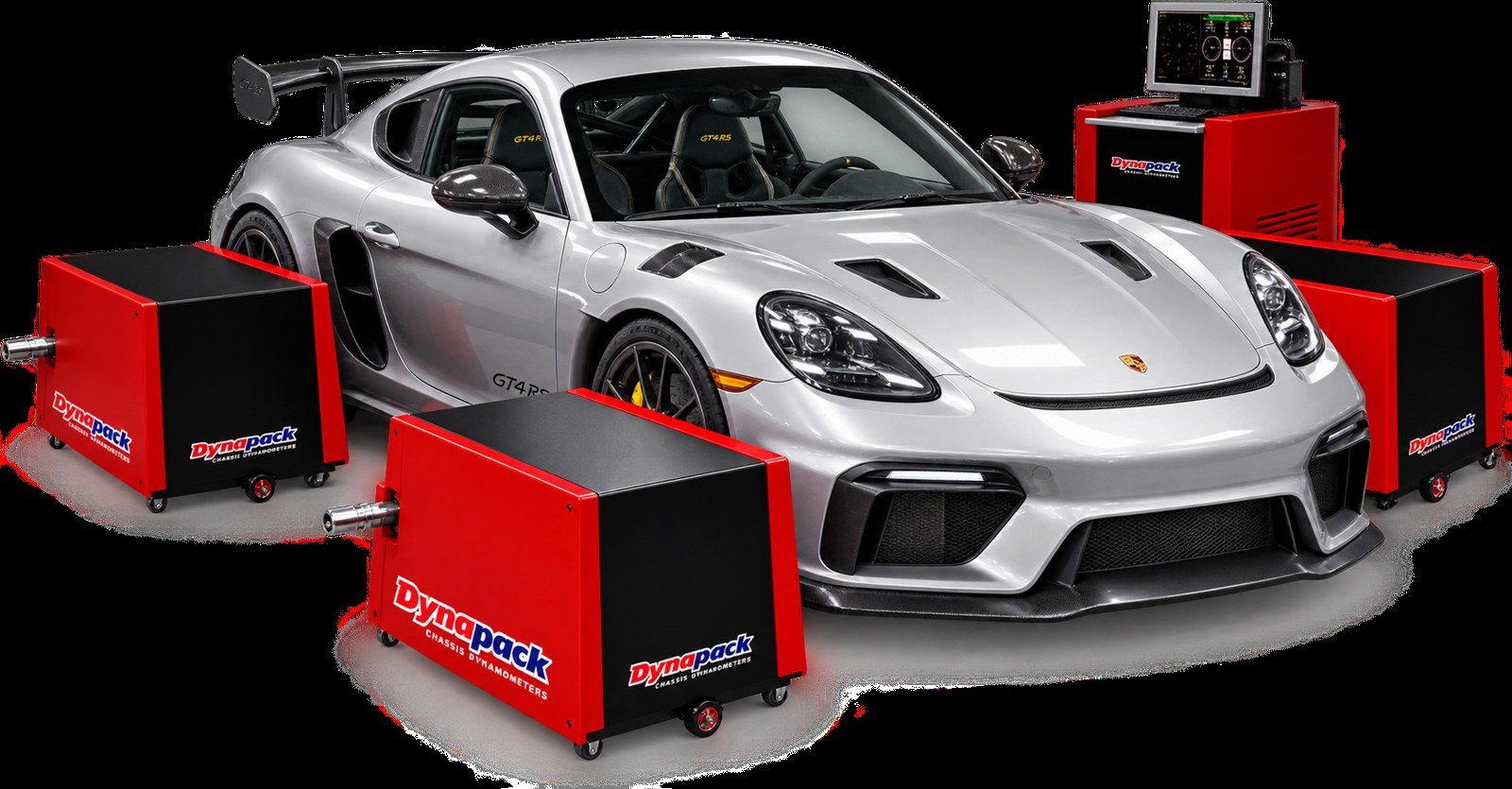
Full guide: Hydraulic hub dynamometers.
Eddy-current hub dynos
Rotation and an excited magnetic field produce circulating currents in conductive parts; the resulting electromagnetic force resists motion and the absorbed power becomes heat. The controller changes brake excitation in response to a speed or load demand. The detailed arrangement varies: current can be induced in different parts of the machine. The Dynolyze manual describes a real hub installation and controls.
Advantages: electrically adjustable, contactless electromagnetic braking supports speed holding and sweeps within the torque–speed envelope. There is no hydraulic working-oil circuit in the eddy brake itself. Air-cooled hub units can avoid a separate water supply where their manufacturer specifies that arrangement.
Disadvantages and considerations: braking torque falls to zero at standstill and is generally reduced at low speed; a suitable torque–speed curve matters. The brake must reject substantial heat, so ventilation and peak versus continuous ratings are important. Excitation supply, fans, sensors and bearings need attention. A passive eddy brake cannot drive the vehicle or normally return absorbed shaft power to the grid; some eddy brakes use water cooling.

Full guide: Eddy-current hub dynamometers.
Electric motor/generator hub dynos
A controlled electric machine absorbs hub power as a generator; in an appropriately equipped installation it can also motor the hub. An inverter controls torque and speed. Absorbed energy may be returned to a compatible electrical supply, used elsewhere in a multi-drive system, or dissipated in a suitable load bank. Four-quadrant equipment can motor and absorb in either rotation direction within its rated envelope. ROTOTEST Energy is a documented four-quadrant hub example.
Advantages: motor-capable systems can simulate both resistive and driving road loads, support overrun and some electric-vehicle regenerative-braking tests, and hold torque at standstill if suitably rated. Appropriate controls can support road-load and transient simulation. A regenerative supply or shared electrical link can reuse part of the absorbed energy.
Disadvantages and considerations: motoring, four-quadrant control and grid regeneration require compatible machines, drives, controls and facility infrastructure; none is automatic merely because a machine is electric. Power electronics, electrical protection, cooling and any grid connection need appropriate engineering and support. Equipment and installation quotations depend on capacity and features, so compare like-for-like rather than assuming a universal price ranking.
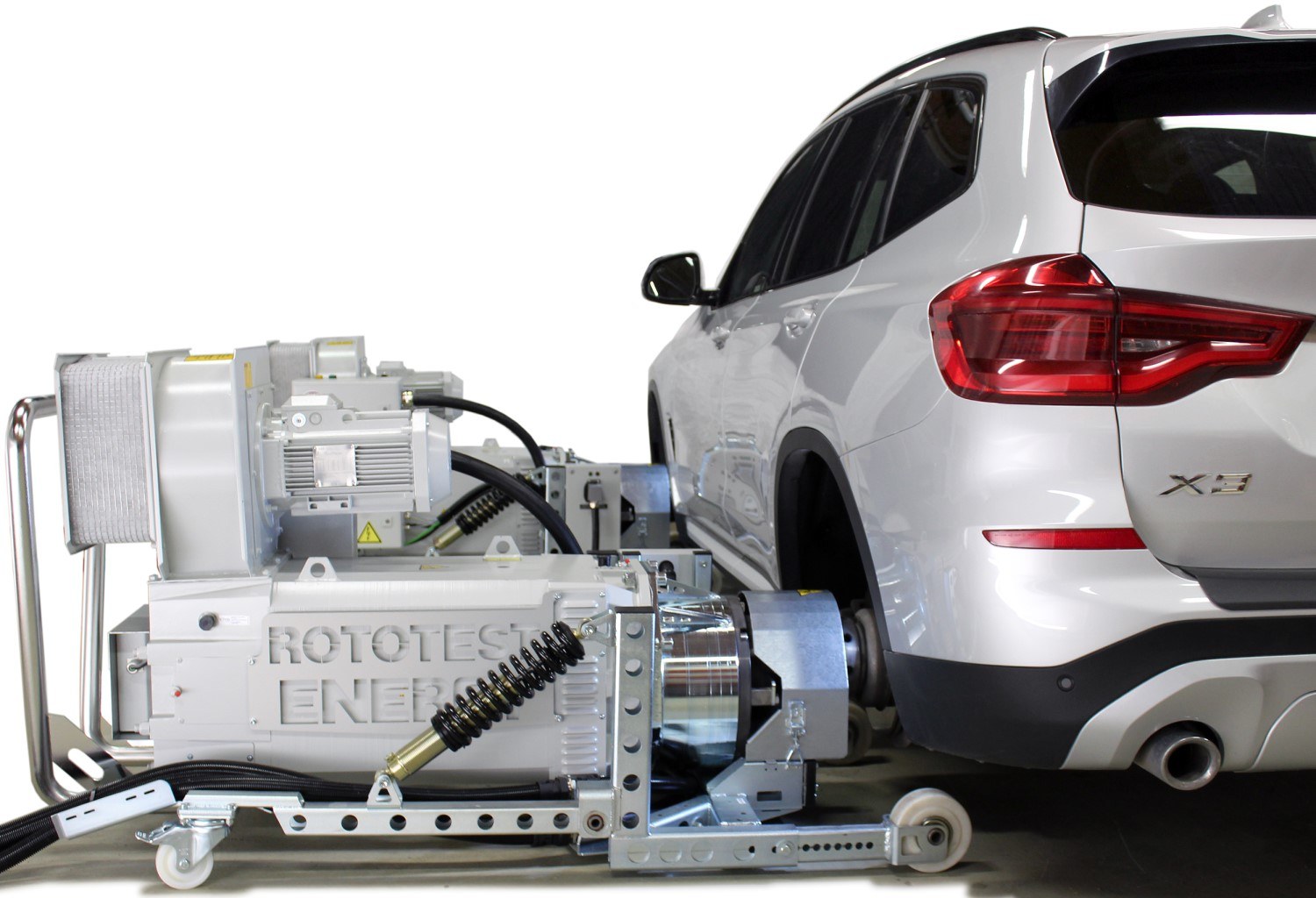
Full guide: Electric motor and regenerative hub dynamometers.
Makes and models
Selected documented examples are listed below; this is not a complete market survey. Availability, controls, adapters, ratings and service support can change. Historic systems are identified as such, and a manufacturer's different generations need not use the same technology.
| Type | Make and model | Configuration and source |
|---|---|---|
| Hydraulic | Dynapack DAQ3, DAQ4, DAQ5; DAQ33, DAQ43, DAQ44, DAQ53, DAQ54 and DAQ55 | Hydraulic hub-pump systems. The first three are 2WD models; combinations are listed for 4WD. Model range. |
| Hydraulic | ROTOTEST VPA-RX88 | Historical 4WD hydraulic pump system with direct torque transducers. RX88 datasheet; current availability not established. |
| Eddy current | Advanced Dyno Solutions 2WD / 4WD Hub | Eddy-current hub systems. 2WD and 4WD supplier information. |
| Eddy current | Dynolyze SMALL, SMALL PLUS, MEDIUM | Different hub-brake capacities and dimensions. Model comparison. |
| Eddy current | Dynocom AWD 2000 POD | Four pods and four eddy-current brakes. Product page. |
| Eddy current | Dynojet Vector-X4000 | Hub dyno with eddy-current brakes and DynoWare RT controls. Installation manual. |
| Eddy current | Rotronics Hubscan / Hubscan Plus | Eddy-current versions with Dynascan controls. Hubscan range. Distinguish these from the electric Hubscan AC series below. |
| Eddy current | Mainline DynoLog ProHub AWD CCS | Published AWD configurations use four eddy-current retarders. Manufacturer specifications. |
| Eddy current | Magicmotorsport Dynomag Hub | 2WD and 4WD configurations. Product information. |
| Electric motor/generator | ROTOTEST Energy 4WD / Energy 500-250 4WD | Four-quadrant electric family with front-end torque measurement and road-load options. System description; 4WD datasheet. Distinct from the hydraulic VPA-RX. |
| Electric motor/generator | Rotronics Hubscan AC 120, 280, 400, 600, 1100, 2000 | Four-quadrant AC hub systems. The published figures distinguish nominal and intermittent duty. Manufacturer range. |
| Electric motor/generator | JINGKETEST WHD | Wheel-hub system advertised with four-quadrant control and energy recovery. Manufacturer information; confirm configuration and facility connection. |
| Electric motor/generator | Sierra CP road-speed hub test systems | Configurable multi-dyno installations and regenerative drive suites with CADET automation. Powertrain systems; not a single fixed model. |
Choosing for the job
- Workshop tuning: first check hub adapter fit, support and restraints, operating range, steady-state and sweep controls, cooling and local service. Hydraulic and eddy-current units can both be suitable when appropriately rated.
- EV, hybrid and vehicle development: establish whether the test needs the dyno to drive a hub, simulate overrun, run a road cycle or control individual wheels. These capabilities require suitable machines, software and controls; a passive absorber cannot itself provide active motoring.
- Comparing quotes: request hub torque–speed curves, peak duration and continuous ratings, cooling and electrical requirements, torque measurement method, calibration, adapters, controller features and training. Confirm the exact AWD arrangement and service support.
Independent control of multiple hubs is a controller and hardware feature, not an automatic property of a brake category. Confirm how each installation handles axle and wheel speeds, and follow both the vehicle and dyno manufacturers' instructions for differentials, clutches and stability systems.
Making fair power comparisons
At the same shaft and instant, power (kW) = torque (N·m) × speed (rpm) ÷ 9,549.3. For a multi-hub system calculate each hub's signed power using its corresponding speed and torque, then add the simultaneous results as appropriate. During acceleration the dyno's rotating inertia and the system's compensation method can influence reported output. Hub power, tyre-on-roller power and any estimated crankshaft figure have different measurement boundaries.
No absorber type alone guarantees a more accurate number: sensor placement and calibration, temperatures, test procedure, drivetrain condition, control response and correction method all matter. Compare before and after on the same verified setup whenever possible. See measurement and interpreting results and test setup and safety.
Related: Hub dynamometers · Hydraulic · Eddy current · Electric and regenerative · Control systems.