The AdBlue pump supplies diesel exhaust fluid (DEF) from its tank to the SCR dosing system. A low-pressure or supply warning does not necessarily mean the pump has failed: low fluid, leaks, restrictions, contamination, freezing, a pressure-sensor fault or an electrical problem can produce similar results. Test the complete supply system before replacing the pump or tank.
Symptoms and first checks
| Observation | What to investigate |
|---|---|
| SCR, AdBlue or engine warning | Save all engine and aftertreatment codes, freeze-frame data and operating conditions. Identify whether the fault concerns pressure, pump control, dosing, sensors or fluid quality. |
| Restart countdown or reduced performance | Follow the vehicle's instructions and arrange diagnosis promptly. A countdown can have several causes and may require a completed verification after repair. |
| Low reductant pressure or failed pressure build-up | Check fluid level and condition, leaks, restrictions, pump supply and command, pressure reading and prescribed priming before deciding the pump is faulty. |
| Warning after a refill or pump replacement | Check correct fluid, refill recognition, connections and the manufacturer's priming and leak-test procedure. Avoid applying another model's procedure. |
| Fault in cold weather | Check fluid temperature, thawing conditions, heater and control faults using vehicle data. Freezing alone does not prove the pump has failed. |
| White residue around a hose or pump | Inspect for a leak and identify its source. Residue can be dried fluid; appearance alone does not identify the failed part. |
Warning and fallback strategies vary. HELLA describes pump-related pressure and contamination faults, while Bosch illustrates one integrated supply design.
What the pump does
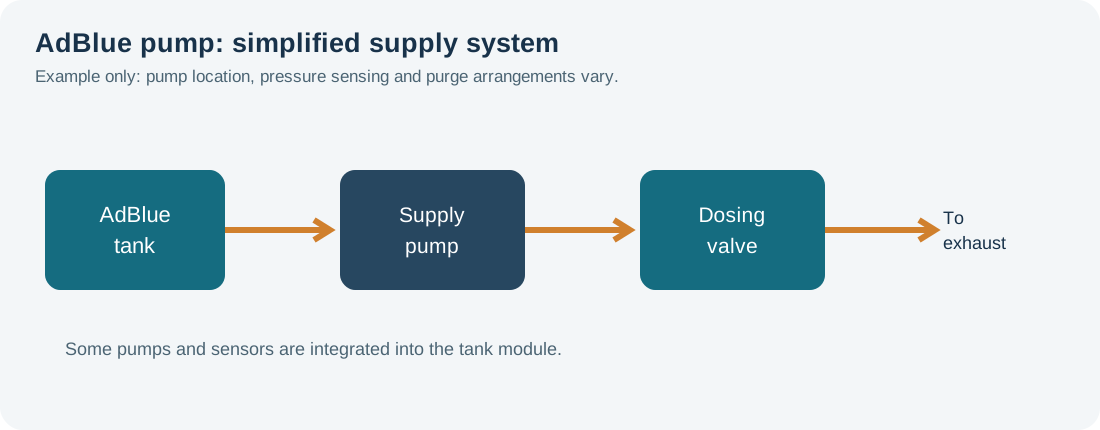
The pump or supply module moves AdBlue from its separate tank to the dosing valve. The controller manages delivery and, depending on the design, monitors pressure and fluid temperature, level or quality. Some units combine the pump, heater, filter and sensors in or on the tank; other systems have separate serviceable components. Pressure control, return lines, purge strategy and available measurements differ by vehicle.
This pump handles reductant for exhaust aftertreatment. It is not the diesel lift pump or high-pressure fuel pump, and their pressures, fluids and test methods are not interchangeable.
Common causes of low-pressure and pump faults
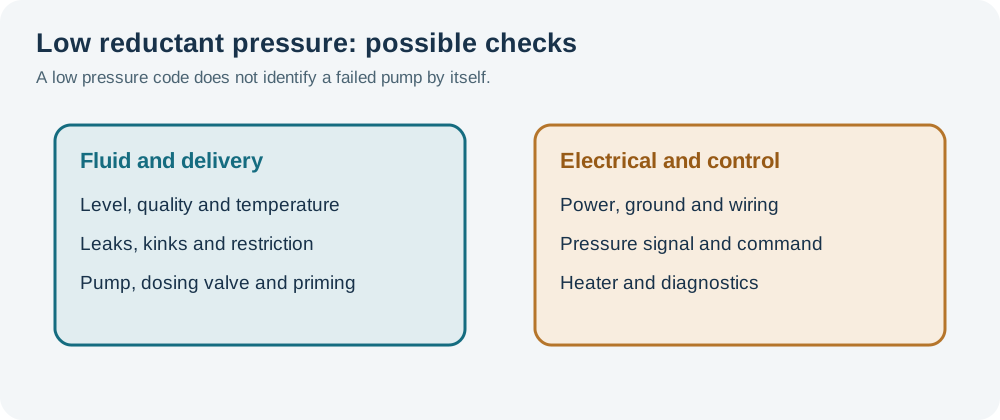
- Fluid condition: insufficient, incorrect or contaminated fluid can prevent correct operation or damage components. A concentration test alone may not detect all contamination.
- Leaks and restriction: damaged seals, loose couplings, kinked or blocked lines, a restricted filter or a leaking dosing valve can prevent pressure build-up or retention.
- Electrical or control faults: blown fuses, wiring damage, corrosion, poor power or ground, network faults or a control-module problem can stop the pump or distort its readings.
- Pressure measurement: an inaccurate pressure sensor or circuit can report an implausible value even if actual pressure differs.
- Cold-weather issues: frozen fluid, a heater or temperature-sensor fault, or insufficient thaw time can affect dosing when the manufacturer’s enabling conditions are not met.
- Mechanical failure or deposits: wear, internal pump damage or deposits can impair the supply. Determine and correct the cause before installing a replacement.
Fault codes and warnings
P20E8 commonly indicates reductant pressure too low; P208B can indicate reductant pump control performance on some vehicles. Other codes concern the pump circuit, pressure sensor, heater, dosing valve, fluid quality or SCR efficiency. The complete manufacturer-specific code, suffix and test conditions matter: P20E8 identifies low pressure, not the failed part. A manufacturer bulletin for specified 6.7-litre vehicles lists both codes and a software-related remedy for its applicable fault conditions.
Practical diagnostic sequence
- Record the complaint. Save all engine and aftertreatment codes, freeze-frame data and any warning or restart countdown. Note weather, recent refills, repairs and whether pressure was reported during an active test.
- Identify the system. Obtain the exact tank and pump layout, wiring diagram, pressure measurement method, applicable bulletins and guided test for the vehicle. Check whether the pump, filter or pressure sensor is separately serviceable.
- Inspect the fluid and installation. Confirm the specified fluid and level, and check the tank, lines, connectors and visible fittings for leaks, damage, kinks and contamination. Use an approved sample test where fluid quality is in doubt.
- Make the system safe. Allow hot exhaust components to cool. AdBlue lines can remain pressurised and some systems purge after shutdown. Wait and depressurise using the manufacturer's procedure before disconnecting a line.
- Review live data and test conditions. Check fluid temperature, level, commanded pump or pressure, measured pressure and related heater or dosing faults as supported. Confirm the diagnostic routine's prerequisites; an inactive pump at key-on is not automatically faulty.
- Check electrical supply and control. Follow the wiring diagram to test fuses, voltage supply, grounds and communication at the correct module. Check voltage drop or control signals only under the stated conditions and with suitable equipment.
- Run the prescribed pressure and leak test. Use the manufacturer's scan-tool routine and rated test equipment. Compare measured results with that vehicle's limits, and distinguish a real leak or restriction from an inaccurate pressure input. Do not apply a universal pressure value.
- Isolate the cause. Follow the approved procedure to check the supply line, dosing valve, pump and pressure sensor. Do not deadhead the pump, apply external pressure or substitute test fluid unless the manufacturer explicitly directs it.
- Repair, prime and verify. Repair the confirmed fault, fit correct seals and connections, perform any specified priming or adaptation and repeat the leak and pressure tests. Complete the required verification cycle and confirm codes, warnings and countdown status.
Use clean, dedicated equipment and suitable eye and skin protection. Keep DEF out of electrical connectors and follow the manufacturer's spill-cleaning and disposal instructions. Never disconnect a hot exhaust or a pressurised line, bypass system safeguards, or run an improvised external pump test.
Pressure, leaks and priming
Low reported pressure can result from a real delivery problem, a leak or an incorrect measurement. Check commanded and measured pressure during the prescribed routine and use an independent gauge only where the vehicle maker specifies a safe connection, pressure range and method. A pump that runs or makes a noise is not automatically delivering the required pressure or flow.
After opening the system or replacing a pump, some vehicles require a scan-tool priming routine. Conditions and repetitions are model-specific. A GM bulletin describes a low-pressure condition after pump or tank replacement for its affected vehicles; it explicitly does not present that procedure as an initial diagnosis for every low-pressure fault.
Freezing, purge and deposits
AdBlue can freeze in cold conditions. Some systems use tank and line heaters and wait for suitable temperature and operating conditions before dosing. A frozen system alone is not proof of a defective pump. Follow the vehicle's cold-weather diagnostic conditions before testing heater circuits or replacing parts; a Bosch supply module uses an integrated heater as one example.
Some systems purge fluid from the line after shutdown to reduce freeze-related risk; the timing and method vary. Interrupting an applicable purge or disconnecting the battery or lines prematurely can affect the system. Follow the manufacturer’s shutdown and depressurisation procedure. Dried fluid around a connection warrants inspection for a leak, while internal deposits or contamination require the specified repair and cleaning process.
Fluid contamination and incorrect filling
Use fresh, vehicle-approved AdBlue/DEF in clean dedicated equipment. Do not dilute it, add additives or transfer it with equipment used for fuel or oil. A refractometer checks concentration where specified but does not rule out every contaminant. If contamination is suspected, follow the manufacturer’s sampling and system-cleaning procedure rather than repeatedly priming a contaminated system.
If AdBlue is put into the diesel fuel tank, or diesel is put into the AdBlue tank, do not switch on the ignition or start the engine. Arrange specialist assistance and follow the vehicle manufacturer’s contamination procedure; pump operation can spread contamination.
Replacement and final checks
Use the correct pump or complete tank assembly for the vehicle, and replace seals, filters and lines only as prescribed. Keep fluid away from electrical connectors and route and secure the harness and lines as specified. Some vehicles need priming, sensor initialisation or other adaptation; others use a different procedure.
After repair, verify pressure build-up, retention and dosing with the manufacturer's tests, then complete the required monitor or driving cycle. Confirm the original fault, warnings and countdown are resolved. If pressure remains incorrect, recheck the fluid path, pressure measurement and electrical evidence rather than replacing further parts by guesswork.
Related diagnostic guides
- AdBlue injector and dosing valve faults
- AdBlue and SCR system faults
- NOx sensor faults
- DPF differential pressure sensor faults
- Exhaust gas temperature sensor faults
- Intake air temperature sensor faults
- Knock sensor faults
- Accelerator pedal position sensor faults
- Throttle position sensor faults
- Camshaft position sensor faults
- Crankshaft position sensor faults
- Coolant temperature sensor faults
- Oxygen sensor faults
- MAP sensor faults
- MAF sensor faults
- Fuel pressure sensor faults
- Fuel pump faults
- Injector faults
- DPF faults
- EGR faults
- Turbo diagnostics
- Boost leaks
- Intake air temperature sensors and heat soak
- Common diesel engine problems