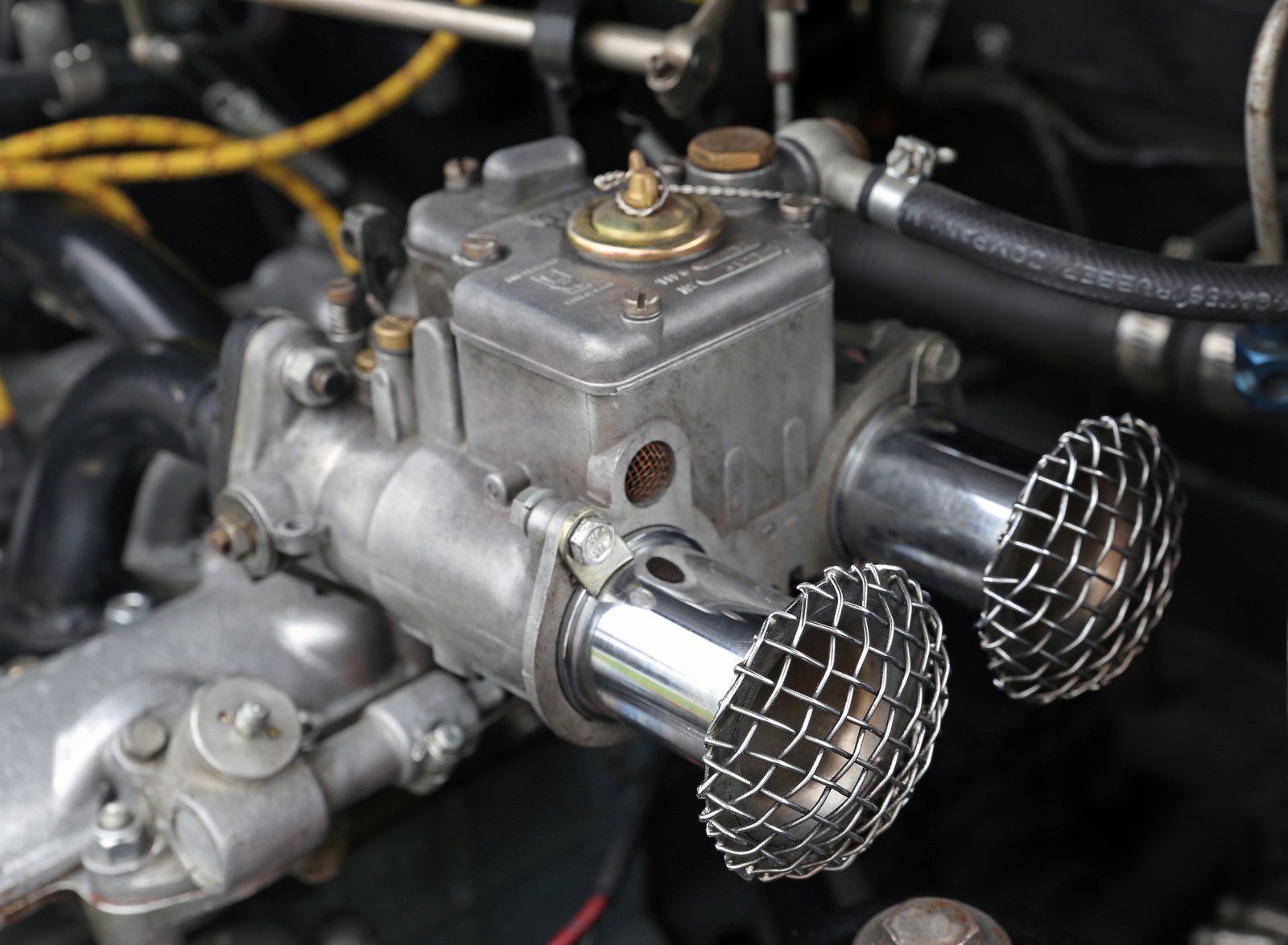
A carburettor (commonly shortened to carb) is a mechanical fuel-metering device that mixes petrol with incoming intake air before the mixture enters the cylinders. Before electronic fuel injection became universal in the 1990s, carburettors served almost every spark-ignition car, motorcycle, marine and small utility engine; they remain widely used in historic motorsport, classic vehicles, karting and small equipment.
Browse Carb Tuning for jetting, mixture adjustment, balancing and guides to Weber, SU and Zenith.



Pages in this section
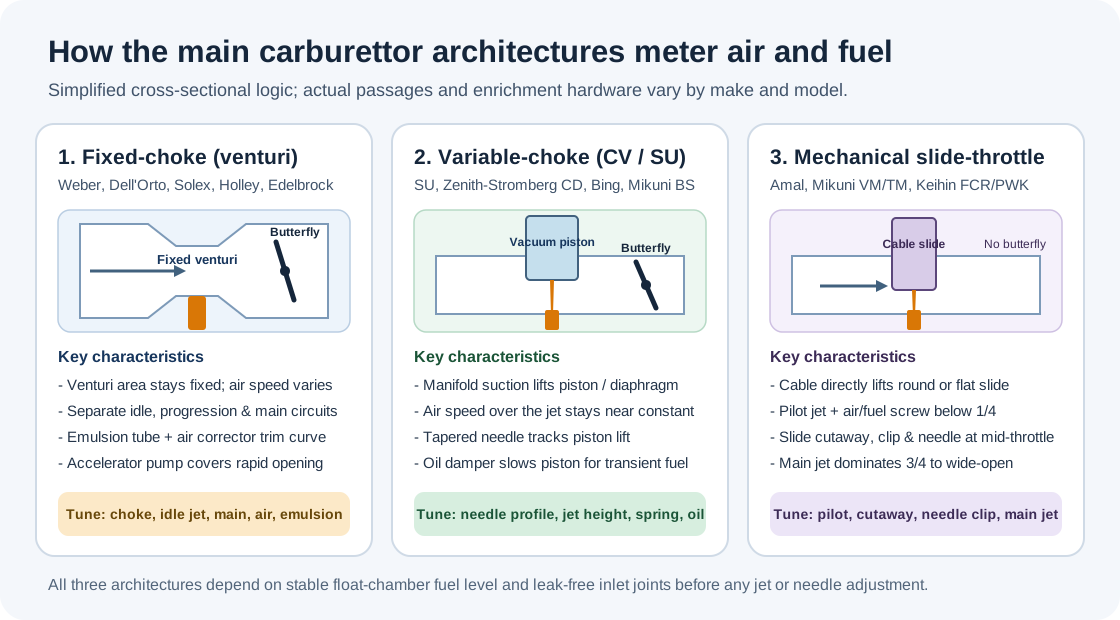
- Carburettor types and layouts — fixed-choke (venturi), variable-choke (constant-depression / CV), sliding-valve VV, mechanical slide-throttle, jetless metering-rod, swinging-arm, electronic feedback, diaphragm pumper, floatless pressure, gaseous mixer, veteran/vintage types, and forced-induction layouts.
- Carburettor makes and model families — European, North American, Japanese and British manufacturers, model codes, and documented factory fitments across Weber, Dell'Orto, SU, Zenith-Stromberg, Solex, Pierburg, Holley, Rochester, Carter/Edelbrock, Autolite/Motorcraft, Mikuni, Keihin, Hitachi, Aisan, Amal, Bing and Walbro/Tillotson.
- Carburettor fuel circuits and metering — how float level, idle and progression ports, main jets, emulsion tubes, air correctors, tapered needles, vacuum power valves, accelerator pumps and cold-start chokes interact across throttle and load.
- Carburettor tuning, jetting and setup — pre-tuning ignition and mechanical checks, venturi sizing, systematic circuit-by-circuit tuning order, family-specific procedures, and wideband/dyno validation.
- Weber carburettors: family tuning guides — overview comparing all Weber ranges, linking to dedicated family pages:
- Weber DCOE and DCO-SP carburettors: specs and tuning
- Weber IDF carburettors: specs and tuning
- Weber IDA and IDA 3C carburettors: specs and tuning
- Weber DGV, DGAV, DGEV and DFV carburettors: specs and tuning
- Weber DGAS, DGES and DGMS carburettors: specs and tuning
- Weber DCNF, ICT and ICH carburettors: specs and tuning
- SU carburettors: types, sizing and models — complete breakdown of all main SU types (HV, OM, D, H, HD, HS, HIF and DU6), Imperial and metric throat-size numbering, documented car/engine fitments, Thermo/AED cold-start variants, and SU needle, spring and damper tuning.
- SU carburettor troubleshooting, servicing and mixture adjustment — diagnosing high idle, vacuum leaks, throttle-disc seating, flooding, float height, jet centring, lift-pin mixture checks and balancing on HS, HD and HIF units.
- SU H-type, Thermo and AED servicing — H-type jet centring and cork-gland servicing, Auxiliary Enrichment (Thermo)
35°Cswitch and stop-nut tuning, and precision AED overhaul precautions. - SU needle profile database — 623-profile SU needle reference (
0.090 inand0.100 injets across 16 stations), 1933–1957 vehicle recommendations, full HTML dimension tables, and downloadable PDF chart. - Zenith carburettor operation, jetting and servicing — Zenith
IZ,24-T2,30 VIGand compound-jet principles:0.01 mmjet calibration, manifold heating, gummed needle valves and no-reamering rules. - Carburettor synchronisation, faults and rebuilds — airflow balancing on multi-carburettor engines, symptom-led fault finding (flooding, air leaks, vapour lock, blown power valves, ethanol corrosion) and safe cleaning/rebuild practices.
How carburettors differ from fuel injection
Because a carburettor relies on pressure drop across a venturi or air valve rather than pressurised injectors timed by an ECU, fuel delivery responds passively to intake airflow, engine vacuum, fuel height in the bowl and air density. Compared with mechanical continuous injection or electronic port and direct injection:
- No closed-loop exhaust correction: except on late emissions-era feedback carburettors (such as Pierburg 2EE Ecotronic or Rochester E4ME), a plain carburettor cannot trim mixture from an exhaust lambda sensor to keep a three-way catalytic converter inside its narrow stoichiometric window (petrol and diesel emissions).
- Sensitivity to fuel pressure and altitude: carburettor float valves operate at low fuel pressures (typically 2.5 to 7 psi depending on type) and meter fuel volume rather than air mass, so changes in altitude, ambient temperature or fuel ethanol content shift the air-fuel ratio unless re-jetted.
- Cylinder-to-cylinder distribution: a single central carburettor feeding a shared plenum manifold carries wet fuel droplets through manifold bends, whereas individual-runner sidedraft or downdraft setups (one choke per cylinder, such as twin Weber DCOEs) give each cylinder its own short intake tract and dedicated metering circuit.
Related sections on the wiki
- Engine performance upgrades — how camshafts, inlet manifolds, exhausts and forced induction affect mixture requirements.
- Throttle bodies and airflow — airflow restrictions, velocity and individual throttle bodies.
- Mixture tuning: AFR and lambda — reading wideband sensors and four-gas CO/HC analysers.
- Petrol and diesel emissions — carburettors vs port/direct injection and MOT non-catalyst limits.
Sources
- The SU Carburetter and Fuel Pump Workshop Manual. The SU Carburetter Company, 1958.
- Weber Carburettors DCOE Manual. Fixed-choke circuit operation.
- Holley Model 4160 Installation and Adjustment Instructions. Four-barrel operation and tuning.
- Mikuni VM Super Tuning Manual. Slide-throttle carburation principles.