Most carburettor drivability complaints turn out to be mechanical alignment, vacuum leaks, incorrect fuel level or fuel contamination rather than a sudden change in jet calibration. Before changing jets or needles, verify that every barrel draws equal air, fuel pressure is inside the needle valve's limit, and no unmetered air or fuel is leaking into the manifold.


1. Synchronising multi-carburettor and multi-barrel setups
On twin or triple sidedraft setups (Weber DCOE, Dell'Orto DHLA, twin SU HS/HIF) and four-cylinder motorcycle banks, uneven throttle opening means one cylinder is pulling harder than its neighbour, upsetting idle quality, progression smoothness and vacuum readings.
- Check linkage geometry with the engine off: disconnect the cross-linkage between carburettors, confirm each throttle shaft returns cleanly to its idle stop without binding or twisting, and check that all butterflies sit at the same angle relative to the first progression hole (on sidedrafts, check through the progression inspection plug if fitted).
- Match airflow at idle: use a direct airflow meter (such as a STE Synchrometer or Uni-Syn) on each choke trumpet, or a balanced mercury/fluid manometer or calibrated vacuum gauge set on manifold vacuum ports. Adjust the balance screw between carburettors until all throats draw equal flow. On carburettors with individual air-bypass screws (late Weber DCOE 151/152 or Dell'Orto DHLA emissions versions), balance individual barrels within one twin-choke body after the twin bodies themselves are matched.
- Re-verify at fast idle (around 2,000–2,500 rpm): bent linkage arms or mismatched drop-links can make carbs match at idle and diverge as soon as the pedal moves. Check sync at both idle and part-throttle before setting idle mixture.
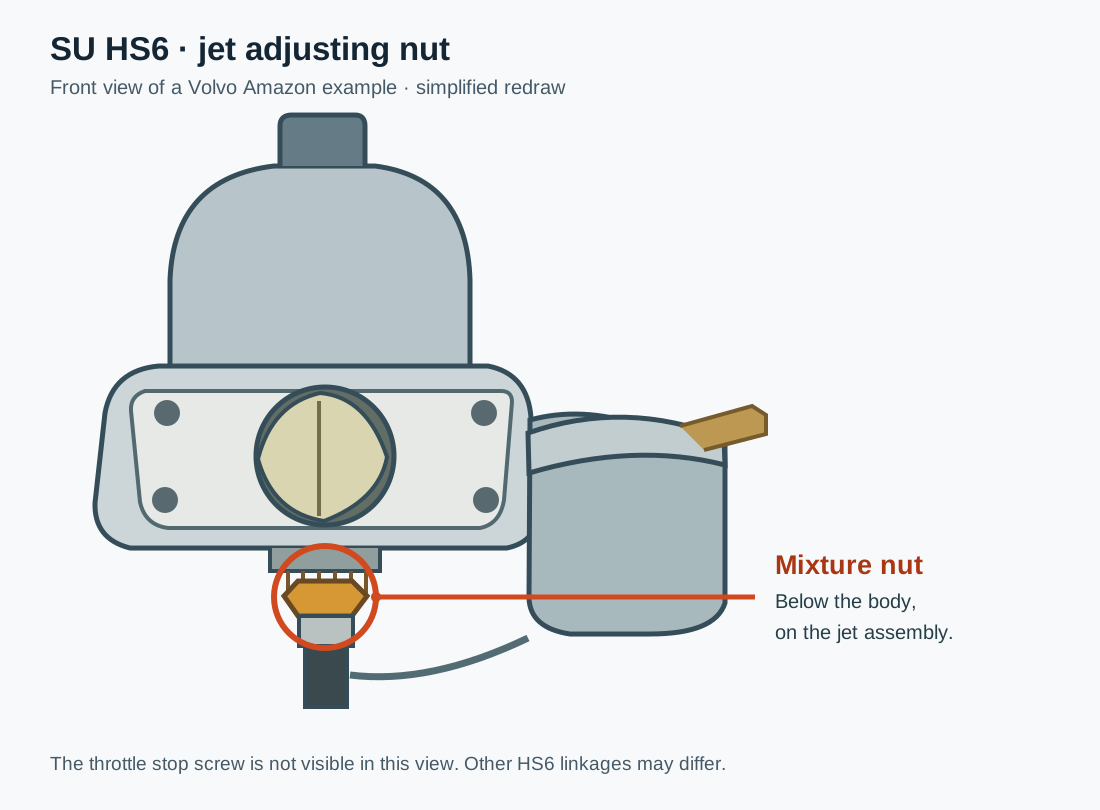
- SU piston-lift check: on twin SU carbs, once airflow is matched with an airflow meter or listening tube, the lifting pin checks mixture rather than sync; raising the piston slightly (about 1 mm / 1/32 in) should cause a brief slight rise or steady idle if mixture is right, a sharp drop if lean, and a sustained speed rise if rich (1958 SU workshop manual).
2. Diagnostic symptom table
| Symptom | Common carburettor causes | Non-carburettor causes to rule out first |
|---|---|---|
| Flooding / fuel dripping into throats | Stuck or worn needle and seat, punctured brass float or fuel-logged foam/nitrophyl float, float level too high, excessive fuel pump pressure overcoming the needle valve | Faulty fuel-pressure regulator or wrong electric EFI pump fitted in place of a low-pressure carburettor pump |
| High or wandering idle; mixture screws unresponsive | Air leak at base gasket, manifold flange or worn throttle-shaft bushes; idle speed screw open too far (uncovering progression/transfer slot); warped carburettor base | Leaking brake-servo hose, split PCV/vacuum hose, sticking distributor advance weights, tight tappets |
| Off-idle hesitation or "lean pop" | Too-small idle/progression jet, dirty progression holes, weak or delayed accelerator pump squirt, low float level, worn pump diaphragm | Retarded ignition timing, weak vacuum advance canister, low coil/HT output under load |
| Rich black smoke & fouled plugs | Ruptured vacuum power valve (pre-1992 Holley without check ball after a backfire), choke flap stuck partly closed, sunk float, overly large main jet | Restricted air filter, weak spark, high crankcase blow-by or oil consumption |
| Hot-soak hard restart / stalling in traffic | Fuel percolation / boiling in float bowl from exhaust/manifold heat; vapour lock in fuel line ahead of pump | Heat-soaked starter/ignition module or weak ignition coil when hot |
| Loss of power at high RPM / high speed | Blocked tank strainer or fuel filter, kinked fuel line, low float level, collapsed rubber hose on suction side of mechanical pump, main jet too small | Coil breaking down under cylinder pressure, valve float, restricted exhaust or collapsed silencer baffle |
3. Common physical faults
- Excess fuel pressure: most automotive carburettors are designed for roughly 2.5 to 7 psi depending on make (SU and Weber DCOE needle valves are especially sensitive and often want around 2.5–3.5 psi; Holley/Edelbrock four-barrels typically specify around 5.5–6.5 psi maximum, check the specific manual). Fitting an unregulated high-pressure injection pump will blow past the needle valve immediately.
- Throttle-shaft and base-flange wear: decades of return-spring tension wear the brass or die-cast shaft bores oval, letting unmetered air leak past the shaft ends and making idle mixture impossible to stabilise. Over-tightening mounting nuts with thick soft gaskets warps zinc-alloy base flanges.
- Power valve rupture on older Holleys: an intake backfire on pre-1992 Holley carburettors without a power-valve blowout check ball can tear the power-valve diaphragm, dumping unmetered fuel into the primary circuit even when the idle mixture screws are seated (Holley power valve guide).
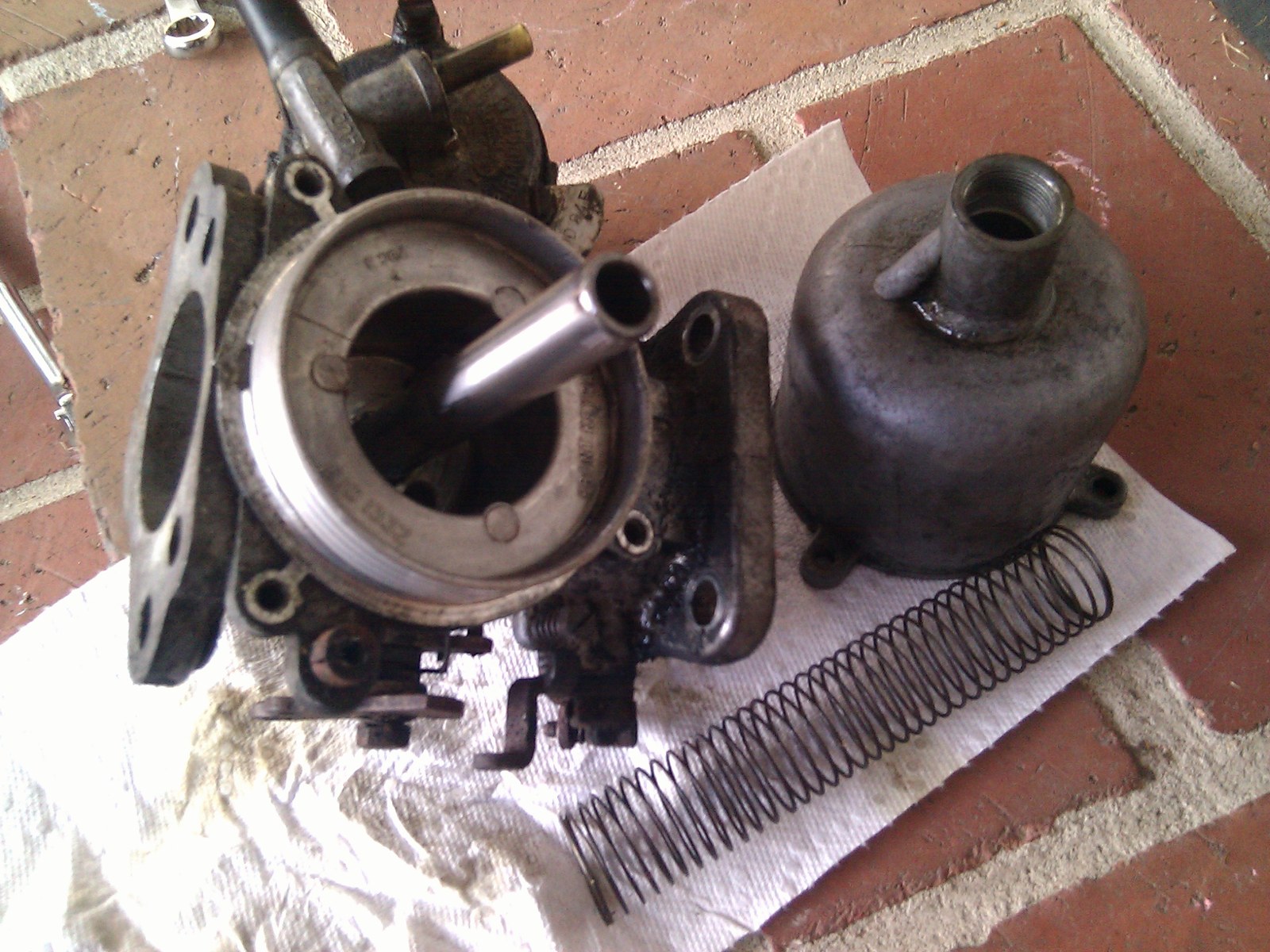
- Torn CV diaphragms & perished O-rings: on Zenith-Stromberg CD and motorcycle CV carbs, even a pinhole in the rubber diaphragm stops the slide lifting fully, causing flat top-end power.
- Ethanol (E10/E5) and standing-fuel deposits: modern ethanol-blended petrol absorbs moisture over winter storage, corroding zinc-alloy bowls and leaving sticky gum in tiny progression holes and needle seats.
4. Safe cleaning and overhaul practices
- Never poke jets or drillings with steel wire or twist drills: brass jets and calibrated air bleeds are easily enlarged or scratched out of round, permanently altering flow. Use carburettor cleaner, ultrasonic cleaning in an aluminium-safe solution, and compressed air or soft nylon bristles only.
- Keep rubber, leather and electrical parts out of harsh solvent dips: remove Viton needle tips, diaphragms, O-rings, leather accelerator-pump cups and any idle-cut solenoids or electric chokes before soaking castings (Solex 30/34 PICT service instructions).
- Verify mating surfaces and hoses: check base flanges with a straightedge on flat glass/surface plate before reassembly, use ethanol-rated fuel hose (such as SAE J30R9 or J30R7 rated for the fuel), and install a clean inline filter ahead of the needle valve.
Related pages
- Carburettors (section overview)
- Carburettor fuel circuits and metering
- Carburettor tuning, jetting and setup
- Fuelling faults
Sources
- The SU Carburetter and Fuel Pump Workshop Manual. The SU Carburetter Company, 1958. Lifting-pin mixture check and twin-carburettor balancing.
- Holley Power Enrichment System Technical Note. Backfire power-valve check ball and seated-screw diagnostic test.
- Holley Model 4160 Installation and Adjustment Instructions. Jet cleaning/no-drilling warning and fuel pressure limits.
- Solex 30/34 PICT-3 Service and Rebuild Instruction Sheet. Solvent precautions and idle-adjustment procedure.