A car that has an optical network almost always has several copper ones as well. The fibre is there for a job that wants a lot of data, or a job that must not be upset by electrical noise. On the cars documented below, that job is either infotainment or the restraint system. The engine, the body and the workshop tester stay on copper: CAN, the earlier single-wire I-bus and K-bus, LIN, and, on later cars, automotive Ethernet and DoIP.
Three optical systems turn up in the Mercedes and BMW documents read for this page. Mercedes D2B and MOST are rings. BMW byteflight, the E65 fibre-optic safety network, is a star. They share a plastic fibre and a red LED. They do not share a topology, a speed or a repair rule. A fibre colour or a bend radius from one document belongs to the car that document describes.
The same kind of fibre
Mercedes' 1998 D2B description uses a synthetic fibre of 1 mm diameter and light at 650 nm, in orange insulation. BMW's E65 bus module uses polymethyl methacrylate, PMMA, with a core about 1 mm thick, again at 650 nm, and says the plastic is used because it can be cut and finished more readily than glass. The MOST specification summary uses the same 1 mm PMMA fibre, a red LED and a silicon photodiode. The detailed MOST account is on the MOST optical bus page. The Mercedes ring is on the D2B optical bus page.
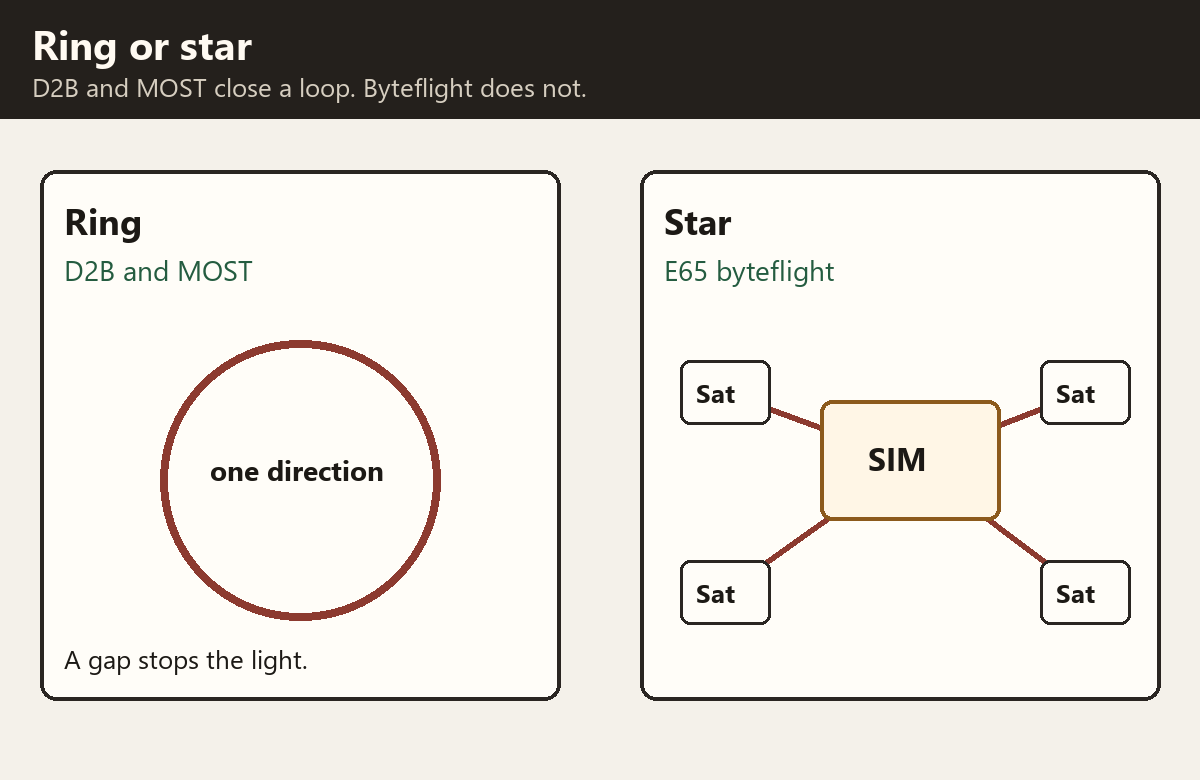
The workshop difference follows from the shape. Opening a ring stops every unit past the gap, so a fibre loop stands in for a missing unit. Opening one arm of a star stops that satellite. The SIM and the other arms keep talking. BMW's E65 module therefore has a test for each satellite, and it forbids repairing the byteflight fibre. MOST fibre on the same car may be repaired once between two control units.
Two fibres on the E65
BMW's E65 bus module, for the 745i from the start of production in November 2001, introduces two optical buses together. MOST, at 22.5 Mbit/s in that module, is the ring for communication and information. Byteflight, at 10 Mbit/s, is the safety-system bus. The third new bus in that module is not optical: K-CAN, two twisted copper pairs, split into K-CAN System and K-CAN Periphery at 100 kbit/s each. Powertrain CAN stays at 500 kbit/s and gains a terminal-15 wake-up wire. The diagnostic bus is 115 kbit/s. Sub-buses are 9.6 kbit/s. A later BMW aftersales manual still lists byteflight at 10 Mbit/s on fibre in a star, MOST at 22.5 Mbit/s on fibre in a ring, and adds LIN at 9.6 to 19.2 kbit/s on a single copper wire. LIN is a sub-bus in that table. It is not a third optical network.
The E65 module colours the fibres so they are not mixed in the harness. Yellow is byteflight. Green is MOST. Orange is the service replacement line for byteflight, which is not repaired in place. Black is the service repair line for MOST. Both use 650 nm. The minimum bend of 50 mm in the MOST fault text, and Audi's 25 mm sleeve, are MOST handling rules. They are not the byteflight rule. Byteflight's own fault list is kink, compression and stretch, with the allowed attenuation stored in the system.
Byteflight and the restraint system
Byteflight exists on the E65 for the Intelligent Safety Integration System, ISIS. The bus module says it is used exclusively for ISIS. Depending on equipment there are up to 11 satellites, the Safety Information Module, and the central gateway. Seven of the eleven satellites contain crash sensors. The SIM is the centre of the star. Each satellite has its own fibre to the SIM, and each fibre is bidirectional. The SIM holds twelve transmitter and receiver modules. Information from any satellite is given to the others by the SIM. The intelligent star coupler in the SIM is the point that does that distribution.
The ISIS training module places the SIM behind the glovebox. It supplies the satellites, including a reserve if the supply fails in a collision, it is the byteflight master, and it requests the emergency call. The master sends a synchronisation pulse every 250 µs. Alarm mode is the width of that pulse: about 2 µs in alarm, about 3 µs in normal operation. A telegram lasts between 4.6 and 16 µs. Any satellite could in principle be configured as master. On ISIS the SIM is the only master.
The satellites named in that module are the A-pillar pair SASL and SASR, the B-pillar pair SBSL and SBSR, the seat satellites SSFA and SSBF, the rear seat satellite SSH, the front-door pair STVL and STVR, the centre satellite SFZ, the steering-column switch centre SZL, and the central gateway ZGM. Acceleration sensors and the ignition stages for the restraints that belong to a satellite sit in that satellite, which is the point of moving the electronics out of one central restraint module. This page is the network. It is not a deployment procedure, and it does not give firing thresholds.
A satellite is shut down if its fibre receives no optical signal for a defined time, if its transmitter diode sends a continuous light, or if attenuation exceeds the value stored in the system. Causes named for that attenuation are a kink, compression, or stretch. Diagnosis does not walk a ring. The diagnosis program has a test module, "Data transmission to the satellites", because the bus is a star. A satellite that does not answer is then checked with its own test module. The fibre between the SIM and that satellite is replaced as a complete cable. It is not spliced.
A later byteflight safety module extends the same star beyond the E65 and E66. It names ISIS for those two, and Advanced Safety Electronics, ASE, for the E85, E60, E63 and E64 from their starts of production. ASE is the same shape with fewer satellites. That module is the source for those chassis. It is not a list of every BMW that ever had a restraint system.
What the fibre is not asked to do
On the E65 the optical buses do not carry the powertrain and they do not carry diagnosis of the whole car. PT-CAN and K-CAN do the first two jobs. The diagnostic bus and, on later cars, DoIP do the workshop job. MOST can gateway into K-CAN, and the E65 control display is that gateway for the infotainment ring. The SIM and the ZGM are the path between byteflight and the other buses. A logger on the diagnostic socket is not listening to the fibre.
Mercedes makes the same split. D2B and then MOST carry the infotainment ring. CAN B is reached through the ring master. The tester stays on the diagnostic connector. Audi's MOST diagnosis, on the MOST page, also stays off the fibre and uses a separate electrical wire to locate a break.
A published teardown of one 2019 Tesla Model 3 does not describe a D2B, MOST or byteflight fibre at all. Its networks are CAN, LIN and automotive Ethernet, with the body split across three controllers. That account is on the Ethernet page, and it is one car, not a rule for every manufacturer.
Sources
- E65 Bus Systems. BMW technical training, 745i, production from November 2001. Two optical buses, 10 Mbit/s and 22.5 Mbit/s, fibre colours, and the star. Accessed 2026-11-12.
- Intelligent Safety Integration System. BMW technical training, E65. SIM, satellites, 250 µs sync pulse. Accessed 2026-11-12.
- Byteflight Safety Systems. BMW training module for ISIS on the E65 and E66, and ASE on the E85, E60, E63 and E64. Accessed 2026-11-12.
- Bus systems. BMW Aftersales Training participant's manual. Byteflight, MOST and LIN in one table. Accessed 2026-11-12.
- The Mercedes D2B optical bus and the MOST optical bus.