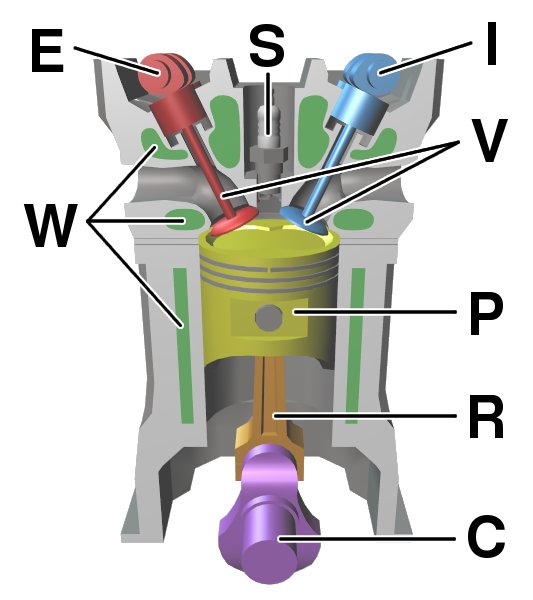
Crank, piston, valves and spark plug. Diagram by Wapcaplet, CC BY-SA 3.0. Wikimedia Commons.
Four piston strokes, and two crank revolutions, make one power stroke: intake, compression, combustion, exhaust. The valves shut while the charge is compressed and while it burns. Where those valves sit, and where the cam that opens them sits, is on valves and camshafts.
The crankshaft receives torque from combustion in pulses. A flywheel stores rotational energy and helps smooth speed changes; some layouts also use a dual-mass flywheel to reduce torsional vibration passed to the transmission.
Petrol and diesel
PetrolDiesel
IgnitionSpark in a premixed charge. DieselNet calls the burn kinetically controlled.Fuel sprayed into hot compressed air. The burn is mixing-controlled, and the charge is globally lean.
Mixture and ratioAbout 14.7 g of air per gram of petrol. Car compression ratios are typically 9:1 to 13:1.Compression ratio typically 15:1 to 23:1. Intake air stays unthrottled.
How torque is setThe throttle sets the air. Fuel is metered to it.The mass of fuel injected.
Knock ratingThe research octane number, measured against iso-octane and heptane.Cetane number. A diesel is meant to ignite from compression.
The ideal petrol model is the Otto cycle, heat added at constant volume. The ideal diesel model adds heat at constant pressure. DieselNet records that smaller, faster diesels from the 1920s burn closer to constant volume. Wikipedia, citing Pischinger, Kell and Sams, puts the diesel’s efficiency down to the high compression ratio, the lean mixture and unthrottled air, and reports peaks up to 43% for passenger cars, 45% for large trucks and buses, and 55% for large two-stroke marine engines. A 75% figure in that article is a theoretical ceiling. Passenger-car diesels are four-stroke.
Fuel systems
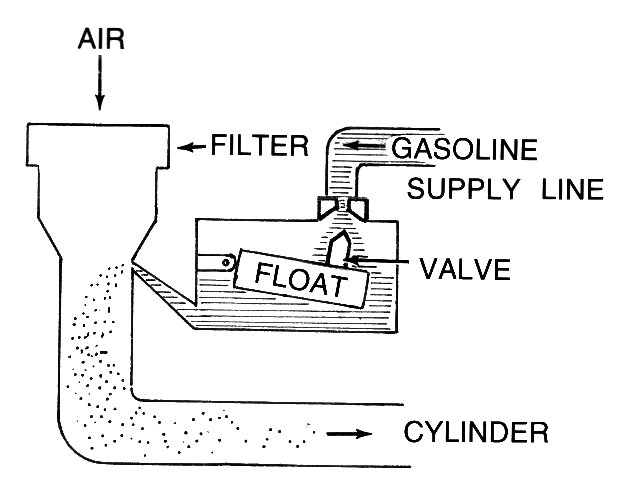
A float carburettor. The drawing uses the American word gasoline for petrol. Pearson Scott Foresman, public domain. Wikimedia Commons.
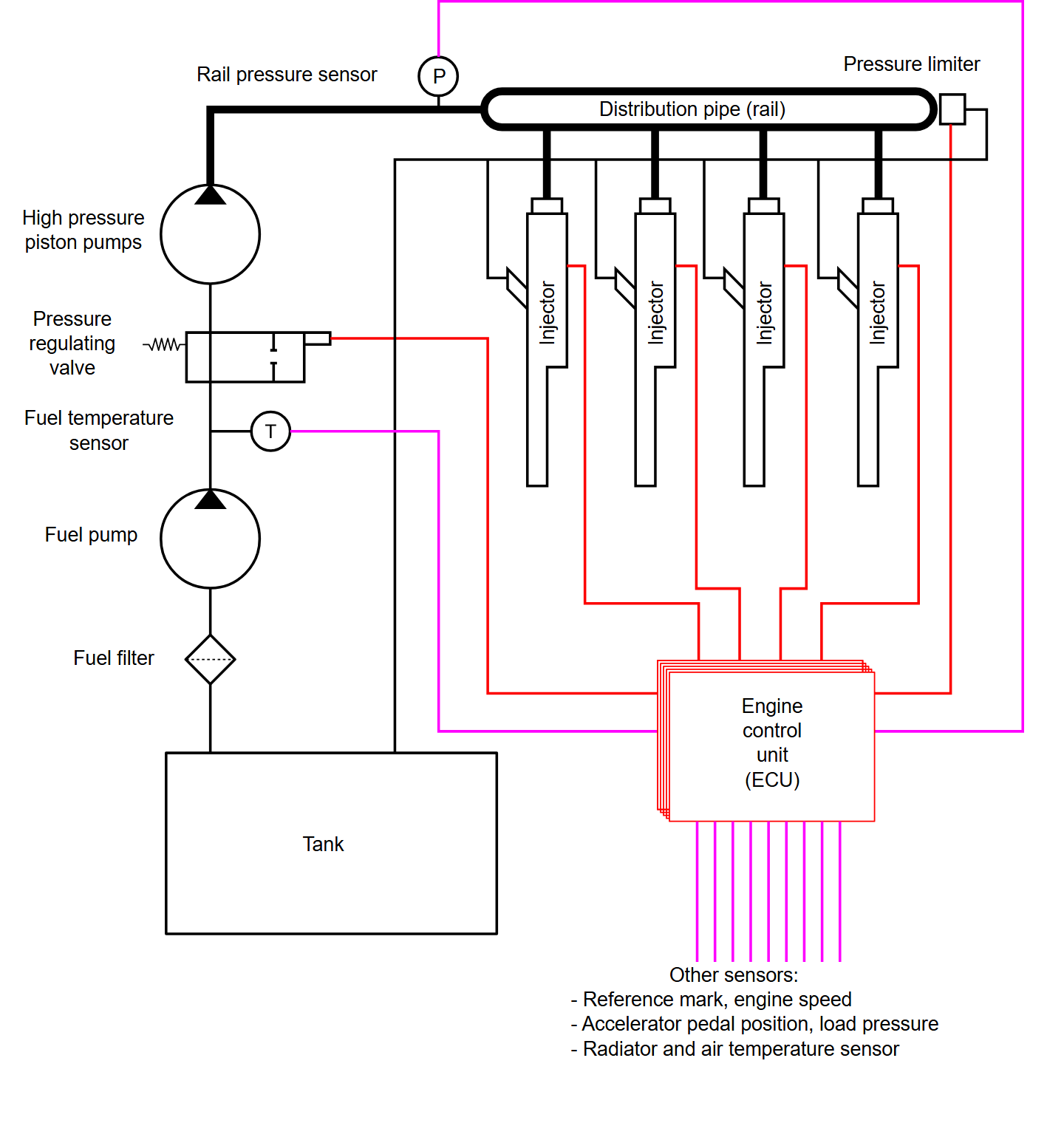
Common rail: a shared pipe feeds the injectors, and the ECU commands them. Drawing by Smakkeloep, public domain. Wikimedia Commons.
LayoutWhat it does
CarburettorMeters fuel into the airstream.
Port injectionSprays onto the intake valve. A second injector, and an injector ahead of the throttle, are on petrol fuel injection.
Direct injectionSprays into the chamber. Mitsubishi’s 1996 electronic system is the mass-production point Wikipedia records.
Dual injectionA port injector and a direct injector on the same cylinder. Wikipedia names Volkswagen, Toyota and Ford. An extra injector added only for fuel capacity is a different arrangement, on the same page.
Indirect dieselA pre-chamber, usually with glow plugs. About 5–10% less efficient than direct injection. Now mostly small industrial engines and some ATVs.
Pump, line and nozzleA mechanical pump times and meters the fuel. Pipes feed spring-loaded injectors.
Unit injectorPump and nozzle in one body. Wikipedia, citing Reif, gives up to 220 MPa at full load.
Common railA high-pressure pump charges a shared rail, and each injector is electrically controlled. Rail pressure varies with the engine and operating condition; some Bosch systems are capable of up to 270 MPa. Bosch: common-rail system. See the EDC17 page.LayoutWhat it does
CarburettorMeters fuel into the airstream.
Port injectionSprays onto the intake valve. A second injector, and an injector ahead of the throttle, are on petrol fuel injection.
Direct injectionSprays into the chamber. Mitsubishi’s 1996 electronic system is the mass-production point Wikipedia records.
Dual injectionA port injector and a direct injector on the same cylinder. Wikipedia names Volkswagen, Toyota and Ford. An extra injector added only for fuel capacity is a different arrangement, on the same page.
Indirect dieselA pre-chamber, usually with glow plugs. About 5–10% less efficient than direct injection. Now mostly small industrial engines and some ATVs.
Pump, line and nozzleA mechanical pump times and meters the fuel. Pipes feed spring-loaded injectors.
Unit injectorPump and nozzle in one body. Wikipedia, citing Reif, gives up to 220 MPa at full load.
Common railOne pump fills a shared rail at 140–270 MPa. Each injector opens electrically. See the EDC17 page.
Air-blast injection, used on early stationary diesels, was too heavy for a road vehicle. Bosch Motronic is the petrol control family on this wiki. Electronic Diesel Control is Bosch’s name for electronic diesel injection, including pumps and unit injectors as well as common rail.
Atkinson and Miller
James Atkinson’s 1882 engine used a different crank to get a long expansion stroke. The car version keeps an ordinary crank and holds the intake valve open into the compression stroke, so expansion exceeds compression. Toyota used that on early Prius engines. Variable valve timing can do it at light load and return to an Otto schedule when power is required. Ralph Miller’s 1957 cycle adds a supercharger or turbocharger to make up the lost filling. Mazda used it on the KJ-ZEM V6 in the Millenia. The Atkinson valve schedule is still used on hybrid engines.
Use and production
Nicolaus Otto, with Gottlieb Daimler and Wilhelm Maybach, patented the compressed-charge four-stroke in 1876. It became the usual car engine and, on the evidence of the four-stroke article revised 2 October 2026, it is still the common internal-combustion engine for cars, trucks, diesel trains, light aircraft and motorcycles. The BMW and Volkswagen Group directories are that class.
Sources
Curated reference notes. Hardware testing by this wiki is not implied. Wikipedia text is adapted from the cited revisions under CC BY-SA 4.0.
Four-stroke engine, rev. 1377982089, 2026-10-02.
History of the internal combustion engine, rev. 1377939080, 2026-10-02. Otto, 1876.
Open University OpenLearn, Transport and Sustainability, section 4. Mixture and compression ratios. Accessed 2026-11-11.
DieselNet: Engine Fundamentals and Diesel Engines. Jääskeläinen and Khair. Accessed 2026-11-11.
Diesel engine, rev. 1384620027, 2026-11-09. Ratio, efficiency, injection pressures.
Gasoline direct injection, rev. 1375708355, 2026-09-19.
Indirect injection, rev. 1355144881, 2026-05-20.
Atkinson cycle, rev. 1372427224, 2026-08-31, and Miller cycle, rev. 1361651109, 2026-06-29.
Rendered revisions
Open each version to inspect formatting, tables and photographs.
Four piston strokes, and two crank revolutions, make one power stroke: intake, compression, combustion, exhaust. The valves shut while the charge is compressed and while it burns. Where those valves sit, and where the cam that opens them sits, is on valves and camshafts.
Petrol and diesel
Petrol
Diesel
Ignition
Spark in a premixed charge. DieselNet calls the burn kinetically controlled.
Fuel sprayed into hot compressed air. The burn is mixing-controlled, and the charge is globally lean.
Mixture and ratio
About 14.7 g of air per gram of petrol. Car compression ratios are typically 9:1 to 13:1.
Compression ratio typically 15:1 to 23:1. Intake air stays unthrottled.
Cetane number. A diesel is meant to ignite from compression.
The ideal petrol model is the Otto cycle, heat added at constant volume. The ideal diesel model adds heat at constant pressure. DieselNet records that smaller, faster diesels from the 1920s burn closer to constant volume. Wikipedia, citing Pischinger, Kell and Sams, puts the diesel’s efficiency down to the high compression ratio, the lean mixture and unthrottled air, and reports peaks up to 43% for passenger cars, 45% for large trucks and buses, and 55% for large two-stroke marine engines. A 75% figure in that article is a theoretical ceiling. Passenger-car diesels are four-stroke.
Fuel systems
A float carburettor. The drawing uses the American word gasoline for petrol. Pearson Scott Foresman, public domain. Wikimedia Commons.Common rail: a shared pipe feeds the injectors, and the ECU commands them. Drawing by Smakkeloep, public domain. Wikimedia Commons.
Layout
What it does
Carburettor
Meters fuel into the airstream.
Port injection
Sprays onto the intake valve. A second injector, and an injector ahead of the throttle, are on petrol fuel injection.
Direct injection
Sprays into the chamber. Mitsubishi’s 1996 electronic system is the mass-production point Wikipedia records.
Dual injection
A port injector and a direct injector on the same cylinder. Wikipedia names Volkswagen, Toyota and Ford. An extra injector added only for fuel capacity is a different arrangement, on the same page.
Indirect diesel
A pre-chamber, usually with glow plugs. About 5–10% less efficient than direct injection. Now mostly small industrial engines and some ATVs.
Pump, line and nozzle
A mechanical pump times and meters the fuel. Pipes feed spring-loaded injectors.
Unit injector
Pump and nozzle in one body. Wikipedia, citing Reif, gives up to 220 MPa at full load.
Common rail
One pump fills a shared rail at 140–270 MPa. Each injector opens electrically. See the EDC17 page.
Air-blast injection, used on early stationary diesels, was too heavy for a road vehicle. Bosch Motronic is the petrol control family on this wiki. Electronic Diesel Control is Bosch’s name for electronic diesel injection, including pumps and unit injectors as well as common rail.
Atkinson and Miller
James Atkinson’s 1882 engine used a different crank to get a long expansion stroke. The car version keeps an ordinary crank and holds the intake valve open into the compression stroke, so expansion exceeds compression. Toyota used that on early Prius engines. Variable valve timing can do it at light load and return to an Otto schedule when power is required. Ralph Miller’s 1957 cycle adds a supercharger or turbocharger to make up the lost filling. Mazda used it on the KJ-ZEM V6 in the Millenia. The Atkinson valve schedule is still used on hybrid engines.
Use and production
Nicolaus Otto, with Gottlieb Daimler and Wilhelm Maybach, patented the compressed-charge four-stroke in 1876. It became the usual car engine and, on the evidence of the four-stroke article revised 2 October 2026, it is still the common internal-combustion engine for cars, trucks, diesel trains, light aircraft and motorcycles. The BMW and Volkswagen Group directories are that class.
Sources
Curated reference notes. Hardware testing by this wiki is not implied. Wikipedia text is adapted from the cited revisions under CC BY-SA 4.0.
Four piston strokes, and two crank revolutions, make one power stroke: intake, compression, combustion, exhaust. The valves shut while the charge is compressed and while it burns. Where those valves sit, and where the cam that opens them sits, is on valves and camshafts.
The crankshaft receives torque from combustion in pulses. A flywheel stores rotational energy and helps smooth speed changes; some layouts also use a dual-mass flywheel to reduce torsional vibration passed to the transmission.
Petrol and diesel
Petrol
Diesel
Ignition
Spark in a premixed charge. DieselNet calls the burn kinetically controlled.
Fuel sprayed into hot compressed air. The burn is mixing-controlled, and the charge is globally lean.
Mixture and ratio
About 14.7 g of air per gram of petrol. Car compression ratios are typically 9:1 to 13:1.
Compression ratio typically 15:1 to 23:1. Intake air stays unthrottled.
Cetane number. A diesel is meant to ignite from compression.
The ideal petrol model is the Otto cycle, heat added at constant volume. The ideal diesel model adds heat at constant pressure. DieselNet records that smaller, faster diesels from the 1920s burn closer to constant volume. Wikipedia, citing Pischinger, Kell and Sams, puts the diesel’s efficiency down to the high compression ratio, the lean mixture and unthrottled air, and reports peaks up to 43% for passenger cars, 45% for large trucks and buses, and 55% for large two-stroke marine engines. A 75% figure in that article is a theoretical ceiling. Passenger-car diesels are four-stroke.
Fuel systems
A float carburettor. The drawing uses the American word gasoline for petrol. Pearson Scott Foresman, public domain. Wikimedia Commons.Common rail: a shared pipe feeds the injectors, and the ECU commands them. Drawing by Smakkeloep, public domain. Wikimedia Commons.
Layout
What it does
Carburettor
Meters fuel into the airstream.
Port injection
Sprays onto the intake valve. A second injector, and an injector ahead of the throttle, are on petrol fuel injection.
Direct injection
Sprays into the chamber. Mitsubishi’s 1996 electronic system is the mass-production point Wikipedia records.
Dual injection
A port injector and a direct injector on the same cylinder. Wikipedia names Volkswagen, Toyota and Ford. An extra injector added only for fuel capacity is a different arrangement, on the same page.
Indirect diesel
A pre-chamber, usually with glow plugs. About 5–10% less efficient than direct injection. Now mostly small industrial engines and some ATVs.
Pump, line and nozzle
A mechanical pump times and meters the fuel. Pipes feed spring-loaded injectors.
Unit injector
Pump and nozzle in one body. Wikipedia, citing Reif, gives up to 220 MPa at full load.
Common rail
A high-pressure pump charges a shared rail, and each injector is electrically controlled. Rail pressure varies with the engine and operating condition; some Bosch systems are capable of up to 270 MPa. Bosch: common-rail system. See the EDC17 page.
Air-blast injection, used on early stationary diesels, was too heavy for a road vehicle. Bosch Motronic is the petrol control family on this wiki. Electronic Diesel Control is Bosch’s name for electronic diesel injection, including pumps and unit injectors as well as common rail.
Atkinson and Miller
James Atkinson’s 1882 engine used a different crank to get a long expansion stroke. The car version keeps an ordinary crank and holds the intake valve open into the compression stroke, so expansion exceeds compression. Toyota used that on early Prius engines. Variable valve timing can do it at light load and return to an Otto schedule when power is required. Ralph Miller’s 1957 cycle adds a supercharger or turbocharger to make up the lost filling. Mazda used it on the KJ-ZEM V6 in the Millenia. The Atkinson valve schedule is still used on hybrid engines.
Use and production
Nicolaus Otto, with Gottlieb Daimler and Wilhelm Maybach, patented the compressed-charge four-stroke in 1876. It became the usual car engine and, on the evidence of the four-stroke article revised 2 October 2026, it is still the common internal-combustion engine for cars, trucks, diesel trains, light aircraft and motorcycles. The BMW and Volkswagen Group directories are that class.
Sources
Curated reference notes. Hardware testing by this wiki is not implied. Wikipedia text is adapted from the cited revisions under CC BY-SA 4.0.