Four-stroke engines · Engine types and cycles
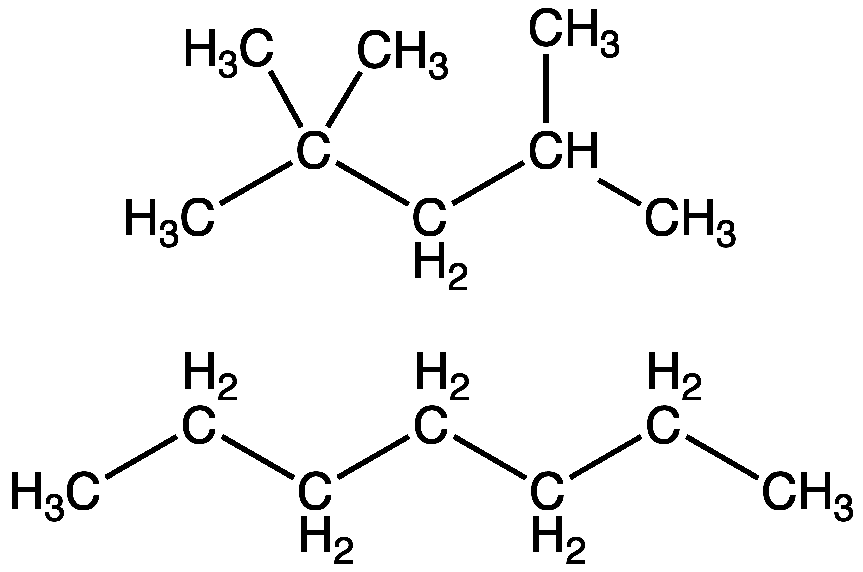

An octane number ranks how much compression a petrol can take before part of the mixture auto-ignites. The number is the volume percentage of iso-octane in a blend with n-heptane that knocks in the same way. A fuel rated 90 knocks like 90% iso-octane and 10% n-heptane. Pump petrol is a mixture of many hydrocarbons. The rating describes the knock behaviour, and it does not describe the recipe.
The number also does not rank the energy in a litre of fuel. Where a higher octane lets an engine make more power, that power comes from the compression and the spark the engine can then use.
The test engine
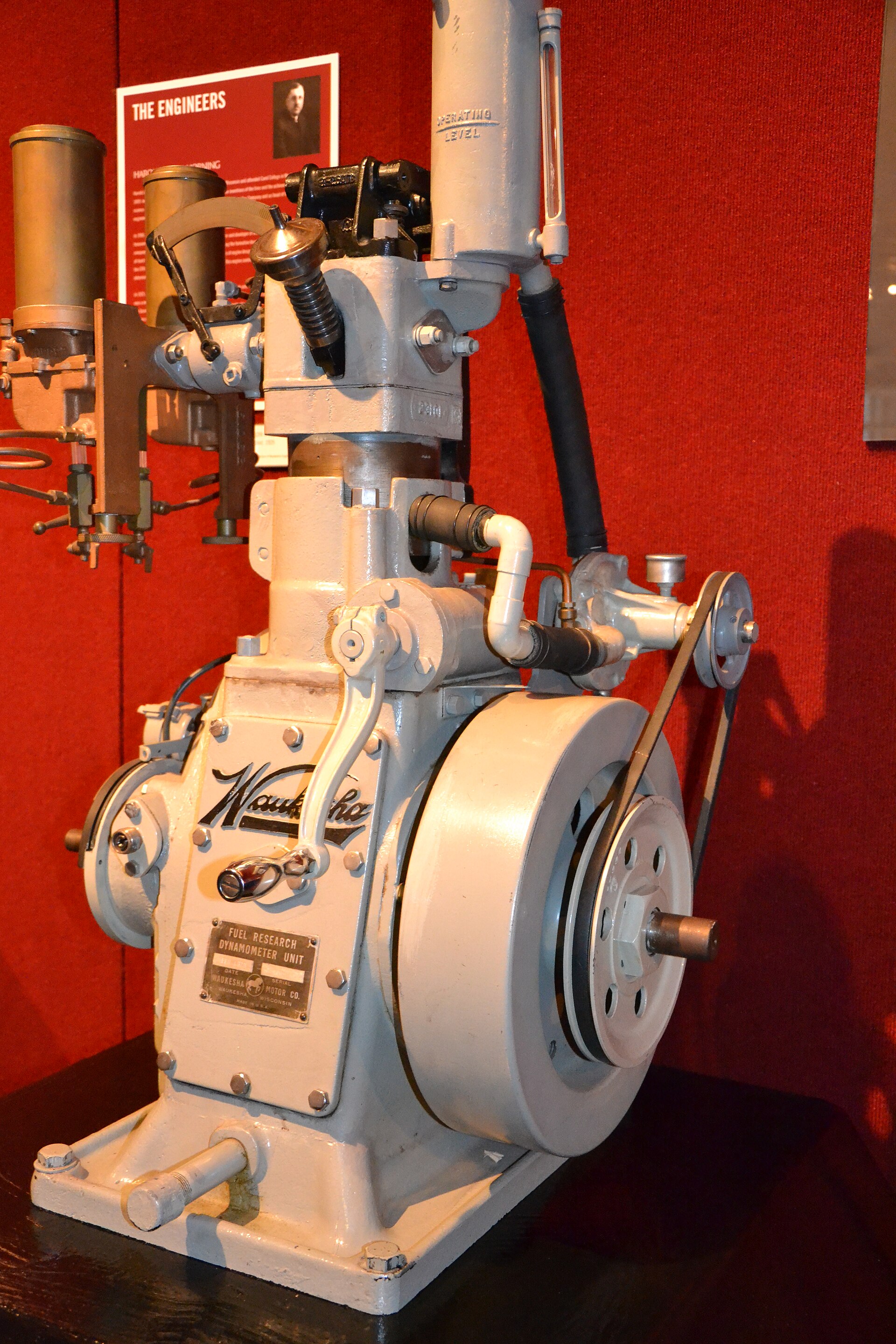

Research octane number (RON) and motor octane number (MON) are both measured on a Cooperative Fuel Research engine. It is a single cylinder whose compression ratio can be changed while it runs, by moving the cylinder relative to the piston. CFR Engines names the current F1/F2 unit as the equipment for the methods below. That unit holds the sample and the reference blends in a four-bowl carburettor, so the test can switch fuels, and it reads cylinder height with a laser. The engine in the photograph is a Waukesha CFR unit of this family. The Commons record of the photograph says the design was designated a landmark by the American Society of Mechanical Engineers.
How the number is read
The sample is run in the engine and the compression is raised until the fuel knocks at the intensity the method uses. That result is compared with blends of iso-octane and n-heptane. The octane number is the percentage of iso-octane in the blend that matches. RON is the figure from this comparison at the research-method settings. It is the number on pumps in the UK and the rest of Europe.
A fuel that knocks less than pure iso-octane is given a performance number above 100. The octane-rating article names racing fuels, aviation gasoline, LPG and methanol as fuels that can sit at 110 or higher. Tetraethyl lead was once added to road petrol to raise the number. The same article records that road use has been phased out since the 1970s because of the lead’s toxicity.
Research method and motor method
MON uses the same kind of engine and the same reference blends, run harder. The speed is higher, the mixture is heated, and the spark timing moves as the cylinder height changes. The difference, RON minus MON, is the fuel’s sensitivity. The octane-rating article says a modern pump petrol is often about 8 to 12 numbers lower on the motor method, and it marks that range as needing a citation. There is no fixed conversion from one number to the other.
| RON, research method | MON, motor method | |
|---|---|---|
| Standards | ASTM D2699, EN ISO 5164, IP 237 | ASTM D2700, EN ISO 5163, IP 236 |
| Speed | 600 rpm, ±1% | 900 rpm, ±1% |
| Spark | 13° before top dead centre | Varies with cylinder height |
| Intake air | Set from the barometer, tolerance ±4.4 °C | 38 °C, ±2.8 °C |
| Mixture | No separate mixture-temperature setting | 149 °C is the standard setting |
CFR Engines’ table for the current F1/F2 unit, read on 11 November 2026, also holds the coolant at 100 °C ±1.5 °C, the oil at 57 °C ±8 °C, the oil pressure at 172–207 kPa, and the intake vacuum at 25–150 mm of water, for both methods. Their research-method intake line also prints a Fahrenheit tolerance that does not match ±4.4 °C. The Celsius figure is the one used here.
What a pump shows
In the UK and Europe the posted grade is the RON. The octane-rating article of 16 October 2026 lists regular unleaded in the UK and Europe at 95 RON, premium unleaded in the UK at 98, and some UK fuels at 99. That examples table is flagged on the article as needing more citations, so the grades are what that revision lists.
In the United States, Canada and Mexico the posted number is the anti-knock index, (RON + MON) / 2, often written (R+M)/2. It sits between the two laboratory results. A US pump figure is an average, and it takes both measurements to turn it back into a RON.
On the engine
Knock is a pocket of mixture exploding outside the flame that the spark started. Pre-ignition is a separate event: combustion that starts before the spark. The octane-rating article treats the two as correlated, because knock heats the cylinder. A higher-compression petrol engine is built around a fuel that will wait for the spark. The same article says a modern control unit listens with a knock sensor and retards the spark if it hears knock, and it tags that sentence as needing a citation.
Diesel engines are ranked the other way, by cetane number. They are meant to ignite from the heat of compression. A RON does not describe a diesel.
Sources
Curated reference notes. Hardware testing by this wiki is not implied. Wikipedia text is adapted from the cited revision under CC BY-SA 4.0.
- Wikipedia: Octane rating, rev. 1380548184, 2026-10-16. The definition, the 600 rpm and 900 rpm methods, the anti-knock index, sensitivity, and the pump grades.
- CFR Engines: F1/F2 octane rating. The current test unit and the operating-condition table. Accessed 2026-11-11.