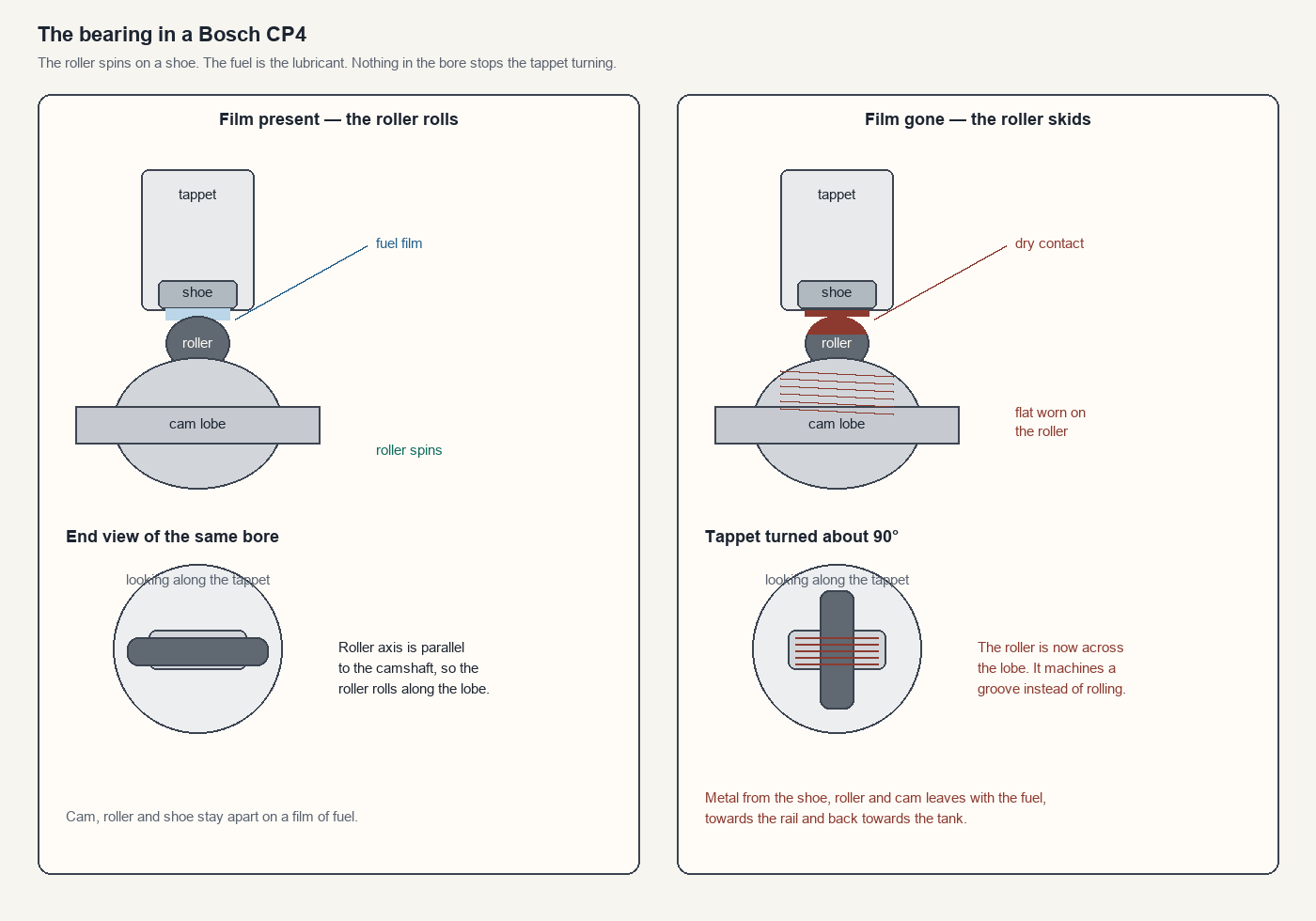
The part that fails in a Bosch CP4 is not an engine-oil bearing. It is a roller, turning on a shoe inside the tappet, and the only lubricant in that gap is the diesel itself. When the fuel film collapses the roller stops rolling, the tappet can turn in its bore, and the roller then machines the cam. The metal from that cut goes out with the fuel, into the rail and back towards the tank. Bosch treats CP4 as a family of pumps, not one part: the roller shoe, the cam, the roller size and material, the clearances and the tappets are chosen for each application. The bearing described here is the one Bosch names. The photographs are of particular pumps, and a pump from another engine will not match them part for part.
How the rest of a common-rail pump is arranged, and how to test feed pressure against rail pressure, is on common-rail supply pumps and common-rail fuel system tests. The general pattern of a high-pressure pump filling the rail with its own debris is on fuel pump faults.
The roller and the shoe
Bosch’s own description of the conditions the pump is built for asks for enough fuel viscosity that a hydrodynamic layer builds up between the rotating roller and the roller shoe. That layer is the bearing. The roller is there so the cam can lift the plunger without sliding on it. The tappet that carries the roller is a plain cylinder in a bore in the housing. Published teardowns of the CP4.2 find no guide that stops that cylinder turning, so the roller stays square to the cam only while it is free to spin and the tappet is held by the load.
A CP4.1 has one plunger. A CP4.2 has two. In a description of the fourth-generation system fitted to the cars in one wear study, the drive shaft carries two lobes 180° apart, one roller sits between those lobes and the single plunger tappet, and diesel is the lubricant of the tappet, the plunger and the bore. A teardown of a CP4.2 from a 6.7 Power Stroke describes the same idea with two roller followers on a two-lobe cam. Bosch says those lobes, the roller and the clearances differ by application, so a drive ratio measured on one pump is not the ratio of every CP4.

What fails first
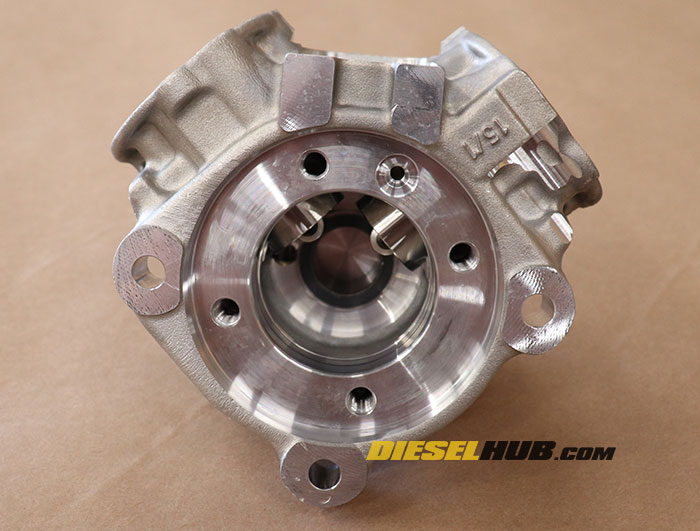
Bosch’s account of pumps run outside their fuel specification puts the first damage in that film. Poor lubricity or viscosity, high fuel temperature, air in the fuel, or hard particles all produce the same initial result: loss of the hydrodynamic layer in the clearance between the roller and the roller shoe, and damage to the roller, the shoe, or both. Aged biodiesel is listed separately. The deposits make the roller sticky, and a flat, a braking plate, forms on it. Water above the allowed content is also separate: it corrodes or embrittles the cam and the roller, and that leads to fatigue. Once any of those has started, metal from the shoe, the roller and the cam enters the fuel system.
The workshop finding that follows is the tappet turning. With the roller no longer spinning, nothing keeps the follower aligned. It can rotate in the bore until the roller lies across the cam instead of along it, and the roller then cuts the lobe rather than rolling over it. That rotation is what the teardowns show. It is not a separate mode in Bosch’s table. It is what a seized roller does in a bore that does not locate it.

Lubrication
The film needs two properties from the fuel, and they are not the same measurement. Viscosity is how thick the fuel is, and it falls as the fuel gets hot. Lubricity is how well it protects a sliding contact, measured as the wear scar in a high-frequency reciprocating rig. European diesel to EN 590 limits that scar to 460 µm at 60°C. US diesel to ASTM D975 allows 520 µm. A larger scar is a poorer lubricant. Bosch’s 2024 account names lubricity and viscosity together as fuel properties that decide whether the film between the roller and the shoe survives, and names high fuel temperature as its own route to the same loss of film. That account does not say the difference between the two fuel specifications is, by itself, a defect in the pump. It says the pump was validated inside an agreed fuel specification, and that pumps returned from the field were outside it.
Anything that thins the fuel or strips its lubricating ability works in the same place. Hot fuel, a light blend, and fuel that has been diluted all sit on that list. So does petrol in the tank. Petrol is a poor diesel lubricant and it lowers viscosity. The pump cannot tell a deliberate contaminant from a fuel that simply does not meet the specification it was validated on.
Bad fuel
Bosch separates three contaminants from a generally poor lubricant:
- Water, acids and other adulterants. Water above the tolerance corrodes or embrittles the cam and the roller. The damage then becomes fatigue of those parts, not only a wiped film. Free water was one of the findings in pumps returned from FCA and BMW vehicles.
- Aged biodiesel. As biodiesel ages it leaves deposits. Those deposits stick the roller, and the stuck roller grows a flat where it should be spinning. The rate of that ageing depends on the fuel, on catalytic materials in the wetted parts, and on how much air the tank sees. Aged-biodiesel deposits were the second finding in those returned pumps.
- Hard particles and fibres. They wedge the roller so it cannot turn, which is another way to lose the film. Bosch includes particles that arrive from upstream parts and from the vehicle maker’s own assembly, not only dirt from a tank. External particles, meaning particles that were not material from the pump itself, were the third finding in the returned pumps.
Bosch’s position, stated to NHTSA in the EA23001 inquiry, is that a CP4 run inside those conditions has no significant risk of this damage over its design life, and that the failures they examined were pumps installed in systems that did not keep the fuel inside the agreed limits. The inquiry covered CP4 pumps on BMW, Ram and Jeep vehicles. The letter treats the pump as a part Bosch supplies to the vehicle maker against that specification, and it says Bosch’s replacement figures do not separate a failed pump from a pump replaced for some other reason.
Air and cavitation
Air in the fuel is in Bosch’s table beside hard particles. Both destroy the hydrodynamic film between the roller and the shoe. A pocket of air is not a liquid, so for that moment there is no film, and the steel runs on steel.
Cavitation is the next step, not a different word for the same thing. Bubbles in the fuel collapse when the pressure recovers, and the collapse pits the metal. A wear study of Kia and Hyundai engines with a CP4.1, published by Bishutin in 2019, separates the two. Inside the pump, airing removes the fuel film and the parts wear by adhesion: scratches and rub marks on the plunger, on the tappet, on the cam, and in the tappet bore of the aluminium housing. At the rail-pressure regulator, the same bubbles collapse against the screen and leave the pitted surface of cavitation. Diesel Hub’s account of the CP4.2 uses cavitation in the other sense, as one of the ways tiny bubbles get into the fuel in the first place, together with sloshing, small leaks and the turbulence of fuel returning to the tank.
The same study records where the air comes from on those cars. A filter housing, a pipe or an injector line left open during repair lets air in continuously. Cranking on the starter, and using an ether start spray while the system is full of air, was enough in those examinations for the fuel system to be ruined within a few hours. A low tank does it on the road: with about 8 to 10 litres in the tank the in-tank lift pump’s pickup can drink air under acceleration, on a grade, or as the fuel sloshes. Summer diesel in ambient temperatures below about −15°C was the other case they examined. The fuel stops flowing, the engine stops, and as the warm fuel in a long suction pipe cools it shrinks and pulls in air and releases air that was dissolved. Their recommendation for those vehicles is to bleed the system after any opening, to keep the tank above about a quarter, and not to run fuel that is wrong for the temperature. That quarter-tank figure is from those examinations. It is not a Bosch specification for every CP4.
Aeration is blamed more often on the Duramax LML and LGH, for a different reason. Those engines have no electric lift pump. A gear pump on the back of the CP4 is the supply, driven only while the pump is turning. Power Stroke and Cummins applications that use a CP4 have an electric lift pump, which can fill the suction line before the engine cranks. Diesel Hub notes that the Duramax arrangement is harder to bleed after a filter change, and that the pump may be turning before the housing is full. RCD Performance, quoted by Diesel World, attributes Duramax failures they see to that missing lift pump, to a filter that was not bled, or to running out of fuel: aerated fuel lets the plunger float, and the tappet is then free to turn. Diesel Hub is careful not to claim the Duramax fails more often than the Power Stroke. The missing lift pump is a reason the film is easier to lose on that one application, not a count of failures.
Where the metal goes
The particles leave in both directions. Fuel that has passed the roller goes to the high-pressure outlet and the rail, and fuel that is spilled at the metering valve goes back towards the tank, so the tank, the filter, the lines, the rail and the injectors all see the debris. On the engines in the Bishutin examinations the tappet rubs the aluminium housing once the film has gone, and the aluminium oxide that forms is harder than the steel tappet. That oxide, and the steel from the pump, then scratches the injector needles across the direction of the original grind marks, and the needles seize. A fine screen at the volume-control valve is one of the first places the steel collects. A screen full of metal is the pump announcing itself. It is not a screen that wants cleaning and refitting.
There is no fault code that means “the roller has failed”. Bosch notes that the codes which appear are the symptoms, such as low system pressure, and that whether a driver gets a warning depends on the vehicle. A pump that has already filled the rail with metal can still show only a low-pressure complaint, or a no-start, or a stall. Replacing the pump and leaving the rail, the lines, the injectors and the tank is how the next pump is fed the same debris. Diesel Hub cites General Motors TSB 16-NA-102 for the Duramax case: the fuel system is replaced rather than the pump alone, and the labour time in that bulletin is 18 to 21 hours. The same article’s practical point is the one that matters on any of these engines. If the filter or the regulator screen contains steel, the repair is the fuel system, not a pump on its own.
Dealers have treated the metal as contamination and declined to cover the rest of the system with the pump. That is a warranty position, reported by the workshops, not a statement about which part made the metal. NHTSA recall 21V-880 covered a large population of 2019–2020 Ram heavy-duty trucks with a CP4, on the concern that a pump failure could stall the vehicle. BMW recall 21V-586 is the matching action named in Bosch’s response. A recall population is not a failure rate, and Bosch’s letter does not give one.
What the pump is, and what it is not
Published rail pressures for this generation sit around 2,000 bar in the description of the CP4.1 system above. Figures quoted for later applications reach 2,700 bar, about 39,000 psi, in Bosch advertising as reported by Diesel Hub, with Ford, GM and Ram applications quoted at 36,000 psi. The number belongs to the pump that was fitted. Early cams in that teardown comparison are asymmetric, and a symmetric lobe appears on pumps phased in around 2020. That change is a reported production change, not evidence that either cam is immune to a dry roller.
Applications named in the Diesel Hub comparison are the 2011-on 6.7 Power Stroke, the 2011–2016 6.6 Duramax LML and LGH, the 2019–2020 Ram 6.7 Cummins, the Ram 1500 and Jeep 3.0 EcoDiesel, and the 2018–2021 F-150 3.0 Power Stroke. The Cummins heavy-duty engines returned to a CP3 for 2021. Passenger-car diesels use the CP4.1 widely; the Kia and Hyundai engines in the wear study are examples, not the whole list. A pump on a European car and a pump on a Duramax share the roller and the shoe. They do not share a lift pump, a cam or a part number.
Keeping the film there
The causes above are also the prevention, and each one is only as useful as the fuel system on that vehicle.
- Fuel that meets the lubricity and water limits the pump was validated on. A lubricity additive is a workshop habit on US fuel because of the 520 µm against 460 µm gap. It does not fix water, petrol, or a tank of aged biodiesel.
- Water drained from the separator, and the reason the water arrived, before a new pump is asked to run.
- No air on the suction side. After a filter change the system has to be bled with the procedure for that vehicle. On a Power Stroke or a Cummins the electric lift pump can be left to run before cranking. On a Duramax LML the primer is on the filter housing, because the gear pump cannot prime itself until the engine is turning. Do not crank a CP4 that is still full of air, and do not add starting fluid to make it catch.
- A filter and pipes that are actually sealed. Bubbles in an approved transparent test section can indicate air ingress, but also check test connections, priming and the system-specific procedure before identifying the source.
- The tank not run dry. Running out is a known way to hand the pump a slug of air.
Once steel is in the filter, none of that saves the pump that is already in pieces. Pressure readings then only describe the symptom. The tests that separate a pump which cannot fill the rail from an injector which is emptying it are on common-rail fuel system tests. Open joints only after the system has been depressurised. The wait used on one Bosch solenoid system, and the reason a common-rail joint is not opened hot, are on fuel pump faults.
Aftermarket kits
The kits sold for this failure do three different jobs, and the names on the boxes mix them up. A disaster-prevention or bypass kit leaves the CP4 in place and tries to catch the metal. A conversion takes the CP4 out and fits a different pump. A lift pump only changes the fuel arriving at the pump. Prices below are the figures on the makers’ own pages in November 2026. They move. None of the three is a repair for a system that already has steel in the rail.
A bypass keeps the CP4
S&S Diesel Motorsport’s Gen2.1 disaster-prevention kit, part CP4-6.7F-BP-G2.1, is listed for 2011–2026 Ford Super Duty trucks with the 6.7 Power Stroke, at $400 for the full kit. A different part, CP4-6.7F650-BP-G2.1, is the one they build for an F-650 or F-750. The kit carries California Air Resources Board executive order D-756-6. That order is an emissions approval for the part. It is not a claim that the roller will last.
S&S is explicit that the kit does not stop the pump failing. The roller, the shoe and the cam are inside the pump, and plumbing outside it does not put the film back. What they change is where the metal can go. On their diagram the stock pump feeds the inlet-metering valve from inside the case, so fuel that has washed the roller can reach the plungers, and the case return goes back toward the tank with no filter of its own. The kit blocks that internal feed. The metering valve gets its own supply, taken off 25 inches upstream of the pump, and the case gets a separate inlet for lubrication. Fuel leaving the case has to pass a spin-on filter, a Donaldson P550943 which they rate at 9 micron and 99 percent efficiency, before it can reach the tank. The first version of the kit split the supply within an inch of the pump. They say a bad enough failure could then clog the return and push debris back into the clean line, which is why the split moved.
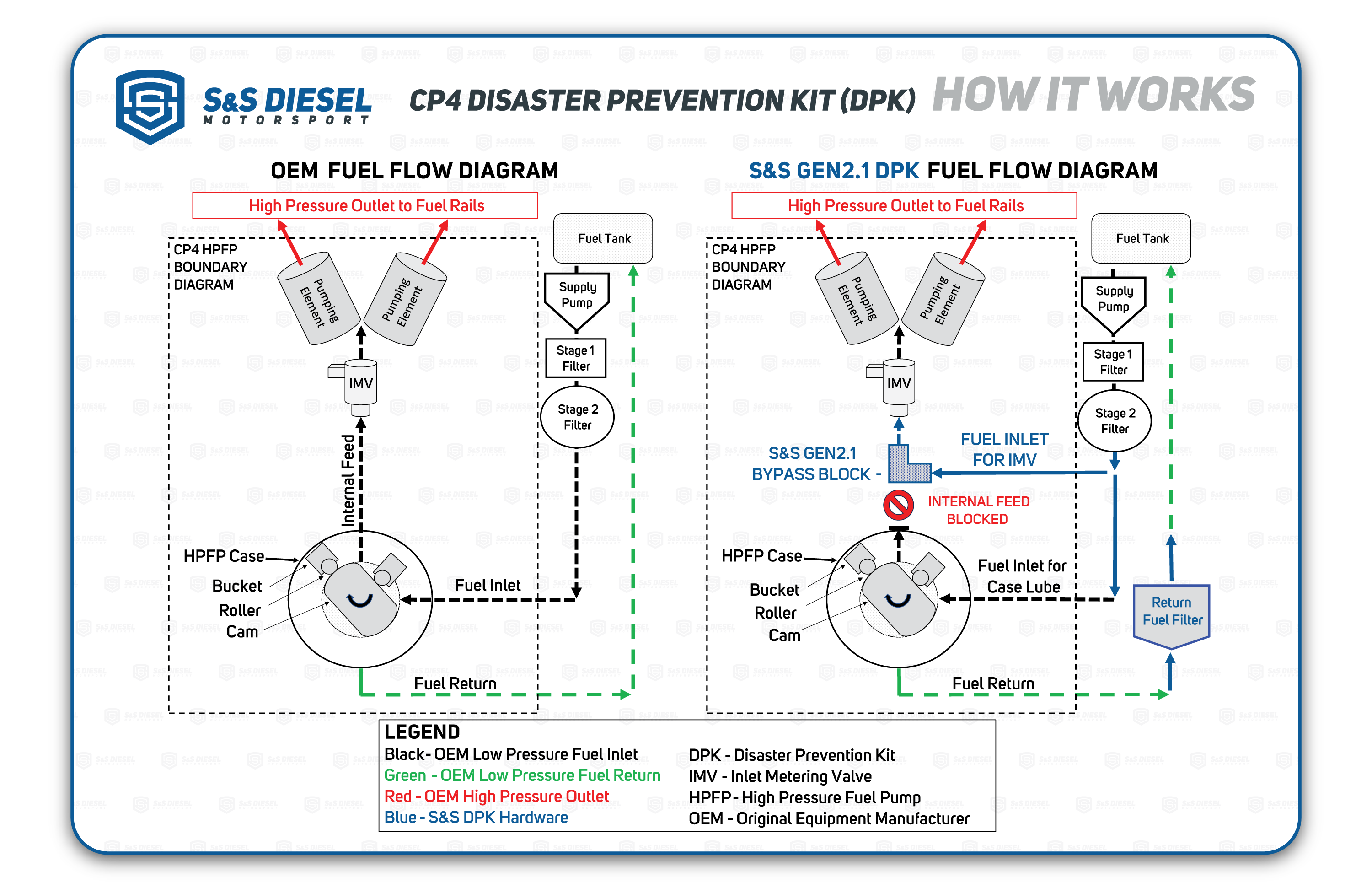
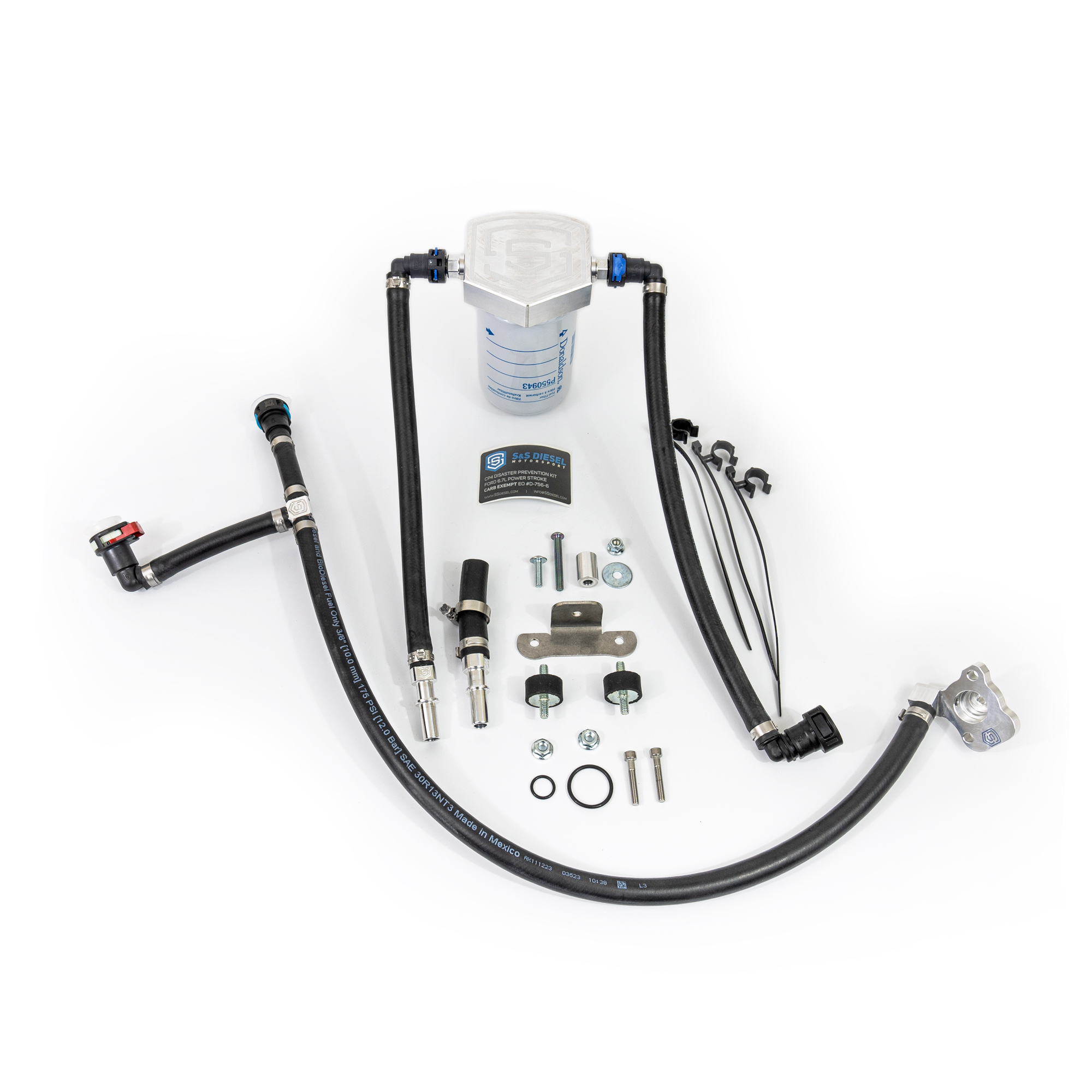
Their evidence for the containment is a set of pumps they failed on purpose, on a fuel-lab bench and in their own trucks, with the kit fitted. They report that those teardowns found no metal in the high-pressure side, and that a truck can be driven further into a failure because the clean side stays clean. That is their test, not a guarantee for every failure, and it does not include a pump that had already filled the rail before the kit was fitted. The fitting instructions tell the installer to look at the metering unit with the actuator off. If that unit is already full of metal, they say the pump and the fuel system are replaced first. A melted fitting on the kit’s return line is, in their service notes, a sign the pump has failed and the return fuel got hot. After a failure on a truck that already had the kit, they say the repair is the return filter and a new CP4, or their DCR conversion, and a look at the metering unit to confirm it stayed clean.
Other companies sell a “bypass” or a “fail-safe” for the same truck. The question their diagram makes easy to ask is whether the case return is filtered before the tank, and whether the plunger feed is actually separated from the case. A filter tee’d into an otherwise stock return is not that layout. S&S says this kit is only for the 6.7 Power Stroke. It is not a kit for a Duramax or a Ram.
Taking the CP4 out
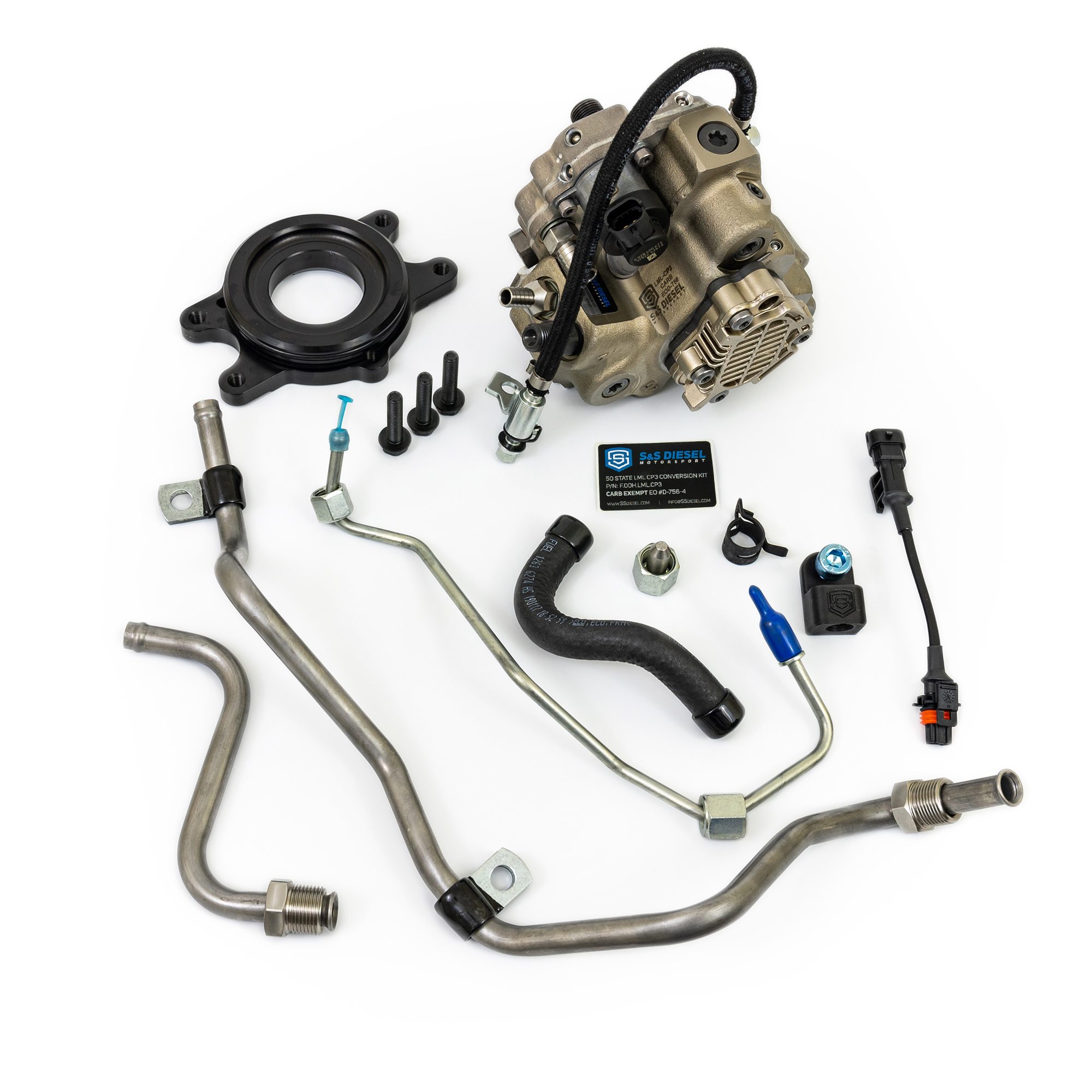
On a 2011–2016 LML Duramax the conversion S&S sells is a Bosch CP3 in the valley, gear-driven where the CP4 was. The 50-state version is listed at $2,600, needs no calibration change, keeps the factory emissions equipment, and carries executive order D-756-4. They also sell competition versions. The no-tune pumps use a metering unit they say is cut to follow the CP4’s flow curve. The tuning-required pump uses an LBZ-based metering unit, and the controller’s pump curve has to be changed to match it. They say a lift pump is not required, because this CP3 has its own gear pump on the back and can draw from the tank. A lift pump still helps when chasing an air leak, because the suction side then becomes a pressure side and a bad joint leaks outward, and they say it is useful on a high-output build. Fleece Performance sells an LML CP3 kit as well, as hardware alone or with a pump. Same idea, another maker’s parts.
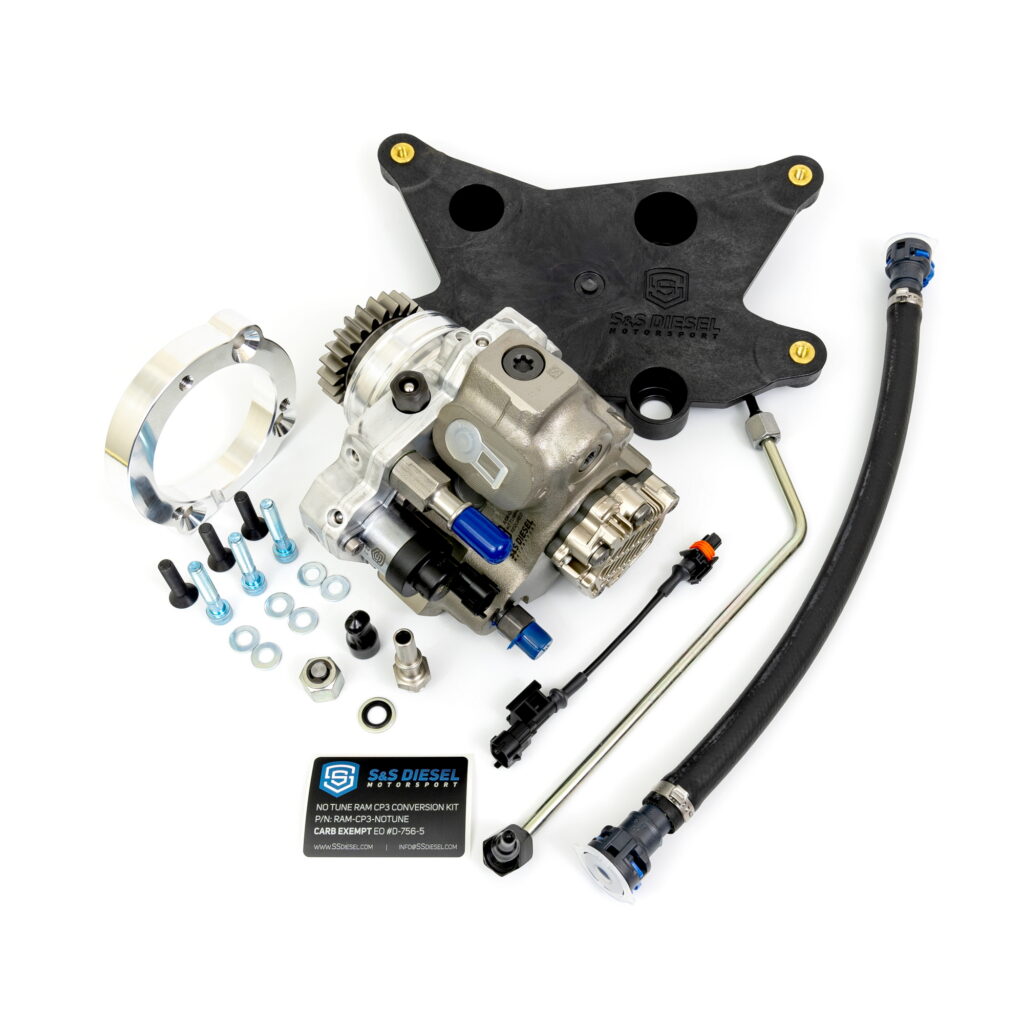
For the 2019–2020 Ram 6.7, S&S sells a CP3 conversion built on a new Bosch CP3NH, modified, with no calibration on the emissions version. That version is listed inside a range of $1,750 to $3,750 depending on the pump, and the no-tune kit’s own card cites executive order D-756-5. Their product page calls the pump it replaces a CP4.2. A later S&S article calls the same trucks’ pump a CP4.5. Bosch’s own letter treats CP4 as a family rather than one part, so the name on the box is the seller’s, not a Bosch part number. S&S says the front cover on this engine overdrives the pump at 1.5 times engine speed, and they publish speed limits for the high-output pumps they sell into that drive: 8,000 pump rpm for the 10 mm, 7,000 for the 12 mm and 6,000 for the 14 mm. A standard CP3, they say, can flatten off past about 3,500 pump rpm if it was not built for that overdrive.
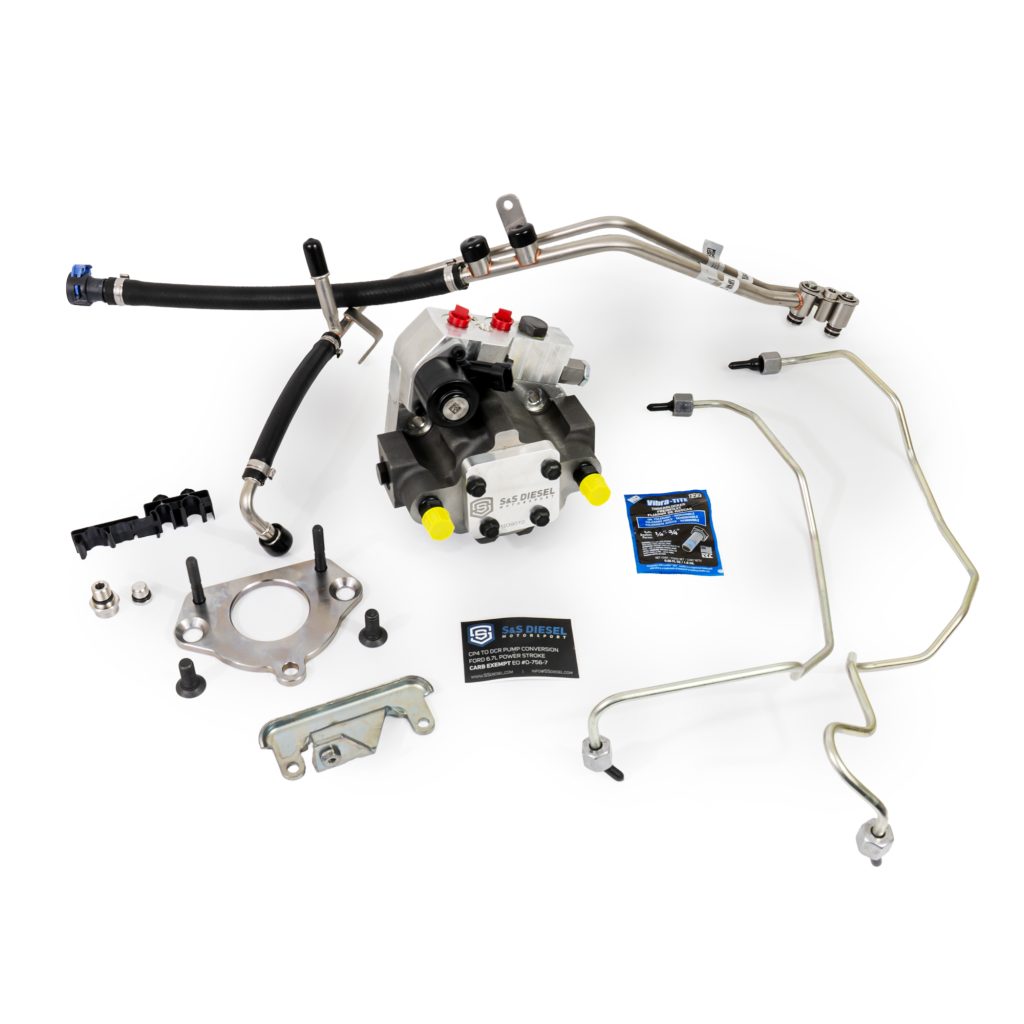
A CP3 does not go in the valley of a 6.7 Power Stroke. S&S says it will not fit there, and that the only way to mount one is a belt off the front of the engine. They do not sell that, because a belt or a tensioner then becomes the thing that stops the engine. Their replacement on that truck is a Stanadyne DCR pump, part 6.7F-DCR-1, developed with PurePower Technologies, Stanadyne’s aftermarket division, and listed at $2,400. They describe it as a two-piston pump with an eccentric drive and a pressure-lubricated cam and bushings, with a cam and metering setup cut so the stock controller still sees a CP4 curve. No calibration. They rate it at 1,250 mm³ per revolution, which they call about 25 percent more than a CP4.2, and they sell it as compatible with biodiesel and with low-lubricity fuel. Executive order D-756-7. It is listed for 2011–2026 F-250 through F-750 trucks, and 2011–2016 trucks need a new vacuum-pump gasket. “Pressure-lubricated” is their description of the cam and the bushings. It is not the CP4’s roller running on a film of whatever diesel is in the tank, and it is not a claim that has been tested here. A high-output arrangement they do accept is a DCR left in the valley, gear-driven, with a second CP3 on a belt, so a belt failure does not take the only pump with it.
A lift pump only feeds it
On the LML the CP4’s own gear pump is the supply, and the air problem that comes with that is already described above. Fleece’s PowerFlo is an in-tank pump for those trucks. Their sheet rates it at 10 to 13 psi at idle, and at 2 to 3 psi if the softer spring they include for a CP3 conversion is fitted. They say the factory system draws on a vacuum from the CP4, that the PowerFlo puts pressure on that line instead, and that the pump will support up to 800 hp and fuel with up to 20 percent biodiesel. The pressure and the priming are real answers to an empty suction line. The horsepower figure is their rating of the lift pump. It does not filter metal out of a failed CP4, and it does not put a film back under a roller that is already running on water or petrol.
A 6.7 Power Stroke and the Ram trucks in this group already have an electric lift pump. S&S describes the Power Stroke supply as sitting at about 60 psi, so a bad joint on that side leaks fuel out rather than pulling air in. A larger in-tank or frame-mounted pump on those trucks is a flow and filtration upgrade. Frame-mounted systems such as FASS and AirDog are sold on that basis, with a filter and some form of air separation ahead of the high-pressure pump. They do not change the roller, and they do not catch the metal once the roller has started cutting the cam.
If the filter or the metering-unit screen already contains steel, the kit decision is the one on fuel pump faults. The rail, the lines, the injectors and the tank are already part of the repair. Fitting a bypass, a CP3 or a lift pump onto that debris feeds the next pump the same metal.
Sources
- Bosch response to NHTSA EA23001, 14 June 2024. The CP4 as a family, the fuel film between roller and roller shoe, the damage table, and the water, aged-biodiesel and external-particle findings on returned FCA and BMW pumps.
- EN 590 and ASTM D975. HFRR lubricity limits of 460 µm and 520 µm.
- Diesel Hub, Bosch CP4 injection pump failure. CP4.2 teardown on a 6.7 Power Stroke, the unguided follower, the application list, the Duramax lift-pump difference, and the citation of GM TSB 16-NA-102.
- Diesel World, 2021, CP4.2 teardown. The roller, the scored cam, and RCD Performance on aerated fuel letting the tappet turn.
- S. G. Bishutin, “Parts wear peculiarities of Common Rail fuel system in diesel engines at its airing”, Bulletin of Bryansk State Technical University, 2019. CP4.1 examinations on Kia and Hyundai: adhesive wear from air in the pump, cavitation at the rail-pressure-regulator screen, and aluminium oxide from the housing reaching the injector needles.
- S&S Diesel Motorsport, Gen2.1 6.7 Power Stroke disaster-prevention kit. The bypass layout, the Donaldson return filter, the listed price and fitment, and their own failed-pump tests.
- S&S, what the disaster-prevention kit does. Their statement that the kit does not stop the CP4 failing, and why they reject a belt-driven CP3 on the Power Stroke.
- S&S, LML Duramax CP3 conversions. The in-valley CP3, executive order D-756-4, and the metering-unit difference between the no-tune and tuning-required kits.
- S&S, 2019–2020 Ram CP3 conversions. The CP3NH kit, the 1.5:1 drive, and the pump-speed limits.
- S&S, 6.7 Power Stroke DCR conversion. The Stanadyne DCR built with PurePower, the displacement they quote, and executive order D-756-7.
- Fleece Performance, LML CP3 conversion kits.
- Fleece Performance, PowerFlo lift pump for the 2011–2016 LML. The idle-pressure ratings, including the softer spring used after a CP3 conversion.
CP4.2 as an M57 upgrade
Some aftermarket M57 conversions fit an adapted CP4.2 in place of the original high-pressure pump. These are application-specific builds with mechanical, fuel-line and control changes. See the M57 guide for examples and the checks to make before choosing a kit.