Alongside the flagship DCOE, IDF, IDA and DGV ranges, three other Weber families see widespread workshop and tuning use: the compact synchronous twin-choke downdraft DCNF (famous on Italian V6/V8s and European hot hatches) and the single-barrel 34 ICT and 34 ICH conversion carburettors.
Adjustment screw diagrams
Use the parts key alongside each exploded view; numbering applies only to the linked drawing.
- Weber Performance: 40 DCNF 12 (PDF): idle mixture screw 46; throttle stop screw 50.
- Carbparts: 34 ICT: idle mixture adjustment screw 24. The Redline 34 ICT tuning guide also shows the assembly and explains the idle speed and mixture adjustments.
- Carbparts: 34 ICH: throttle stop screw 23; adjusting screw 32. For screw 32 the supplier's parts list describes it as a carburettor adjusting screw; its companion 34 ICH parts key identifies it as the idle mixture screw.
Match the model and parts key before working on the carburettor; these are exploded views, so screw orientation can differ from the assembled view.
1. Weber DCNF (36 / 40 / 42 / 44 DCNF)
The Weber DCNF is a compact, low-height synchronous two-barrel downdraft carburettor whose float chamber runs crosswise beside the venturis for tight engine-compartment packaging. It was OEM equipment on the Fiat Dino V6, Ferrari 246 Dino and 308 GT4/GTB, Lamborghini Urraco, Maserati Ghibli/Merak, and Chrysler/Talbot/Simca models, and is a popular transverse twin-carb fitment.


| Model (example) | Choke / aux | Main jet | Emulsion tube | Air corrector | Idle jet | Pump / needle | Float (closed / drop) |
|---|---|---|---|---|---|---|---|
| 36 DCNF 17/18 (Chrysler France) | 29 mm / 3.5 | 120 | F36 | 185 | 45 | 40 / 1.75 | 52 / 58.5 mm |
| 40 DCNF 12 (Fiat Dino V6) | 32 mm (or 30) / 4.5 | 125 | F24 | 220 | 50 | 45 / 1.75 | 50 / 58.1 mm |
| 42 DCNF 9 (Maserati Ghibli) | 34 mm / 3.5 | 140 | F25 | 180 | 60 | 40 / 2.00 | 48 / 58.5 mm |
| 44 DCNF 44 (Maserati Merak) | 36 mm / 3.5 | 140 | F25 | 170 | 65 | 40 / 2.00 | 48 / 58.5 mm |
- DCNF jet parts & tuning: DCNF main jets are Weber
41115.003(73405—different length/thread from DCOE/IDF41110.001). Plastic floats typically set around42 mmclosed /55 mmdrop (Bigorre float chart). Multi-carb DCNF banks follow the same barrel-by-barrel Lean Best Idle and Synchrometer balancing sequence as IDF carbs.
2. Weber 34 ICT (dual single-barrel conversions)
The Weber 34 ICT is a compact single-barrel downdraft carburettor without a choke plate, sold primarily in twin-carburettor hex-bar kits for air-cooled VW Type 1, Type 3 and Type 4 engines (1,600–2,000 cc).
- Baseline jetting:
27 mmor29 mmventuri (4.5aux),130–135main jet,F78emulsion tube,160air corrector,50–60idle jet,50pump jet (40bleed),1.75needle valve (CB Performance chart; Top End chart). - Float & fuel pressure:
6.5 mmclosed /13 mmdrop (Weber jetting chart); keep fuel pressure regulated to2.5–3 psi. - Tuning approach: because a pair of
34 ICTsshares the same single-barrel simplicity with one mixture screw and one idle speed screw per side, disconnect the hex-bar linkage first, set both throttle stops cleanly at low idle, balance airflow with a Synchrometer at both idle and ~2,500 rpm(checking hex-bar arm symmetry), and tune each mixture screw to Lean Best Idle. With no choke flap, cold starting relies on a couple of accelerator-pump primes before cranking.
3. Weber 34 ICH (single-barrel replacement carb)
The Weber 34 ICH is a manual-choke single-barrel downdraft replacement widely fitted to Land Rover Series IIA/III 2,286 cc, Ford Cortina/Escort/Capri 1.1/1.3/1.6, Saab V4 1,498 cc, Bedford CF 2.3 L, and Audi 80/VW Passat conversions (Eurocarb Weber applications).
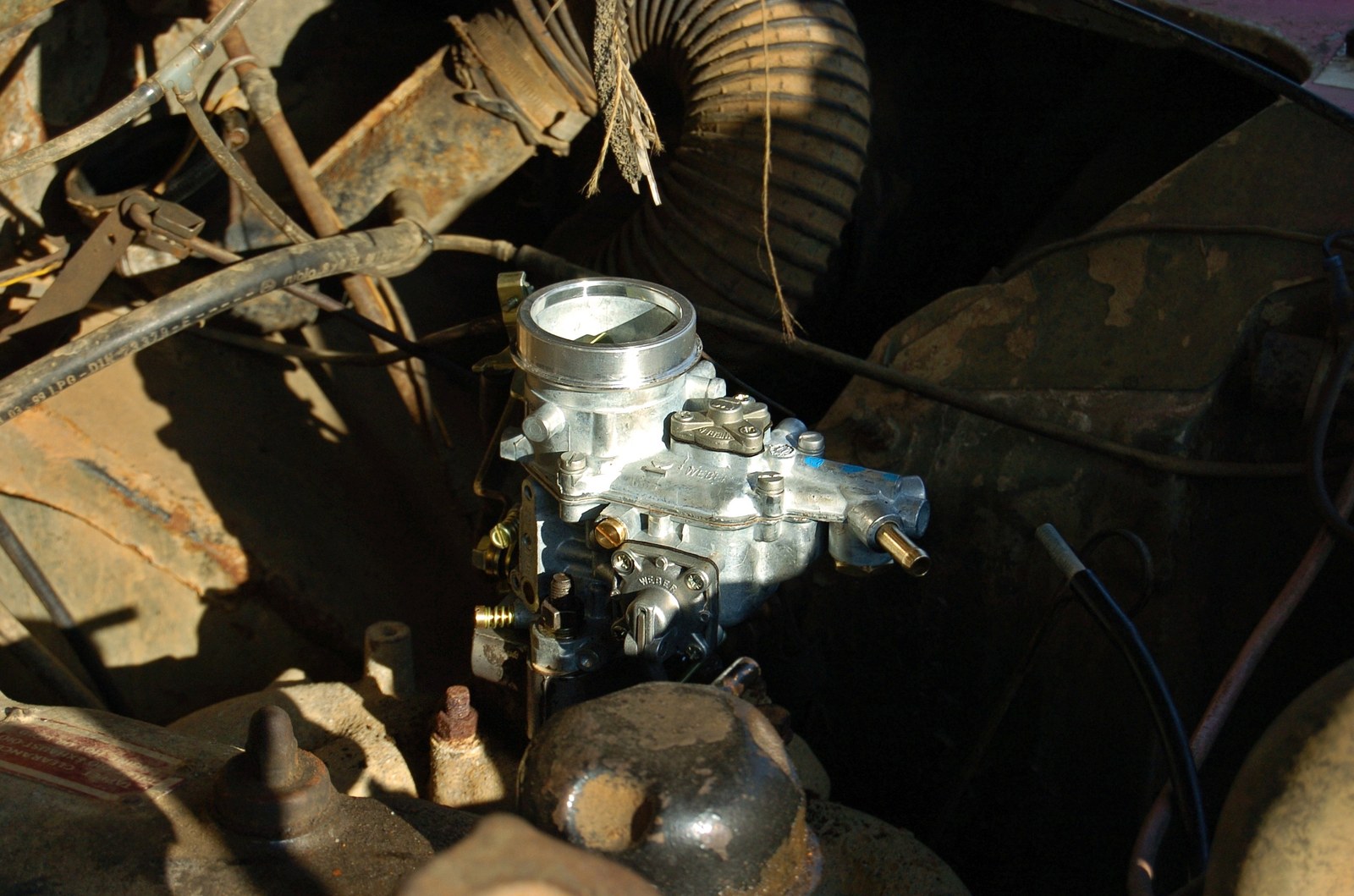

- Baseline jetting: depending on kit specification,
25 mmor29 mmventuri (4.5or3.5aux),130–165main jet,F6emulsion tube,150–190air corrector,50–57idle jet,50–55pump jet (40bleed),1.75needle valve, and6.5 mm/13 mmfloat height. - Tuning approach: confirm the manual choke cable releases completely so the strangler flap sits fully vertical when warm, keep fuel pressure around
2.5–3 psi, set idle mixture to Lean Best Idle with the speed screw kept minimal, and tune main jet /F6emulsion / air corrector using loaded road/dyno AFR checks.
4. Related pages
- Weber carburettor tuning overview
- Weber DCOE and DCO-SP carburettors: specs and tuning
- Weber IDF carburettors: specs and tuning
- Weber DGV, DGAV, DGEV and DFV carburettors: specs and tuning