Removed text is struck through; added text is highlighted.
The Weber DGV (manual choke), DGAV (water-heated automatic choke), and DGEV (electric choke)—along with their mirror-image DFV / DFAV / DFEV siblings—are progressive two-barrel downdraft carburettors with fixed venturis. They are widely used both as OEM equipment (Ford Pinto/Crossflow) and as bolt-on replacement conversions for worn OEM carbs on 4-cylinder road and off-road engines.
Weber 32/36 DGAV fitted to a Saab 96's Ford Taunus engine; the red circle marks the crankcase ventilation valve. Photo: Sonett72, Wikimedia Commons, CC BY-SA 3.0.
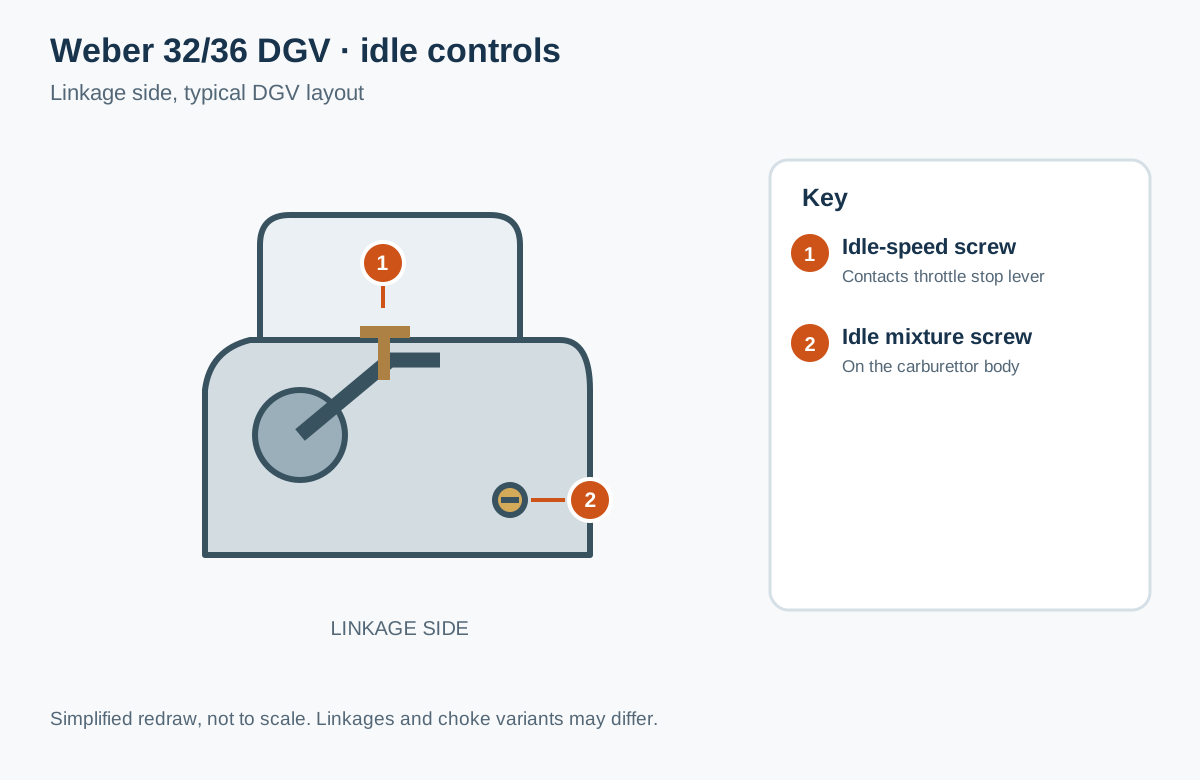
Adjustment screw diagram
Typical 32/36 DGV idle-speed and mixture adjustment controls. Original simplified redraw for Tuning Wiki, CC BY 4.0, based on Weber Performance’s figure 1. Not to scale; linkage and choke versions differ.
View Weber Performance's 32/36 DGV adjustment diagram (figure 1, PDF). It labels the idle speed and idle mixture screws. The Redline 32/36 DGAV/DGEV and DFAV/DFEV exploded views provide variant-specific parts references; do not assume every choke or linkage layout is identical to the DGV.
1. Progressive layout & factory baseline specs
In a progressive 32/36 carburettor, the smaller 32 mm primary barrel (26 mm choke) handles idle, light throttle and road cruising with high air velocity, while the larger 36 mm secondary barrel (27 mm choke) opens mechanically via progressive linkage once primary throttle passes roughly half-way.
Fuel pressure: Redline Weber recommends 2.5–3 psi; exceeding 3.5 psi frequently pushes fuel past the needle valve and causes rich idling.
Float height (top cover vertical, gasket in place, tang touching ball without compressing spring):
Brass float (41030-019): typically 35 mm closed / 51 mm drop (or 41 mm / 52 mm depending on specific body/needle revision—verify the sheet supplied with the rebuild kit).
Plastic / Nitrophyl float (41030-020): typically 17 mm closed (Bigorre float chart).
Off-road float drop: for aggressive off-road / trail bouncing, Redline specifies limiting maximum float drop to 44.5 mm.
3. Tuning approach: progressive Lean Best Idle & Sync Link
Clear fast-idle cam & set speed screw: confirm the choke fast-idle cam is completely released and the linkage returns freely without binding. On a progressive DGV/DGAV/DGEV, wind the idle speed screw out from contact, then turn in no more than 1½ turns maximum past contact (further opening exposes the primary transfer slot at idle and disables mixture-screw control).
Single primary mixture screw: unlike synchronous 38 DGAS carbs, a progressive 32/36 idles on the primary barrel only via one idle mixture screw (and note the primary 74409 idle jet on the choke side vs secondary 74403 idle jet on the inlet side). Lightly seat the mixture screw and back out 2 turns (progressive baseline; 1 turn on synchronous setups), then tune by ear for smoothest, highest idle before setting final RPM with the speed screw.
Diagnosing primary idle jet size: if best idle requires backing the mixture screw out beyond ~2½ turns (or opening the speed screw past 1½ turns), the primary idle jet is too small; if best idle occurs under 1 turn out, the primary idle jet is too large.
Main circuit & secondary transition: 32/36 carbs use 41120.001 (73801) main jets, 61440 emulsion tubes (F50, F6, etc.), and 41360.001 (77201) air correctors. A stumble just as the secondary opens often points to the secondary idle jet (74403) being too small or plugged, rather than the primary main jet.
Motorsport Sync Link conversion: for competition classes requiring a single 32/36 DGV/DGAV, Webcon's Sync Link kit (MT0098L) links both throttle shafts to open synchronously together with a dual-nozzle accelerator pump jet (Webcon Sync Link release).
4. Related pages
Weber carburettor tuning overview
Weber DGAS, DGES and DGMS carburettors: specs and tuning
Weber DCNF, ICT and ICH carburettors: specs and tuning
Carburettor fuel circuits and metering
Sources
Redline Weber 32/36 DGEV / DGAV Parts Breakdown & Float Notes and 32/36 vs 38 DGAS Application Guide.
Webcon UK 32/36 DGV 5A Specification and Webcon DGV Sync Link Kit (MT0098L).
Weber Factory Jetting Chart and Baseline Weber Jetting Chart.
Bigorre Carburateur Float Height Reference.
Page organisation changed
Field
Revision 3
Revision 5
Page type
Technical article
Technical article
Subject
Carburettors
Carb Tuning
Parent
Section level
Section level
Applies to
No ECU-specific applicability
No ECU-specific applicability
Tool groups
None
None
Vehicle makes
None
None
Rendered revisions
Open each version to inspect formatting, tables and photographs.
Revision 3: Weber DGV, DGAV, DGEV and DFV carburettors: specs and tuning
The Weber DGV (manual choke), DGAV (water-heated automatic choke), and DGEV (electric choke)—along with their mirror-image DFV / DFAV / DFEV siblings—are progressive two-barrel downdraft carburettors with fixed venturis. They are widely used both as OEM equipment (Ford Pinto/Crossflow) and as bolt-on replacement conversions for worn OEM carbs on 4-cylinder road and off-road engines.
Weber 32/36 DGAV fitted to a Saab 96's Ford Taunus engine; the red circle marks the crankcase ventilation valve. Photo: Sonett72, Wikimedia Commons, CC BY-SA 3.0.
In a progressive 32/36 carburettor, the smaller 32 mm primary barrel (26 mm choke) handles idle, light throttle and road cruising with high air velocity, while the larger 36 mm secondary barrel (27 mm choke) opens mechanically via progressive linkage once primary throttle passes roughly half-way.
Model (Choke type)
Chokes (P / S)
Aux (P / S)
Main (P / S)
Emulsion (P / S)
Air corr. (P / S)
Idle (P / S)
Pump / needle
32/36 DGV 5A (Manual)
26 / 27
3.5 / 3.5
140 / 135
F50 / F6
165 / 160
55 / 50
50 / 2.00
32/36 DGAV (Water) / DGEV (Electric)
26 / 27
3.5 / 3.5
140 / 140
F50 / F50
170 / 160
60 / 50
50 / 2.00
32/36 DFAV (Water) / DFEV (Electric)
26 / 27
3.5 / 3.5
137 / 140
F50 / F66
165 / 160
60 / 50
55 / 2.00
32 DGV / DGAV / DGEV
23 / 24
3.5 / 4.5 (or 3.5)
120–125 / 115–130
F50 / F50 (or F6)
160–180 / 120–180
45–55 / 45–50
45–55 / 2.00
2. Fuel pressure & float adjustments
Fuel pressure:Redline Weber recommends 2.5–3 psi; exceeding 3.5 psi frequently pushes fuel past the needle valve and causes rich idling.
Float height (top cover vertical, gasket in place, tang touching ball without compressing spring):
Brass float (41030-019): typically 35 mm closed / 51 mm drop (or 41 mm / 52 mm depending on specific body/needle revision—verify the sheet supplied with the rebuild kit).
Plastic / Nitrophyl float (41030-020): typically 17 mm closed (Bigorre float chart).
Off-road float drop: for aggressive off-road / trail bouncing, Redline specifies limiting maximum float drop to 44.5 mm.
3. Tuning approach: progressive Lean Best Idle & Sync Link
Clear fast-idle cam & set speed screw: confirm the choke fast-idle cam is completely released and the linkage returns freely without binding. On a progressiveDGV/DGAV/DGEV, wind the idle speed screw out from contact, then turn in no more than 1½ turns maximum past contact (further opening exposes the primary transfer slot at idle and disables mixture-screw control).
Single primary mixture screw: unlike synchronous 38 DGAS carbs, a progressive 32/36 idles on the primary barrel only via one idle mixture screw (and note the primary 74409 idle jet on the choke side vs secondary 74403 idle jet on the inlet side). Lightly seat the mixture screw and back out 2 turns (progressive baseline; 1 turn on synchronous setups), then tune by ear for smoothest, highest idle before setting final RPM with the speed screw.
Diagnosing primary idle jet size: if best idle requires backing the mixture screw out beyond ~2½ turns (or opening the speed screw past 1½ turns), the primary idle jet is too small; if best idle occurs under 1 turn out, the primary idle jet is too large.
Main circuit & secondary transition:32/36 carbs use 41120.001 (73801) main jets, 61440 emulsion tubes (F50, F6, etc.), and 41360.001 (77201) air correctors. A stumble just as the secondary opens often points to the secondary idle jet (74403) being too small or plugged, rather than the primary main jet.
Motorsport Sync Link conversion: for competition classes requiring a single 32/36 DGV/DGAV, Webcon's Sync Link kit (MT0098L) links both throttle shafts to open synchronously together with a dual-nozzle accelerator pump jet (Webcon Sync Link release).
Revision 5: Weber DGV, DGAV, DGEV and DFV carburettors: specs and tuning
The Weber DGV (manual choke), DGAV (water-heated automatic choke), and DGEV (electric choke)—along with their mirror-image DFV / DFAV / DFEV siblings—are progressive two-barrel downdraft carburettors with fixed venturis. They are widely used both as OEM equipment (Ford Pinto/Crossflow) and as bolt-on replacement conversions for worn OEM carbs on 4-cylinder road and off-road engines.
Weber 32/36 DGAV fitted to a Saab 96's Ford Taunus engine; the red circle marks the crankcase ventilation valve. Photo: Sonett72, Wikimedia Commons, CC BY-SA 3.0.
Adjustment screw diagram
Typical 32/36 DGV idle-speed and mixture adjustment controls. Original simplified redraw for Tuning Wiki, CC BY 4.0, based on Weber Performance’s figure 1. Not to scale; linkage and choke versions differ.
In a progressive 32/36 carburettor, the smaller 32 mm primary barrel (26 mm choke) handles idle, light throttle and road cruising with high air velocity, while the larger 36 mm secondary barrel (27 mm choke) opens mechanically via progressive linkage once primary throttle passes roughly half-way.
Model (Choke type)
Chokes (P / S)
Aux (P / S)
Main (P / S)
Emulsion (P / S)
Air corr. (P / S)
Idle (P / S)
Pump / needle
32/36 DGV 5A (Manual)
26 / 27
3.5 / 3.5
140 / 135
F50 / F6
165 / 160
55 / 50
50 / 2.00
32/36 DGAV (Water) / DGEV (Electric)
26 / 27
3.5 / 3.5
140 / 140
F50 / F50
170 / 160
60 / 50
50 / 2.00
32/36 DFAV (Water) / DFEV (Electric)
26 / 27
3.5 / 3.5
137 / 140
F50 / F66
165 / 160
60 / 50
55 / 2.00
32 DGV / DGAV / DGEV
23 / 24
3.5 / 4.5 (or 3.5)
120–125 / 115–130
F50 / F50 (or F6)
160–180 / 120–180
45–55 / 45–50
45–55 / 2.00
2. Fuel pressure & float adjustments
Fuel pressure:Redline Weber recommends 2.5–3 psi; exceeding 3.5 psi frequently pushes fuel past the needle valve and causes rich idling.
Float height (top cover vertical, gasket in place, tang touching ball without compressing spring):
Brass float (41030-019): typically 35 mm closed / 51 mm drop (or 41 mm / 52 mm depending on specific body/needle revision—verify the sheet supplied with the rebuild kit).
Plastic / Nitrophyl float (41030-020): typically 17 mm closed (Bigorre float chart).
Off-road float drop: for aggressive off-road / trail bouncing, Redline specifies limiting maximum float drop to 44.5 mm.
3. Tuning approach: progressive Lean Best Idle & Sync Link
Clear fast-idle cam & set speed screw: confirm the choke fast-idle cam is completely released and the linkage returns freely without binding. On a progressiveDGV/DGAV/DGEV, wind the idle speed screw out from contact, then turn in no more than 1½ turns maximum past contact (further opening exposes the primary transfer slot at idle and disables mixture-screw control).
Single primary mixture screw: unlike synchronous 38 DGAS carbs, a progressive 32/36 idles on the primary barrel only via one idle mixture screw (and note the primary 74409 idle jet on the choke side vs secondary 74403 idle jet on the inlet side). Lightly seat the mixture screw and back out 2 turns (progressive baseline; 1 turn on synchronous setups), then tune by ear for smoothest, highest idle before setting final RPM with the speed screw.
Diagnosing primary idle jet size: if best idle requires backing the mixture screw out beyond ~2½ turns (or opening the speed screw past 1½ turns), the primary idle jet is too small; if best idle occurs under 1 turn out, the primary idle jet is too large.
Main circuit & secondary transition:32/36 carbs use 41120.001 (73801) main jets, 61440 emulsion tubes (F50, F6, etc.), and 41360.001 (77201) air correctors. A stumble just as the secondary opens often points to the secondary idle jet (74403) being too small or plugged, rather than the primary main jet.
Motorsport Sync Link conversion: for competition classes requiring a single 32/36 DGV/DGAV, Webcon's Sync Link kit (MT0098L) links both throttle shafts to open synchronously together with a dual-nozzle accelerator pump jet (Webcon Sync Link release).