Removed text is struck through; added text is highlighted.
What a throttle body does
A throttle body contains an air valve in the intake. By changing the opening it changes the restriction to airflow and helps control cylinder filling and torque. On a conventional spark-ignition engine the throttle is a principal means of load control, especially at part load; the ECU also coordinates fuel and ignition. Intake pressure, engine speed, valve timing, boost and the rest of the intake affect the actual airflow, so 50% throttle angle does not mean 50% airflow or torque. Some engines control normal load primarily through intake-valve lift instead, as in the Valvetronic example below.
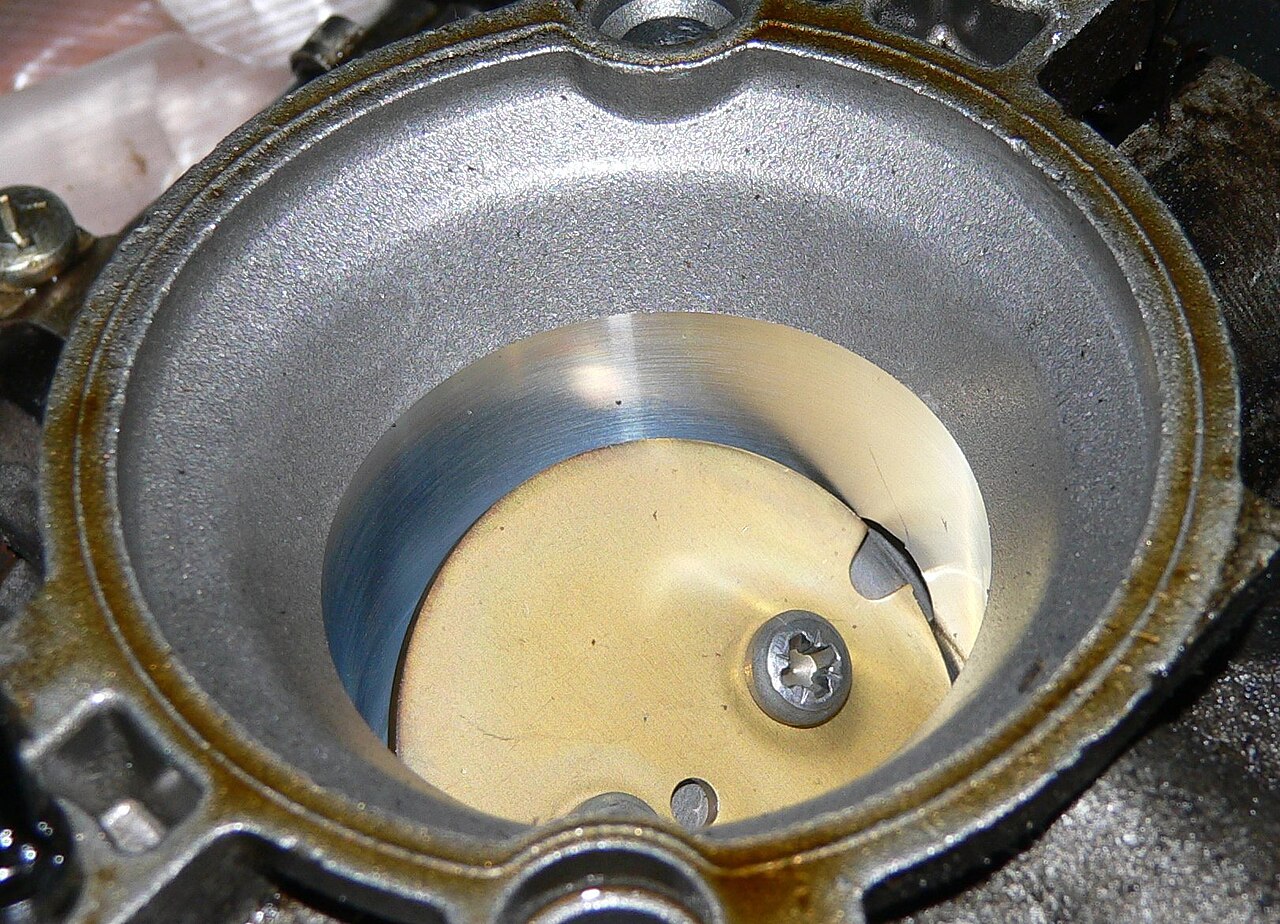
A butterfly plate in its bore. “Drosselklappe” by Florian Lindner, CC BY 2.5; resized. Actuation type is not established by the photograph.
A throttle body is not necessarily a carburettor or an injector. In throttle-body injection, fuel is injected at the throttle assembly; in port injection, injectors are in the intake runners; direct injection delivers fuel to the cylinder. A carburettor contains fuel-metering circuits as well as an air valve. Holley's fuel-injection terminology describes these layouts.
Valve shapes
TypeHow it opensWhere it is encountered and what to consider
ButterflyA disc rotates on a shaft across the bore.Common in road-car and motorsport throttle bodies. The shaft and plate remain in the passage when open. Bore size, blade shape and linkage affect flow and progression at small openings.
Flat slide / guillotineA flat plate slides across the passage to uncover it.Used in some racing intake assemblies and flat-slide carburettors. A fully withdrawn slide can leave the passage clear; sealing, friction, sticking and progressive control need attention.
Round slideA cylindrical slide travels across the airflow passage; this is a translating slide, not a rotating barrel.Found in carburettors such as Mikuni's VM series. Some slide carburettors use a needle for fuel metering. A slide can be cable-controlled or, in a constant-velocity carburettor, moved by a pressure difference.
Barrel / rotaryA ported barrel rotates to align its opening with the intake passage.Used in some specialist performance intakes. Packaging, sealing, idle and part-throttle characteristics depend on the design. An air-throttle barrel is distinct from a mechanical fuel-injection barrel metering fuel.
Valve geometry and actuation are separate choices. A butterfly can be cable-operated or electrically driven; a slide can be part of a fuel-injected intake or a carburettor. Jenvey's comparison discusses butterflies, barrels and slides for performance engines, while Mikuni's catalogue identifies the VM round-slide carburettor and its slide and needle. Mikuni also describes a pressure-operated slide in its constant-velocity designs. Do not assume an unobstructed bore automatically makes more power: the complete intake, operating range and calibration determine the result.
Cable and electronic operation
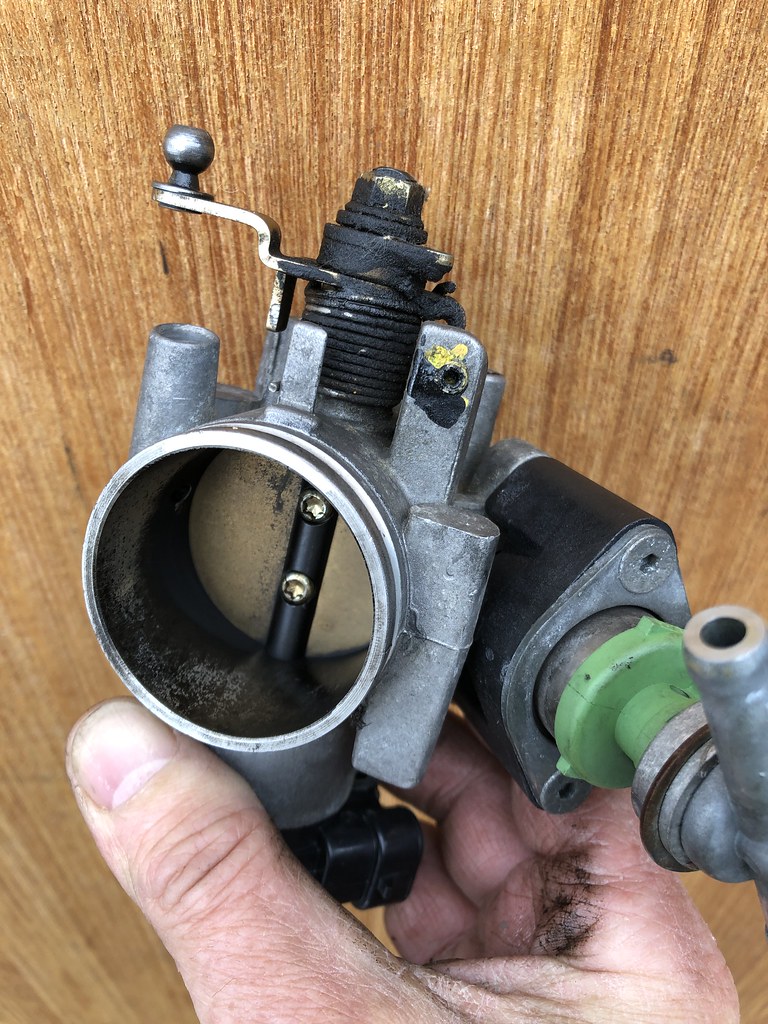
Throttle body with external linkage before cleaning. “Throttle body before cleaning” by Jan Hammershaug, CC BY 2.0; Flickr resized version.
With a mechanical linkage or cable, pedal or twist-grip movement acts on the throttle linkage, often with a return spring. A throttle position sensor can still report angle to the ECU, and an idle-air bypass or idle actuator may be fitted separately. The exact arrangement varies.
Electronic throttle photographed above a schematic of its DC motor, gearing, return spring and position sensor. The photograph shows the assembled body; the motor and sensor are enclosed. Figure 1 from Acho, Pujol-Vázquez and Gibergans-Báguena, “A Recent Electronic Control Circuit to a Throttle Device” (2020), CC BY 4.0; unmodified.
With drive-by-wire, the accelerator position is measured and the ECU commands an electric motor to move the throttle. Position feedback lets it check and control the plate; the ECU can respond to other torque requests too. See electronic throttle control for redundant sensors, motor control, PID, fault response and stop learning. A motorised idle actuator on a cable throttle is not by itself proof of full drive-by-wire control.
One throttle or individual throttles
A single throttle can feed a shared plenum and runners. Individual throttle bodies (ITBs) place separate valves in individual intake paths, usually linked so they open together; a multi-barrel assembly may have more than one valve in a common unit. Runner length, airbox, linkage synchronisation, idle air provision, sensor placement and the ECU's load strategy all matter. SBD Motorsport describes a four-cylinder kit using four individual butterfly bodies and tapered runners. An ITB conversion needs appropriate calibration and does not guarantee a gain on every engine.
ITBs, dual throttles and Ferrari variable intakes
An engine can have individual throttles inside or below an airbox and another common throttle upstream. Porsche documents this on the 2022 911 GT3: six individual throttles control the cylinders and a central valve remains open in normal operation as a backup. Exact placement relative to trumpet mouths is not specified in that source.
Ferrari layouts differ. The 360 workshop manual describes two bank throttles, short and long intake paths with electro-pneumatic control valves, and a separate butterfly between the chambers. Those runner-selection valves are not evidence of another set of driver-controlled ITBs. The ITB and dual-throttle guide compares this with the F355 and explains how to trace the air path. Velocity stacks and intake runner tuning covers the mouths and their lengths.
BMW Valvetronic: controlling load at the intake valves
BMW Valvetronic changes intake-valve lift using an adjustable mechanism with an eccentric shaft. In normal operation, varying valve lift controls cylinder filling, greatly reducing reliance on the throttle butterfly for load control. This can reduce the pumping losses associated with a heavily throttled intake at part load. Valvetronic varies valve lift; BMW VANOS varies camshaft timing, and the systems can work together.
“Throttle-free” load control does not necessarily mean there is no throttle body. BMW's N62 training material (independent mirror) describes an electronic throttle with a motor and two potentiometers. In that engine it has roles including some starting conditions, providing a small intake vacuum for crankcase ventilation and tank ventilation, and backup conventional load control if Valvetronic fails. These are N62-specific examples: the detailed throttle strategy differs by engine and operating condition. See also BMW N62 engines and BMW petrol engine management.
Selection and checks
Size and progression: a larger bore may reduce restriction at high flow but can make small openings harder to meter smoothly. Jenvey describes that trade-off for road applications. Match the complete intake to the engine, use and ECU.Compatibility: check mounting, bore, linkage, travel, springs, sensors, motor driver, injector layout, airflow model and ECU calibration. Similar-looking bodies are not necessarily interchangeable.Condition: inspect the bore, deposits, air leaks, linkage, return spring and sensor readings using the vehicle's procedure. For multiple throttles check synchronisation where specified. Do not change factory stop settings without the applicable instructions.Electronic systems: verify supply, both position signals and fault status; perform the specified calibration or adaptation after applicable work. Keep clear of the plate: it can move when commanded without pedal input.
Related topics: airflow metering, electronic throttle control and ME7.1 M-box throttle, airflow and fallback.
Rendered revisions
Open each version to inspect formatting, tables and photographs.
Revision 3: Throttle body
What a throttle body does
A throttle body contains an air valve in the intake. By changing the opening it changes the restriction to airflow and helps control cylinder filling and torque. On a conventional spark-ignition engine the throttle is a principal means of load control, especially at part load; the ECU also coordinates fuel and ignition. Intake pressure, engine speed, valve timing, boost and the rest of the intake affect the actual airflow, so 50% throttle angle does not mean 50% airflow or torque. Some engines control normal load primarily through intake-valve lift instead, as in the Valvetronic example below.
A butterfly plate in its bore. “Drosselklappe” by Florian Lindner, CC BY 2.5; resized. Actuation type is not established by the photograph.
A throttle body is not necessarily a carburettor or an injector. In throttle-body injection, fuel is injected at the throttle assembly; in port injection, injectors are in the intake runners; direct injection delivers fuel to the cylinder. A carburettor contains fuel-metering circuits as well as an air valve. Holley's fuel-injection terminology describes these layouts.
Valve shapes
Type
How it opens
Where it is encountered and what to consider
Butterfly
A disc rotates on a shaft across the bore.
Common in road-car and motorsport throttle bodies. The shaft and plate remain in the passage when open. Bore size, blade shape and linkage affect flow and progression at small openings.
Flat slide / guillotine
A flat plate slides across the passage to uncover it.
Used in some racing intake assemblies and flat-slide carburettors. A fully withdrawn slide can leave the passage clear; sealing, friction, sticking and progressive control need attention.
Round slide
A cylindrical slide travels across the airflow passage; this is a translating slide, not a rotating barrel.
Found in carburettors such as Mikuni's VM series. Some slide carburettors use a needle for fuel metering. A slide can be cable-controlled or, in a constant-velocity carburettor, moved by a pressure difference.
Barrel / rotary
A ported barrel rotates to align its opening with the intake passage.
Used in some specialist performance intakes. Packaging, sealing, idle and part-throttle characteristics depend on the design. An air-throttle barrel is distinct from a mechanical fuel-injection barrel metering fuel.
Valve geometry and actuation are separate choices. A butterfly can be cable-operated or electrically driven; a slide can be part of a fuel-injected intake or a carburettor. Jenvey's comparison discusses butterflies, barrels and slides for performance engines, while Mikuni's catalogue identifies the VM round-slide carburettor and its slide and needle. Mikuni also describes a pressure-operated slide in its constant-velocity designs. Do not assume an unobstructed bore automatically makes more power: the complete intake, operating range and calibration determine the result.
With a mechanical linkage or cable, pedal or twist-grip movement acts on the throttle linkage, often with a return spring. A throttle position sensor can still report angle to the ECU, and an idle-air bypass or idle actuator may be fitted separately. The exact arrangement varies.
With drive-by-wire, the accelerator position is measured and the ECU commands an electric motor to move the throttle. Position feedback lets it check and control the plate; the ECU can respond to other torque requests too. See electronic throttle control for redundant sensors, motor control, PID, fault response and stop learning. A motorised idle actuator on a cable throttle is not by itself proof of full drive-by-wire control.
One throttle or individual throttles
A single throttle can feed a shared plenum and runners. Individual throttle bodies (ITBs) place separate valves in individual intake paths, usually linked so they open together; a multi-barrel assembly may have more than one valve in a common unit. Runner length, airbox, linkage synchronisation, idle air provision, sensor placement and the ECU's load strategy all matter. SBD Motorsport describes a four-cylinder kit using four individual butterfly bodies and tapered runners. An ITB conversion needs appropriate calibration and does not guarantee a gain on every engine.
ITBs, dual throttles and Ferrari variable intakes
An engine can have individual throttles inside or below an airbox and another common throttle upstream. Porsche documents this on the 2022 911 GT3: six individual throttles control the cylinders and a central valve remains open in normal operation as a backup. Exact placement relative to trumpet mouths is not specified in that source.
Ferrari layouts differ. The 360 workshop manual describes two bank throttles, short and long intake paths with electro-pneumatic control valves, and a separate butterfly between the chambers. Those runner-selection valves are not evidence of another set of driver-controlled ITBs. The ITB and dual-throttle guide compares this with the F355 and explains how to trace the air path. Velocity stacks and intake runner tuning covers the mouths and their lengths.
BMW Valvetronic: controlling load at the intake valves
BMW Valvetronic changes intake-valve lift using an adjustable mechanism with an eccentric shaft. In normal operation, varying valve lift controls cylinder filling, greatly reducing reliance on the throttle butterfly for load control. This can reduce the pumping losses associated with a heavily throttled intake at part load. Valvetronic varies valve lift; BMW VANOS varies camshaft timing, and the systems can work together.
“Throttle-free” load control does not necessarily mean there is no throttle body. BMW's N62 training material (independent mirror) describes an electronic throttle with a motor and two potentiometers. In that engine it has roles including some starting conditions, providing a small intake vacuum for crankcase ventilation and tank ventilation, and backup conventional load control if Valvetronic fails. These are N62-specific examples: the detailed throttle strategy differs by engine and operating condition. See also BMW N62 engines and BMW petrol engine management.
Selection and checks
Size and progression: a larger bore may reduce restriction at high flow but can make small openings harder to meter smoothly. Jenvey describes that trade-off for road applications. Match the complete intake to the engine, use and ECU.
Compatibility: check mounting, bore, linkage, travel, springs, sensors, motor driver, injector layout, airflow model and ECU calibration. Similar-looking bodies are not necessarily interchangeable.
Condition: inspect the bore, deposits, air leaks, linkage, return spring and sensor readings using the vehicle's procedure. For multiple throttles check synchronisation where specified. Do not change factory stop settings without the applicable instructions.
Electronic systems: verify supply, both position signals and fault status; perform the specified calibration or adaptation after applicable work. Keep clear of the plate: it can move when commanded without pedal input.