Performance Trends supplies dynamometer data-acquisition hardware, Dyno DataMite software and separately configured brake-control equipment. Its systems can instrument engine and chassis dynos, including inertia and absorbed-load installations. The manufacturer states that it has produced racing computer tools since 1986; this does not establish the launch date of a particular DataMite. Performance Trends product information.
DataMite hardware and software
The manufacturer describes three logger sizes: DataMite 4 with up to 40 channels, DataMite III USB with up to 20, and DataMite Mini USB with up to seven. These are published maximum logger capacities, not a promise that any quoted kit includes every sensor or channel type. Depending on the configuration, measurement can include roller or shaft speed, torque, temperature, pressure, fuel flow, air/fuel ratio and weather. The Dyno DataMite page describes Basic, Pro and Enterprise software editions, live gauges, graphs, saved runs and comparison. Check the hardware, edition and options together.
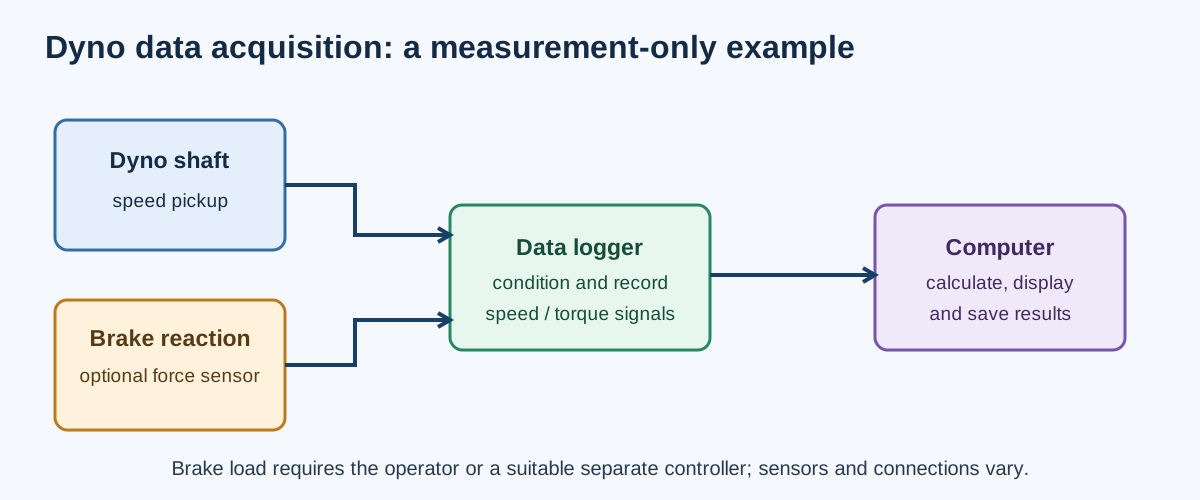
For an inertia dyno the software uses measured speed and the configured rotating inertia. On an absorber dyno a calibrated reaction/load-cell or compatible torque signal is needed. A calculated corrected or estimated crankshaft value is not direct crank measurement; the input data and calculation method matter. See measurement and interpreting results.
Separate brake controls
A DataMite logger is not by itself proof of an automatic brake controller. Performance Trends sells separately configured dyno controllers. Its eddy-current system describes RPM-feedback control or manual coil-current demand with a suitable power box. Its water-brake or hydraulic-pump controller uses valve-position feedback, not closed-loop RPM hold, according to the supplier's description. These are distinct modes, with different actuators and feedback requirements.
The supplier identifies a water-brake stepper-motor arrangement DT4-WBCS and an optional SuperFlow actuator DT4-WBCSF4. Confirm the installed valve, actuator, power stage, sensors and software before assuming fit or automatic control. The eddy-current controller guide illustrates one setup; it is not a universal wiring diagram.

Compatible dynos and retrofit points
Performance Trends describes instrumentation of chassis examples including Dynojet and Clayton, and engine dynos including Stuska, Go Power, Land & Sea and SuperFlow. These are supplier-reported examples, not guarantees for every model, sensor or brake. Document the dyno's speed pickup and pulse count, load-cell arrangement, brake power or valve, calibration and software options before choosing a kit. Supplier retrofit information.
The manufacturer's equipment photographs illustrate available logger and sensor packages. For other suppliers and the distinction between data logging and closed-loop control, see dynamometer control systems and factory and aftermarket controller comparison.