Carburettors (often called carbs) can be classified in four independent ways: how they meter fuel relative to airflow, which direction air enters the throttle bore, how many barrels and stages they use, and whether they run naturally aspirated or under boost. Identifying the architecture first prevents misapplying jetting rules from one design to another.
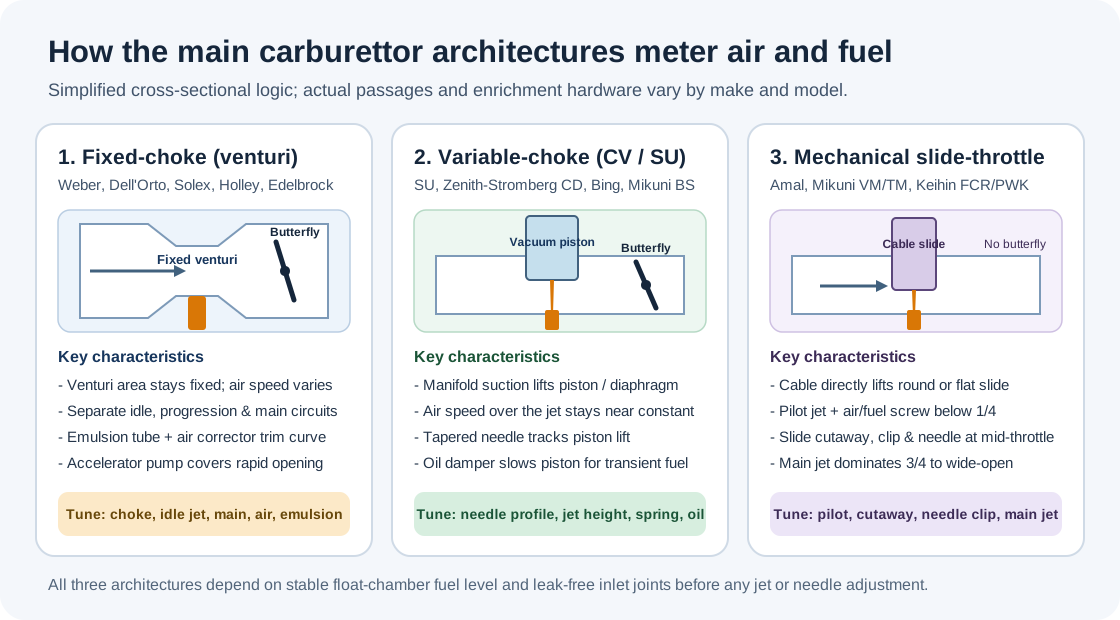
1. By metering principle (main & specialist architectures)
| Architecture | How airflow & fuel are matched | Typical makes & families | Key tuning parts |
|---|---|---|---|
| Fixed-choke (fixed venturi) | A fixed venturi accelerates the air to create a pressure drop that draws fuel from jets. Separate circuits handle idle, progression, main flow, power enrichment and acceleration. | Weber (DCOE, IDF, IDA, DGV), Dell'Orto (DHLA, DRLA), Solex, Holley (4150, 4160, 2300), Rochester Quadrajet, Carter/Edelbrock AFB & AVS2 | Venturi/choke diameter, idle/slow jet, main jet, air corrector, emulsion tube, power valve or metering rods, pump shooter/cam |
| Variable-choke (constant depression / CV) | Manifold suction downstream of a butterfly lifts a vacuum piston (SU) or rubber diaphragm slide (Stromberg, motorcycle CV) to keep air speed over the single main jet roughly constant. | SU (H, HD, HS, HIF), Zenith-Stromberg CD, Bing Type 64/94, Mikuni BS/BST, Keihin CV/CVK | Tapered metering needle, jet height/seat, piston return spring, damper oil viscosity, idle mixture |
| Sliding-valve variable venturi (VV) | Movable venturi valves above conventional twin butterfly throttles slide horizontally with airflow and vacuum while pulling attached tapered metering rods; uses a cranking enrichment circuit rather than a choke flap. | Ford / Motorcraft 2700 & 7200 VV (1977–1980s Ford/Lincoln/Mercury) | Tapered metering rods, venturi-valve diaphragms, cranking enrichment solenoid, idle mixture & feedback controls |
| Mechanical slide-throttle (jet & needle) | A cable pulls a round or flat slide directly in the bore without a separate butterfly. Slide height sets venturi area while a tapered needle in a needle jet meters mid-range fuel. | Amal Monobloc & Concentric, Mikuni VM & TM/HSR, Keihin PWK & FCR, Dell'Orto PHBH/VHSB | Pilot jet, air/fuel screw, slide cutaway, needle taper & clip position, needle jet/atomiser, main jet |
| Flat-slide metering-rod (jetless) | Replaces pilot, intermediate and main jets with a single precision-ground tapered metering rod (flat engine side, round intake side) riding in the fuel pickup bore; air-density differential compensates across altitude. | Lectron (metering rod + power jet / PRO 3-circuit), SmartCarb SC2 (internally vented sealed bowl, external clicker) | Metering rod profile & height, idle set screw, optional power jet (Lectron) |
| Swinging-arm / hollow-spindle (jetless) | Uses neither a venturi choke tube nor removable brass jets: a swinging arm on the hollow throttle spindle tracks a tapered groove in the float bowl and sprays fuel out of cross-holes in the spindle itself. | Fish, Minnow Fish, Reece Fish (historic aftermarket & Imp/Mini/stock-car racing) | Tapered main adjustment screw into throttle spindle, butterfly angle on spindle, swinging-arm groove |
| Electronic / feedback carburettor | Retains venturi metering with a solenoid-controlled air bleed or metering rod driven by an early ECU and narrowband oxygen sensor to hold lambda near 1 for a three-way catalyst. | Pierburg 2EE Ecotronic, Rochester E4ME / E4MC, Motorcraft/Weber feedback units | Mixture-control solenoid dwell, TPS/vacuum switches, coolant sensors, base mechanical float & idle stops |
| Diaphragm pumper carburettor | Uses crankcase or intake pressure pulses acting on a flexible pumping diaphragm and metering diaphragm instead of a gravity float bowl, allowing operation inverted or at any tilt angle. | Walbro, Tillotson, Zama (chainsaws, karts, handheld and marine two-strokes) | Low-speed (L) and high-speed (H) needle screws, metering lever height, pop-off pressure, diaphragm condition |
| Floatless pressure / injection carburettor | Eliminates the gravity float bowl; fuel is held under pump pressure by servo diaphragm/poppet regulators and sprayed downstream of the throttle or at the supercharger eye while the venturi measures airflow only—immune to negative-G starvation. | Bendix-Stromberg PS / PD / PT / PR (WWII & radial/inline aircraft engines, e.g. Allison V-1710) | Air-metering venturi, pressure-regulator diaphragms, automatic mixture-control bellows, economiser valve |
| Gaseous / LPG & CNG air-valve mixer | A vacuum-lifted air-valve diaphragm meters vaporised propane (LPG) or compressed natural gas proportionally to airflow with no liquid float bowl or brass fuel jets. | IMPCO (CA125, CA300, CA425), Bendix-Zenith gaseous mixers | Air-gas valve profile/spring, power mixture screw, idle air/fuel adjustment, converter/vaporiser outlet pressure |
| Compound-jet / compensating-jet (historic) | Combines a standard venturi main jet (which richens as airflow rises) with a gravity-fed compensating jet (whose constant flow per second leans out as airflow rises) so both curves balance out. | Early 20th-century Zenith (Baverey compound-jet principle) | Main jet, compensating jet, slow-running jet |
| Surface & wick carburettor (veteran era) | 1890s evaporative design that draws intake air over heated liquid petrol or fuel-soaked wicks to pick up vapour before spray-jet float carburettors replaced it. | Early Benz, De Dion-Bouton, 1898 Fisson | Air/vapour mixing slide valve, fuel heating |
The 1958 SU workshop manual explains the constant-depression principle directly: keeping air velocity over the jet nearly constant lets the carburettor atomise fuel cleanly at small openings without strangling peak airflow, which is why SU designs omit a separate fixed-choke idle jet and accelerator pump (relying instead on a damped piston whose brief lag enriches rapid throttle openings). In contrast, fixed-choke designs such as the Weber DCOE require dedicated progression drillings, emulsion tubes and a mechanical pump because venturi depression collapses at low air speed.
2. By airflow orientation
- Downdraft: air enters from above and flows vertically downwards into the manifold. Very common on road cars (Weber DGV/IDF, Solex PICT, Holley/Rochester four-barrels) because gravity assists atomised droplets into the plenum and bonnet clearance is easier on V-engines and upright inline engines.
- Sidedraft (horizontal): air flows horizontally through the carburettor straight into the cylinder-head port. Favoured for multi-carburettor individual-runner performance setups (Weber DCOE, Dell'Orto DHLA, twin SU HS/HIF) because it provides a straight, short inlet path with minimal bends, at the cost of requiring clean float-chamber mounting geometry and careful throttle-linkage synchronisation.
- Semi-downdraft: tilted slightly downwards (for example 20° to 40° on certain SU HS and HIF installations) to clear inner wings or bonnet lines while preserving the straighter flow of a sidedraft.
- Updraft: air enters from below and rises into the manifold. Historically common on pre-war cars, stationary engines and tractors where gravity-fed fuel tanks sat above the carburettor and excess liquid fuel drained safely away from the cylinders; rare on post-war performance cars.
3. By barrel count and secondary staging
- Single-barrel (1V): one venturi and throttle feeding either a shared manifold plenum (Solex 34 PICT, single SU) or a single cylinder (motorcycle slide/CV carbs).
- Synchronous twin-choke (2V): both throttles sit on a common shaft and open identically together (Weber DCOE, IDF, IDA; Dell'Orto DHLA, DRLA). In a typical four-cylinder dual-carburettor setup, four chokes feed four individual runners (one choke per cylinder) so each cylinder has its own intake pulse and metering circuit.
- Progressive two-barrel (2V): a smaller primary barrel handles idle, light load and part-throttle cruising with strong air speed, and a larger secondary barrel opens mechanically or by vacuum above roughly half to two-thirds primary throttle (Weber DGV/DGAV, Pierburg 2E2/2E3, Aisan/Hitachi OEM units).
- Three-barrel (3V): exists in two completely different forms: (1) Honda's stratified-charge Keihin CVCC 3-barrel (two main barrels feeding the main cylinder intake plus a small third auxiliary barrel feeding a rich mixture to the pre-chamber torch-ignition valve on 1970s–1980s Civic/Accord CVCC engines), and (2) the late-1960s Holley 3160 (`950` and `1,050 CFM`), which paired two primary barrels with one huge undivided oval vacuum-operated secondary butterfly across a standard 4-barrel flange (Hagerty Holley 3160 review).
- Four-barrel (4V) square-bore vs spread-bore: square-bore carbs (such as the Holley 4150/4160 and Edelbrock Performer/AVS2) use four similar-sized throttle bores; spread-bore carbs (such as the Rochester Quadrajet and Carter Thermoquad) pair small primary bores for crisp low-speed signal and economy with very large secondary bores for top-end flow.
- Multi-carburettor staged racks ("Tri-Power" / "Six Pack" / "Dual Quad"): factory and hot-rod manifolds pairing three two-barrels (such as `3×Holley 2300` on Chrysler 340/440 Six Pack or `3×Holley 1904/1908` inline-six kits, where the centre carb runs idle/cruise and outer carbs open progressively) or two four-barrels (Chrysler Street Hemi `2×Carter AFB`).
- Vacuum vs mechanical secondaries: on four-barrels, vacuum secondaries sense primary venturi airflow through a diaphragm so the secondary throttles only open as far and as fast as the engine can actually ingest air—avoiding the bog caused by opening too much area too early on heavy vehicles or automatic transmissions. Mechanical ("double-pumper") secondaries open directly via linkage and include a second accelerator pump to cover the sudden pressure drop when all four bores open together. See Holley 4160 installation instructions and Holley secondary diaphragm spring tuning.
4. Forced-induction layouts: draw-through vs blow-through
Combining a carburettor with a turbocharger or supercharger changes the pressure reference around the float chamber:
- Draw-through: the carburettor sits upstream of the compressor, so the carburettor itself always sees atmospheric pressure at its inlet and vacuum below the throttle. Traditional Roots-type superchargers and early carburetted turbos used draw-through layouts, which must be paired with a turbocharger carbon-face compressor seal capable of withstanding high throttle-closed manifold vacuum without drawing oil into the intake, and cannot normally run an intercooler downstream of the compressor because wet fuel mixture would puddle in the core.
- Blow-through: the carburettor sits downstream of the compressor (and any intercooler), so boost pressure fills the carburettor throat. If the float bowl remained vented only to atmosphere, boost pressure would push fuel back down the jets and starve the engine immediately. A blow-through conversion therefore requires: (1) referencing the float-bowl vents and fuel-pressure regulator 1:1 to bonnet/hat boost pressure so differential fuel pressure stays constant; (2) solid or nitrophyl floats that will not collapse under boost pressure; (3) sealed throttle shafts and gaskets; and (4) a boost-referenced power valve or enrichment circuit, because normal manifold vacuum stays low or positive under boost (Holley/Weiand supercharger carburetion reference).
Related pages
- Carburettors (section overview)
- Carburettor makes and model families
- SU carburettors: types, sizing and models
- Carburettor fuel circuits and metering
- Carburettor tuning, jetting and setup
- Forced induction
Sources
- The SU Carburetter and Fuel Pump Workshop Manual. The SU Carburetter Company, 1958. Constant-depression operation and piston damping.
- Burlen Ltd: SU Carburetter Design Features. HS and HIF mounting angles and technical features.
- Weber Carburettors DCOE Manual. Sidedraft fixed-choke operation, progression, emulsion tubes and pump circuits.
- Holley Model 4160 Installation and Adjustment Instructions (199R8108-3), Secondary Diaphragm Spring Kit (20-13), and Holley / Weiand Supercharger Technical Information.
- Ford Motorcraft 2700 / 7200 Variable Venturi Carburetor Technical Overview and Rochester Quadrajet Service Manual (9D-5).
- Lectron Fuel Systems: Metering Rod Technology and SmartCarb vs Lectron Design Comparison.
- Reece Fish Swinging-Arm Carburettor Notes and Hagerty: Holley 3160 Three-Barrel Carburetor.
- Bendix-Stromberg Pressure Carburetor (PS/PD/PT/PR), Allison V-1710 PD12-B notes, and Motor Sport (Dec 1931): Surface, Wick and Zenith Compensating-Jet Carburettors.