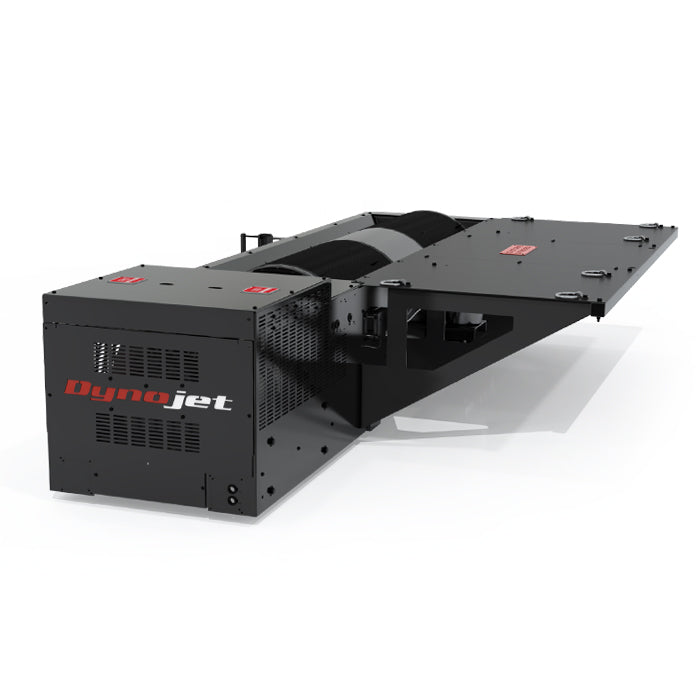
An inertia dynamometer measures the rate at which a test engine or vehicle accelerates a rotating mass of known moment of inertia. The rotating drum or flywheel stores kinetic energy. Unlike an adjustable brake on its own, an inertia is a load whose torque depends on how quickly its speed changes. A dynamometer may combine an inertia drum with an adjustable absorber; the two contributions must both be considered.

The physics
For a known constant rotational inertia J, angular acceleration α produces net accelerating torque T = Jα. The stored kinetic energy is E = ½Jω² and the rate of increase is P = Jαω, with J in kg·m², ω in rad/s, α in rad/s², T in N·m and power in watts. A speed sensor records drum rotation over time and the system derives angular acceleration. The Dynojet WinPEP theory of operation explains the use of drum speed and acceleration in an inertia dyno.
For example, if the effective test inertia is 10 kg·m², its speed is 100 rad/s and its angular acceleration is 20 rad/s², its net accelerating torque is 200 N·m and the rate of energy storage is 20 kW. This ideal example excludes friction, added brake load and any inertia not included in J.
From roller acceleration to vehicle output
The measured acceleration gives torque accelerating the dyno inertia, not automatically all torque produced by the engine. Friction, windage, tyre/roller losses and any applied brake consume torque. Engine, drivetrain, wheel and coupling inertias also accelerate during a sweep, and their effect at the measurement point depends on gearing and slip. The calculation and any loss or inertia corrections must match the machine and measurement boundary. Engine rpm requires a separate pickup or a justified relationship to roller speed. SAE 2017-36-0212 discusses experimental determination of chassis-dyno inertia and losses.
Sweep rate and steady state
A pure inertia system generally performs an acceleration sweep: torque causes the drum to accelerate, with acceleration varying across the run. Under sustained positive input torque it cannot hold a chosen steady speed by inertia alone. An added controllable absorber can hold or shape the speed trajectory within its torque, power and thermal limits. Sweep rate matters because an engine's boost, temperature and control response may change with time, and because acceleration consumes energy in rotating parts. Smoothing acceleration data can also alter peaks.
Repeatability
Use the correct calibrated inertia and speed signal, repeat gear and run procedure, control vehicle and dyno temperatures, and check tyre condition and restraint on a roller machine. Record correction standard, sweep method and RPM source. Results from inertia-only, load-controlled and engine dynamometers can differ for legitimate reasons; their reported numbers should be compared with their measurement methods and conditions.
See also: Dynamometers overview · Rolling roads · Engine dynamometers · Hub dynamometers · On-car and portable systems · Inertia dynamometers.
Manufacturer example
Advanced Dyno Solutions describes a 2WD two-roller inertia chassis dyno with an SP1 electronics package. The listing is an example of an inertia-only configuration; confirm equipment and availability directly with the supplier.
Example manufacturer: Dynojet 224xLC combines an inertia-based roller system with an eddy-current load absorber, illustrating that the two methods can be used together.