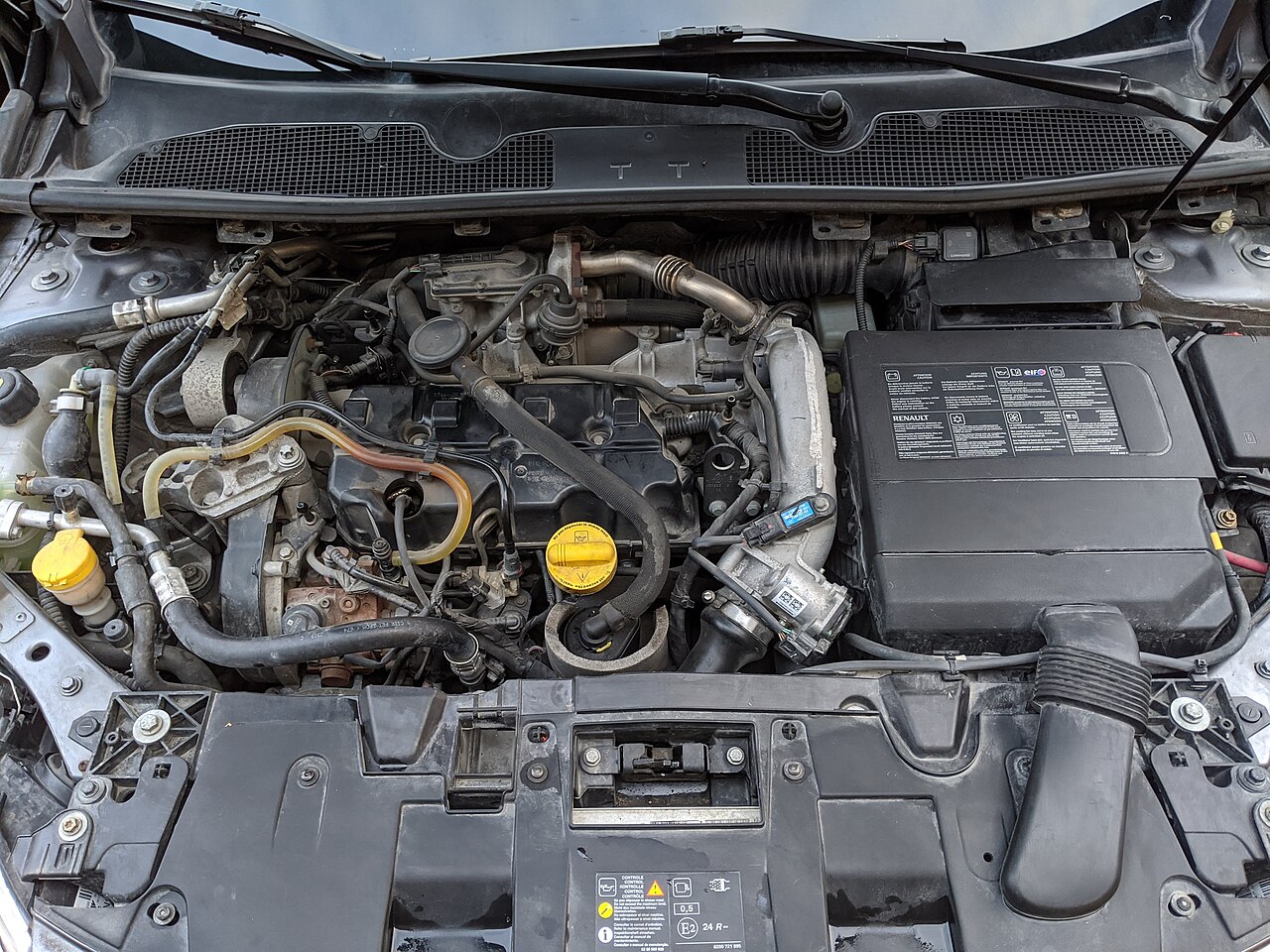

The Renault F9Q is the 1.9-litre direct-injection diesel of the F-Type family. It began as the mechanically injected 1.9 dTi in 1997 and became Renault's first common-rail dCi engine in July 1999. This guide covers the common-rail 1.9 dCi: identifying the engine and controller, health checks before calibration, the calibration areas involved and how to validate the result. It does not give map addresses or values, which depend on the exact ECU software.
Engine identification
The F9Q displaces 1,870 cc with an 80 mm bore and 93 mm stroke. It is an eight-valve, single-overhead-camshaft engine with swirl-generating intake ports. The same code covers the earlier pump-injected dTi and the common-rail dCi, so the injection system has to be checked before anything else. Renault F-Type engine, Wikipedia.
The F9 family was fitted well beyond Renault's own range:
| Maker | Vehicles listed |
|---|---|
| Renault | Mégane, Scénic I to III, Laguna I and II, Clio, Espace, Master, Trafic II |
| Nissan | Primera P12, Primastar, Interstar |
| Vauxhall and Opel | Vivaro |
| Volvo | S40 and V40 |
| Mitsubishi | Carisma and Space Star |
| Suzuki | Vitara |
The source's own vehicle tables and history text disagree in places, and it does not split these by dTi and dCi. Read the full engine code from the engine plate (for example F9Q 758 or F9Q 804) and confirm the injection system on the vehicle.
ECU identification
- Bosch EDC16C3. The Mégane II 1.9 dCi with F9Q 800, 803 and 804 engines is listed with Bosch EDC16C3-10.22, part 0281011275. See Bosch EDC16C3 10.22, which includes a photograph of the label. Tuning vendors also list EDC16C3 on the Laguna II 1.9 dCi. Other EDC16C3 suffixes may exist on other F9Q applications; the suffix is read from the label.
- Bosch EDC15. Earlier 1.9 dCi cars from around 2002 are reported with Bosch EDC15C3 controllers. This rests on owner reports rather than Renault or Bosch documentation. Unverified: confirm on the ECU label.
The F9Q was also used by Nissan, Vauxhall, Opel, Volvo, Mitsubishi and Suzuki, whose controllers and software may differ from Renault's. Read the Bosch part number and software identification with the diagnostic tool before choosing a file, definition or tool protocol. An EDC15 file does not transfer to an EDC16 controller, and one EDC16C3 suffix does not establish compatibility with another.
Health checks before tuning
- Injection system. Confirm the car is a common-rail dCi and not a pump-injected dTi. Check injector condition and any stored injector correction values before judging fuelling.
- Air and boost. Check for boost leaks, turbocharger actuator faults and EGR problems, and confirm air-mass readings against expected values.
- Fault memory. Read and understand all stored faults first. A calibration change is not a fix for an existing fault.
- Driveline. More torque loads the clutch, dual-mass flywheel where fitted, and gearbox. Check them before increasing torque.
Calibration areas
EDC15 and EDC16 calibrate the engine through injected quantity and torque requests, with limiters that must change together. See EDC15 fuel control and tuning basics and EDC16 torque fuel and tuning basics. The main areas are:
- Driver demand and torque limits, including any gearbox protection.
- Torque-to-fuel conversion and smoke limits, which tie the injected quantity to measured air mass.
- Boost control, including the boost target and its limits. Stay within the turbocharger's operating range.
- Rail pressure and injection timing, which affect combustion pressure, noise and exhaust temperature.
- Protection strategies, which should remain active.
Map names and structure differ between EDC15 and EDC16 and between software versions. Work from a definition matched to the exact software identification; see Choosing ECU definition files.
Reading, writing and validation
Tool support depends on the controller and software. Check the current documentation of the tool for the exact ECU, keep a verified copy of the original read, and support the battery voltage while programming. Renault's factory diagnostic application is described in Renault CLIP and Alliance Diagnostic Tool.
- Log requested and actual boost, air mass, injected quantity and rail pressure before and after the change, under the same conditions.
- Check for smoke, high exhaust temperature, clutch slip and any new faults.
Emissions and legal limits
Disabling or removing EGR or other emissions equipment on a road vehicle can be unlawful and can fail inspection. Calibrate with all emissions equipment working. See Emissions cheating, defeat devices and enforcement cases.
Related pages
- Renault K9K 1.5 dCi tuning guide
- Bosch EDC16C3 10.22
- Bosch EDC15
- Renault G9T 2.2 dCi tuning guide
- Renault G9U 2.5 dCi tuning guide
Sources
- Wikipedia, Renault F-Type engine: dimensions, injection history and vehicle applications. Accessed 19 November 2026. Secondary source with internal inconsistencies.
- DIPA Sport, EDC16C3-10.22 Renault Mégane 1.9 dCi, as cited on Bosch EDC16C3 10.22.
- Chiptuning vendor listing, Renault Laguna II 1.9 dCi. Tool coverage, not a build record.
- Owner reports of EDC15C3 on 2002 Laguna II 1.9 dCi: Planète Renault discussion. Unofficial; not confirmed by Renault or Bosch documentation.