A motorcycle chassis dynamometer measures or estimates performance at a motorcycle’s driven tyre while the machine remains in a controlled test area. The tyre drives a roller of known inertia; many systems also have an eddy-current absorber for controlled load. Manufacturers also offer variations for scooters, electric two-wheelers, quads and karts. Capacity, restraints and software differ between models.
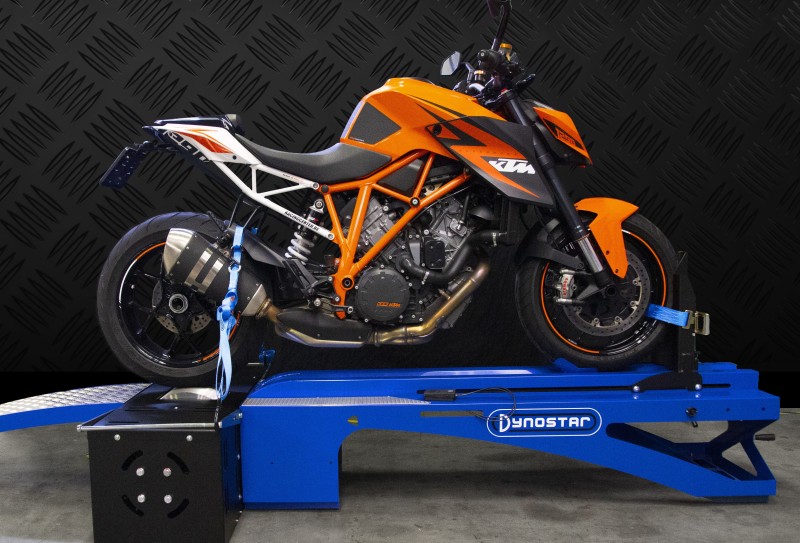
How it works
The motorcycle drives its rear tyre against the roller. A speed pickup measures roller speed, and the acquisition system records speed against time. On an inertia-only machine, software uses the roller's known moment of inertia and rate of acceleration to estimate net torque at the roller. The result depends on measured speed, the effective inertia, test conditions and the treatment of mechanical losses. Vehicle gearing and tyre contact affect the relationship between roller speed, engine rpm and tyre torque; a roller measurement is not a direct crankshaft measurement. See inertia dynamometers and interpreting results.

A loaded dyno combines the roller with a separately controlled absorber. On an eddy-current machine, the controller adjusts brake excitation to resist rotation; torque reaction is commonly measured by a load cell. Depending on the machine and software, this supports a speed hold, stepped test, controlled acceleration or simulated road resistance. Reaction torque alone in a fast sweep does not include all torque needed to accelerate the rotating parts. The controller's measurement and compensation method matters.
Representative models
| Manufacturer and model | Arrangement and published features | Check before comparing |
|---|---|---|
| Dynostar D50i / D50ECB | D50i is an inertia machine with supplementary inertia; D50ECB adds a 400 N·m eddy-current brake. Dynostar lists MiniDAS and Advanced Dyno Station software. | The current D50 page lists D50ECB 120 kW dynamic and 43 kW continuous static, illustrating why peak and continuous ratings differ. Confirm configuration and applicable version. |
| Dynostar D70 / D70Ti | High-inertia motorcycle roller with an air-cooled eddy-current brake. D70Ti has a three-piece drum for adjustable inertia. | Dynostar states up to 465 kW dynamically and up to 355 kW absorbed; check the actual brake duty curve and cooling requirements. |
| Dynostar 2C | Portable two-wheeler roller with an eddy-current brake for scooters, e-bikes and light motorcycles. | Published brake figures distinguish 62.8 kW cold from 14 kW continuous; the required speed and operating duration also matter. |
| Dynojet 250i | Motorcycle roller combining inertia testing and eddy-current load control. Dynojet also describes the 200i as its starting motorcycle platform and the 250i as adding an absorber. | Equipment and accessories depend on configuration; see the 250i installation guide and Dynojet profile. |
| Dyna Pro T62-LCC | Compact bike, kart and ATV roller with inertia plus eddy brake and Dyna Run V3. The published EU sheet includes a calibration arm and weight. | Sheet lists 600 hp dynamic versus 250 hp static. Confirm dimensions, vehicle fit, units and conditions with the maker; see Dyna Pro. |
These are manufacturer-stated examples, not a ranking or a promise of interchangeable specifications. Model pages can be revised, and different generations may differ. Cold, peak, dynamic and continuous ratings describe different limits: select for the intended torque, speed, test duration, cooling and vehicle type.
Installation, testing and safety
Secure the motorcycle using the equipment and vehicle manufacturer's designated wheel support and rated restraints. Provide a suitable fan and separate exhaust extraction, appropriate guards, emergency stop access and a clear operating area. Never assume the restraint arrangement shown in a product photograph applies to another machine. Confirm tyre condition and speed rating, alignment, gear, cooling, oil and coolant temperatures, and where applicable chain condition before a controlled test. Keep people clear of tyres, roller, chain and hot exhaust; follow the machine and site's operating and shutdown procedures. Dynojet's 250iP instructions show one model-specific motorcycle setup; consult test setup and safety.
For comparable before-and-after results, record fuel, correction standard, tyre and restraint setup, temperatures, gear, test mode and sweep rate. Electronic intervention, heat soak, tyre slip or different filtering can change results. Electric motorcycles can move silently and their systems can regenerate; use the vehicle-specific procedure and the dyno's permitted mode.
Related guides
Rolling-road chassis dynamometers · Eddy-current absorbers · Calibration and verification · Dynostar controllers
Dimsport also lists a combined inertia and brake motorcycle dyno in its DynoBike range; confirm the particular version and equipment with the supplier.