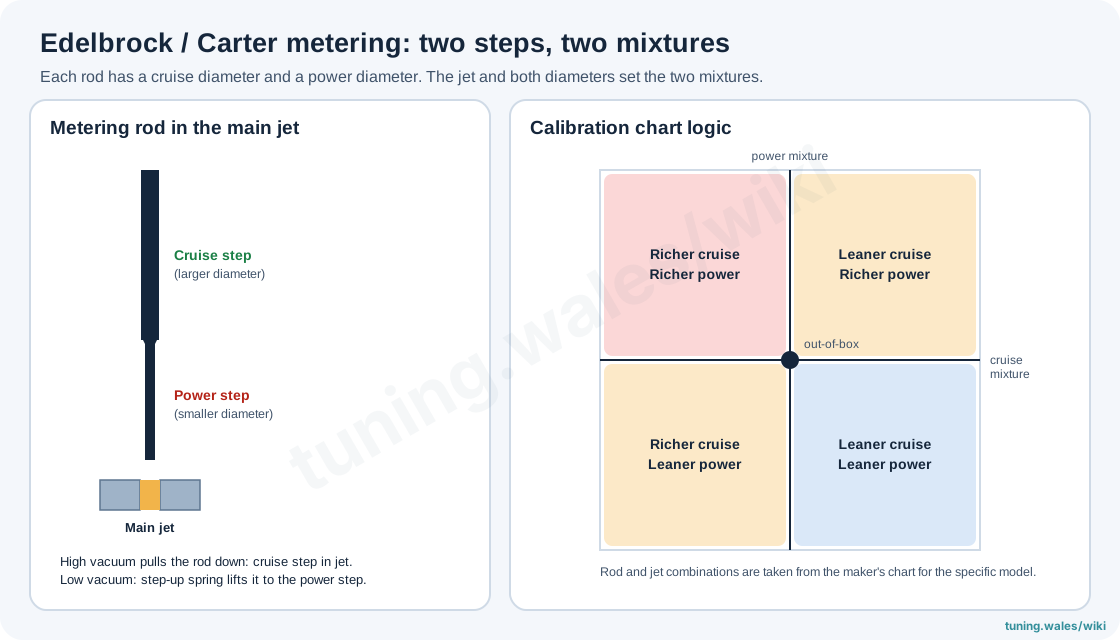
The Edelbrock Performer and Thunder Series AVS four-barrel carburettors are modern versions of the Carter AFB (Aluminum Four Barrel, 1957) and Carter AVS (Air Valve Secondary). Instead of a Holley-style power valve, they enrich the mixture with a vacuum-operated step-up piston that lifts a two-step metering rod in each primary jet. Each rod has a cruise diameter and a power diameter, so a rod change alters cruise and full-load mixture separately. Edelbrock publishes a calibration chart for each model that turns this into a grid of cruise and power stages. Rods and step-up springs can be changed from the top of the carburettor in a few minutes without draining the bowl.
History and identification
- Carter AFB: introduced in 1957 and original equipment on many US V8s until 1971, the dual quads on the 1971 426 Hemi being the last notable use. Its secondaries use a counterweighted velocity valve below the secondary venturi, which is not externally adjustable (specialist source, carbdoc).
- Carter AVS: adds a spring-loaded air-valve flap above the secondary venturi, adjustable from outside. Reported first use is the 1966 Chevrolet 327 (single source); it was used mainly on 1968–71 Chrysler products.
- Edelbrock Performer (1400-series): AFB-pattern, counterweighted secondaries. Carter sold its performance AFBs until 1998; the Edelbrock carburettors are reported to be built by Weber USA, and most jets and rods interchange with original Carters (specialist source; no Edelbrock statement found).
- Edelbrock Thunder Series AVS (1800-series) and AVS2 (1900-series): adjustable air-valve secondaries. The AVS2 adds annular boosters on the primaries.
| Model | CFM | Notes |
|---|---|---|
| 1403 / 1404 | 500 | 1403 electric choke (vendor) |
| 1405 / 1406 | 600 | 1405 manual choke, 1406 electric choke |
| 1407 | 750 | Manual choke |
| 1409 / 1410 | 600 / 750 | Marine, US Coast Guard certified |
| 1411 | 750 | |
| 1412 / 1413 | 800 | |
| 1400 | 600 | Electric choke and EGR; emissions-legal version for 1980-and-earlier GM V8s (vendor) |
| 1801/1802, 1803/1804, 1805/1806, 1825/1826, 1812/1813 | 500, 500 (dual-quad), 650, 650, 800 | Thunder Series AVS |
| 1905/1906, 1912/1913 | 650, 800 | AVS2 (vendor listings; EngineLabs gives the largest as 850) |
Specifications from the Edelbrock owner's manual and tuning guide unless marked. Manual-choke Thunder AVS units cannot be converted to electric choke.
How the metering works
- Primary main circuit: manifold vacuum under the step-up piston holds the rod down against the step-up spring, putting the larger "lean step" in the jet at cruise. When vacuum falls below the spring's rating, the spring lifts the piston and the smaller "rich step" sits in the jet. Rods are named by their two diameters, e.g.
.070 x .047. - Secondaries: the secondary throttles start to open at about 65 % primary opening and reach full throttle together with the primaries. The secondary jets feed both the main nozzle and an auxiliary nozzle below the air valve, which covers the moment the secondaries open.
- Accelerator pump: a piston pump with three link holes on the external lever.
- Jet numbers: Edelbrock jets carry a
120-prefix; the last three digits minus 300 give the orifice in thousandths (120-398 = 0.098 in, kit part 1427).
Step-up springs
| Colour | Blue | Yellow | Orange | Pink | Plain |
|---|---|---|---|---|---|
| Rods lift below (inHg) | 3 | 4 | 5 | 7 | 8 |
Most Performer models ship with orange (5 inHg); the 1406 uses yellow. The spring rating must stay below the engine's idle vacuum in neutral, and Edelbrock's baseline is about half of idle vacuum (14 inHg idle suggests the 7 inHg pink spring). Below about 7 inHg idle vacuum the rods may sit on the rich step at idle. Both manuals mention a stiffer "silver" spring for long-duration camshafts without giving its rating.
Factory calibrations (Performer)
| Model | Primary jet | Secondary jet | Rod | Spring |
|---|---|---|---|---|
| 1404 | .086 | .095 | .065 x .052 | orange |
| 1405 | .100 | .095 | .070 x .047 | orange |
| 1406 | .098 | .095 | .075 x .047 | yellow |
| 1407 | .113 | .107 | .071 x .047 | orange |
| 1409 | .098 | .101 | .068 x .047 | orange |
| 1410 | .113 | .107 | .071 x .047 | orange |
| 1411 | .110 | .107 | .075 x .047 | orange |
| 1412 / 1413 | .113 | .101 | .071 x .047 | orange |
All Performer models: needle and seat 0.0935 in, float level 7/16 in. The Thunder AVS 1806 uses a 0.095 primary jet, 0.068 x 0.047 rod and 0.098 secondary jet (Edelbrock tuning guide).
Using the calibration chart
Each model has a chart of cruise stage against power stage in 4 % steps, up to three stages (12 %) richer or leaner. The tuner picks the reference number nearest the wanted change and reads the jet and rod from the rod/jet reference chart. Edelbrock's worked example on a 1405: one stage leaner cruise and two stages leaner power is reference 21, a 0.098 jet (1427) with a 0.070 x 0.052 rod (1452). A separate ladder covers the secondary jets (for the 1405/1406: 0.086, 0.089, 0.092, 0.095 stock, 0.098, 0.101, 0.104). The calibration kits are numbered per model (for example 1479 for the 1405 and 1487 for the 1406).
- Full throttle: time full-throttle runs over the top half of the power band. Try the richest rod-only power change (about two stages, 8 %). If it is faster, richen the secondaries two stages and continue; if slower, go one stage leaner on primaries and secondaries. Of two settings that give equal power, keep the richer.
- Cruise: lean the cruise step until a surge appears, then go back one stage.
- Power mode at part throttle (below about 5 inHg): never run it lean because of detonation risk; any surge calls for at least one stage richer.
- Staging: a lean spot at mid throttle that clears with more throttle calls for a stronger (higher-rated) step-up spring.
- Altitude: about 2 % leaner per 1,500 ft (8 % at 6,000 ft).
Rods and springs are changed by loosening the step-up piston cover screws and swinging the plates aside; the screws take only 12–17 in-lb, and overtightened heads can snap and fall into the engine. Jets require the air horn off (eight screws, plus the choke and pump links). Mixture measurement is covered on air-fuel ratio and wideband lambda sensors.
Other settings
- Float: level 7/16 in, measured with the air horn inverted from gasket to float top. Float drop is given as 15/16–1 in in the procedure text; the specification tables differ (1-1/4 in in one manual, 1.00 in in the other), so the procedure text is preferred.
- Accelerator pump: for a stumble not cured by metering, move the link to a hole nearer the body for a longer stroke.
- Idle mixture: with the engine warm and the air cleaner fitted, turn each screw for peak rpm, then lean until speed drops by about 20 rpm.
- Fuel pressure: no more than 6.0 psi at idle, regulator set to 5.5 psi, and not below 2.0 psi at full throttle (owner's manual; a later section asks for 4–5 psi minimum at full throttle on high-output engines). See carburettor fuel supply.
- Thunder AVS air valve: factory setting is closed plus 1½ turns (1803/1804: one turn on dual quads). Hold the flat-blade screw, loosen the Torx lock; anticlockwise opens the valve later. Do not go more than one turn beyond the factory setting or 2½ turns from closed. AVS2 tension is preset.
Common faults
| Symptom | Usual cause and remedy |
|---|---|
| Hard hot restart, stalling after heat soak | Fuel boiling in the bowl. Route lines away from heat; fit an insulator: 9266 on dual-plane manifolds, 9265 on single-plane, 9267 for dual quads. |
| Flooding | Dirt in the needle and seat or a sticking float; fuel pressure above 6 psi (regulator 8190). The troubleshooting chart allows lowering the float to 1/2 in. |
| Hesitation | Rule out ignition and vacuum leaks, then pump stroke, metering and step-up spring, in that order. |
| Erratic idle settings | Volatile winter fuel in a warm garage; set idle outdoors after a drive. Fuels above 10 % ethanol need richer metering. |
Compared with the Holley
A Holley 4150/4160 uses fixed jets and a power valve inside the metering block, and changes require removing the bowl. The Edelbrock has no power valve: enrichment comes from the rod, piston and spring, which change from the top. Because one jet serves both rod steps, Edelbrock cruise and power changes are linked through the jet, which is why the calibration chart lists jet and rod together.
Not established
- The launch year of the Edelbrock Performer and the formal Carter–Weber–Edelbrock manufacturing history.
- The rating of the "silver" step-up spring and the official AVS2 calibration charts.
Related pages
- Carburettor fuel circuits and metering (power enrichment diagram)
- Carburettor tuning, jetting and setup
- Rochester Quadrajet
- Carburettor-replacement EFI systems
Sources
- Edelbrock, Performer Series Carburetor Owner's Manual #1403–1413, revisions 8/94–12/01 (archive copy). Accessed 2026-11-19.
- Edelbrock, Performer Series / Thunder Series AVS Tuning Guide, undated (retailer-hosted). Accessed 2026-11-19.
- Edelbrock, Thunder Series AVS Installation Instructions, rev. 6/10. Accessed 2026-11-19.
- Carbdoc, Carter AFB Tech and Carter AVS Tech, undated. Accessed 2026-11-19.
- J. Smith, Inside Edelbrock's AVS2 Carburetors, EngineLabs, 25 Feb 2020. Accessed 2026-11-19.
- JEGS, Holley vs Edelbrock Carburetors, undated. Accessed 2026-11-19.