A carburettor meters fuel from a float bowl kept full by a needle valve, so it needs a steady supply at a low pressure that the needle valve can shut off. Too much pressure forces the needle off its seat and floods the engine or raises the effective float level; too little, or fuel that boils in the line, starves the bowl at high load or after a hot stop. The pressure required varies by carburettor family by a factor of about four: SU, Zenith-Stromberg and Weber needle valves want roughly 1.5–3.5 psi, while Holley and Edelbrock four-barrels run at 5–7.5 psi. An electric pump intended for fuel injection (about 3 bar, 43 psi) must never feed a carburettor directly.
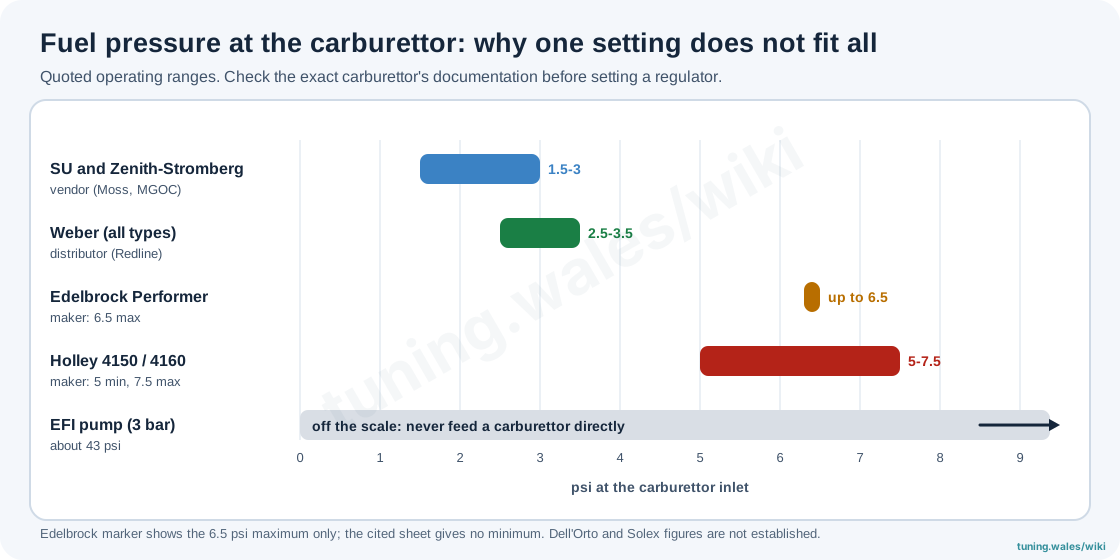
Pressure by carburettor family
| Carburettor | Quoted pressure | Source and grade |
|---|---|---|
| SU (HS, HD, HIF) and Zenith-Stromberg CD | 1.5–3 psi at the float chamber | Moss Motors and MGOC Spares (vendor). No Burlen figure found. |
| Weber (DCOE, IDF, DGV etc.) | 2.5–3 psi best; needle valve "will not take more than 2.5–3.5 lbs" | Redline Weber, main US distributor (vendor). No Weber factory figure found. |
| Solex on air-cooled VW | 1.5–3 psi | Vendor sources only; unverified |
| Edelbrock Performer (Carter AFB pattern) | 6.5 psi maximum | Edelbrock installation instructions (maker) |
| Holley 4150/4160 | 5 psi minimum, 7.5 psi maximum | Holley 4150 HP sheet (maker); other Holley sheets give 5–7 psi |
| Rochester Quadrajet | About 4–7 psi | Vendor and specialist only; no GM figure found |
| Dell'Orto DHLA | Not established | No Dell'Orto figure found; treated as low-pressure like the DCOE |
For gravity-fed motorcycle carburettors, Dell'Orto's tuning guide sizes the needle valve about 30 % larger than the main jet; with a pump the needle valve is smaller than the main jet, because pump pressure is far higher than a gravity head. The same relationship holds on car carburettors: needle-valve size, pressure and float level act together, and Holley notes that any change in pressure changes the float level.
Pump types
Mechanical diaphragm pumps
A cam or eccentric on the engine strokes a diaphragm; delivery pressure is set by the diaphragm spring, not by engine speed. When the needle valves close, the diaphragm stays down against its spring and the pump stops delivering, so a correctly specified mechanical pump needs no regulator. Moss quotes 1.5–3.7 psi for the AC pumps on Triumphs (vendor). Burlen's AUF 800 mechanical pump is mounted with gaskets and an insulating block to limit heat transfer.
SU electric pumps
| Type | Pressure | Flow |
|---|---|---|
| L (low pressure) | up to 1.5 psi | 9.6 gal/h |
| HP | up to 2.7 psi | 8.4 gal/h |
| LCS | up to 3.8 psi | 15 gal/h |
| AZX1307 / AZX1308 | 2.7 / 3.8 psi | 18 gal/h |
| AZX1400 dual | 2.7 or 3.8 psi | 36 gal/h |
Table from Moss Motors (vendor). Burlen describes the L type as a suction pump mounted near the engine and the HP as designed to mount near the tank.
Facet solid-state pumps
Facet (Purolator) cube pumps are self-regulating, so the right model can feed a carburettor without a regulator. Figures from the Facet automotive catalogue (maker), maximum to minimum pressure:
| Part | Pressure | Flow | Typical match |
|---|---|---|---|
| 40104 | 4.0–1.5 psi | 25 gal/h (US) | SU, Stromberg, Weber, Dell'Orto |
| 40105 / 40288 | 4.5–3.0 psi | 30 gal/h | Weber, Dell'Orto with care |
| 40106 / 40289 | 7.0–4.0 psi | 32 gal/h | Holley, Edelbrock |
| 40107 | 10.0–7.0 psi | 34 gal/h | Needs a regulator for any carburettor |
The "typical match" column is derived from the pressure ranges above, not from Facet. UK distributor Merlin Motorsport quotes slightly different ranges (for example 40106 at 4.5–7.0 psi), so check the label on the pump. The catalogue says cube pumps work on positive or negative earth; Merlin's listing says negative earth only, and Moss describes Facet's negative-earth-only instruction as an error.
Holley vane pumps
Holley's Red pump (12-801-1) is preset to 7 psi and needs no regulator for most Holley applications. The Blue (12-802-1) is preset to 14 psi and is supplied with a 12-803 regulator. The Black (12-815-1) is preset to 14 psi, requires a regulator and is alcohol-compatible (Holley 199R7914-3).
Layouts: deadhead and return
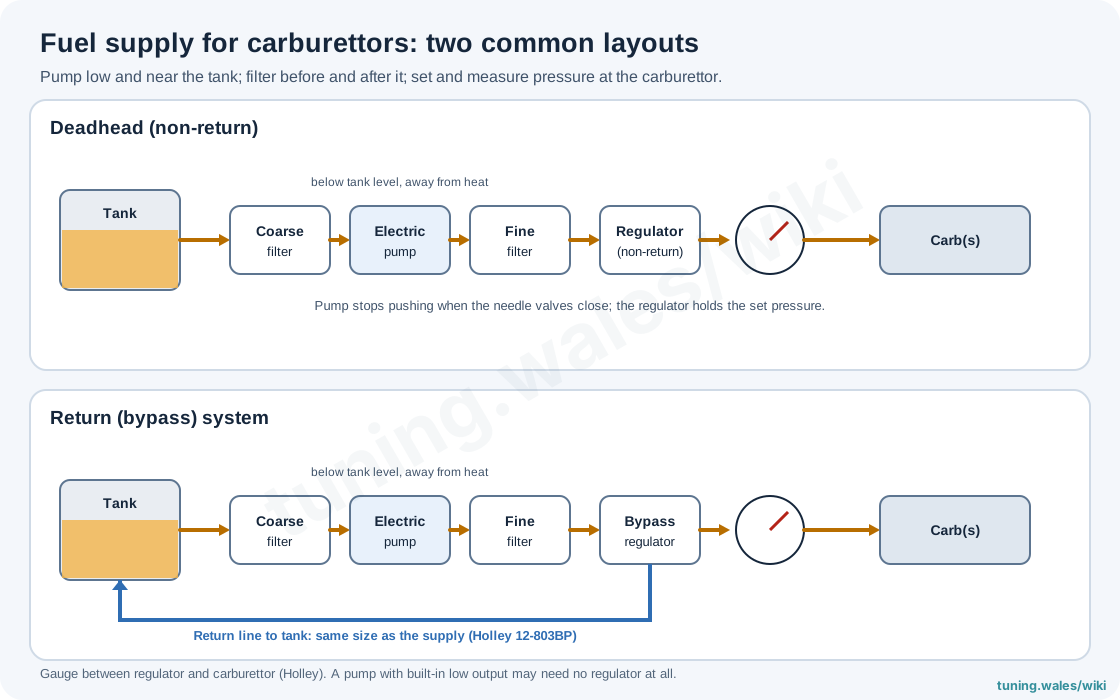
- Deadhead (non-return): the usual road-car layout. A non-return regulator such as the Malpassi Filter King (quoted at 1.5–5 psi by MGOC, 1.5–7 psi by other sellers) or Holley 12-804 (1–4 psi) or 12-803 (4.5–9 psi) holds a set pressure; the pump stalls against it when the needle valves close.
- Return (bypass): a bypass regulator near the carburettor sends surplus fuel back to the tank, keeping fuel moving and cooler. Holley's 12-803BP must not be used with a mechanical pump, and its return line must be the same size as the supply.
- EFI pump feeding a carburettor: needs a regulator designed for the job, such as Malpassi's FPR014 "injection to carburettor" unit, which drops about 88 psi to 2 psi while keeping the existing feed and return lines (vendor). Aeromotive's equivalent holds 8–16 psi on the pump side and 5–9 psi at the carburettor.
- Gauge: Holley states the gauge must sit between the regulator and the carburettor. Set pressure with fuel flowing; a reading taken with the engine stopped on a deadhead system can differ from the running value.
- When a regulator is not needed: if the pump's own output is inside the carburettor's range (a standard mechanical pump, an SU electric pump, or a Facet 40104 on an SU), adding a regulator only adds a failure point. MGOC Spares advises a regulator alongside any performance pump.
Pump placement and wiring
- Push, do not pull: Holley states its pumps must be mounted below and as close to the tank as possible, because they are designed to push fuel. Facet's instructions (as restated by Moss) say the pump should be no more than 12 in above the bottom of the tank, with the outlet pointing at least 45° above horizontal so vapour can pass, and nowhere hotter than 65 °C (140 °F), such as the engine bay or near the exhaust.
- Safety cut-off: an electric pump should stop when the engine stops. Holley recommends a relay and fuse with its 12-810 oil-pressure switch, which keeps the pump from running after shutdown or with the key left on; the switch's normally closed terminal is fed from the starter circuit so the pump runs while cranking. Factory inertia switches serve the same purpose on later cars.
Filters
Holley recommends a coarse screen before the pump and a high-quality filter after it; Edelbrock treats a new filter between pump and carburettor as a warranty requirement; Facet recommends a filter for every pump installation and supplies 74-micron external filters. A filter between the tank and the pump protects the pump from tank rust (Moss). After a classic car is switched to an ethanol blend, check filters early, because ethanol loosens old deposits (FBHVC). Whether glass-bowl filters are acceptable in the engine bay is an unresolved question: no manufacturer, insurer or Motorsport UK rule against them was found, and the claims are forum-based.
Vapour lock and percolation
Two different hot-fuel faults are often confused. SAE paper 841400 separates them:
- Vapour lock forms on the suction side of the pump or in the line, usually after a hot soak. Fuel vapour displaces liquid, the pump cannot deliver and the engine starves or will not restart until it cools. Causes in the Facet catalogue: a pump in a hot area, a restricted inlet putting fuel under high suction, poor routing and a blocked tank vent.
- Percolation (carburettor foaming) is fuel boiling in a hot carburettor. Foam can block the float-chamber vent, raise bowl pressure and push fuel out of the nozzles, giving a rich, flooded hot restart. SAE 841400 warns that some cures for pump vapour lock make foaming worse.
Remedies supported by maker and club guidance: move the electric pump to the tank and below fuel level; keep supply lines away from the exhaust; fit an insulating spacer or gasket between carburettor and manifold (Edelbrock "highly recommends" its insulator gasket for hot-restart problems); fit heat shields; use a return system to keep fuel moving. The FBHVC (as reported by Wheels Alive) endorses heat shields, insulating gaskets and routing lines away from heat, and rejects adding paraffin to fuel. Owner tests on an MG XPAG engine found that insulation only slows heat flow and can make long hot soaks worse, so a cooler pump position and fuel circulation are more effective than wrapping alone.
Ethanol (E10), hoses and storage
- The FBHVC advises pre-2000 vehicles to use the E5 "protection" grade where available. It gives the enleanment from E10 as equivalent to about 2.6 % (a 2016 secondary article says 3.6 %; the FBHVC primary text is preferred).
- Replace rubber hose, seals and gaskets with ethanol-compatible materials; check float levels after a fuel change, because ethanol can alter the buoyancy of some plastic floats; drain float bowls when a car is laid up.
- FBHVC names SAE J30 as the most widely used fuel-hose standard family and identifies J30R14T1 as low-permeation and approved for ethanol blends. The grade should be printed on the hose. Older grades (R6, R7, R9) are described inconsistently by vendors; confirm ethanol compatibility with the supplier.
Not established
- Factory fuel-pressure figures from Weber, Dell'Orto, Solex, Rochester or Burlen.
- Whether Facet's "Silver Top" designation denotes a pressure grade.
Related pages
- Carburettor fuel circuits and metering (float chamber and needle valve)
- Carburettor synchronisation, faults and rebuilds
- Holley 4150 and 4160 carburettors
- Turbocharging and supercharging a carburettor engine (boost-referenced regulators)
- Fuel system upgrades (injection systems)
Sources
- Holley, Electric Fuel Pumps and Regulators, 199R7914-3, rev. 16 Dec 2013 (retailer-hosted). Accessed 2026-11-19.
- Holley, 4150 HP Installation, 199R10016-2, rev. 24 Jan 2014. Accessed 2026-11-19.
- Edelbrock, Performer Series Carburetors Installation Instructions, c. 2013. Accessed 2026-11-19.
- Facet/Purolator (Motor Components LLC), Automotive catalogue, c. 2018. Pump ratings, filters, troubleshooting. Accessed 2026-11-19.
- Moss Motors, Fuel Pump Types and Applications, modified 11 Jan 2023, and Solid State Electric Fuel Pump Installation 377-420, modified March 2018. Accessed 2026-11-19.
- Burlen/SU, AUF 800 Mechanical Fuel Pump and Single and Dual Type Electric Fuel Pumps, undated. Accessed 2026-11-19.
- MGOC Spares, Fuel regulators, undated. Accessed 2026-11-19.
- Redline (LCE Performance), Weber and Holley Carburetor Fuel Pressure, 30 Dec 2024. Accessed 2026-11-19.
- Merlin Motorsport, Facet fuel pumps for carburettors and Malpassi FPR014, undated. Accessed 2026-11-19.
- Aeromotive, FAQ, undated. Accessed 2026-11-19.
- Dell'Orto, Motorcycle Carburetor Tuning Guide, section 3.2, as hosted by Ducati Meccanica, undated. Accessed 2026-11-19.
- L. J. Clarke, The Causes and Control of Carburettor Foaming, SAE 841400, 1 Oct 1984. Accessed 2026-11-19.
- FBHVC, Essential Guide to Fuels v3, 2023. Accessed 2026-11-19.
- Dave Moss, Danger Ahead! Ethanol and Classics, part two, Wheels Alive, 16 Sep 2016. FBHVC and VSCC vapour-lock measures. Accessed 2026-11-19.
- Manchester XPAG Tests, part 1: fuel, ttypes.org, undated. Owner test of insulation. Accessed 2026-11-19.