Accudyno supplies data-acquisition hardware and software for dynamometer testing. Its Gyra DS is aimed at inertia testing; Forza DS adds load-cell measurement and control outputs for appropriately configured absorber dynos. They are different product applications, and an acquisition interface is not the mechanical dyno or a high-current brake supply.
Product generations and applications
Accudyno's documentation index groups Gyra DS and Forza DS as 2025-onwards devices, Gyra and Forza as 2022–2024, and the earlier GO and PRO families as 2011–2022. Those are the supplier's broad generation groupings, not proof of a particular unit's exact firmware or compatibility. Consult its software and driver guidance for older interfaces.
The manufacturer overview describes Gyra DS for inertial rollers and rotating masses, and Forza DS for absorber test stands, including hydraulic and eddy-current brakes. Both the input/measurement range and the required brake power or actuator must match the installed system.
Gyra DS and inertia measurement
In an inertia test the measured acceleration of a known rotating inertia is used in the power calculation, subject to calibration and losses. The Gyra DS listing specifies two RPM inputs, four analogue inputs, one EGT thermocouple input and a weather station. The stated kit includes an interface, one roller/flywheel rotation sensor, magnet and USB-C cable; software and manuals are downloaded. Confirm accessories and sensor interfaces for the supplied version.
Gyra is an inertia-measurement system. The presence of configurable outputs is not evidence that it is a complete closed-loop absorber brake package; choose the documented Forza configuration when that function is needed.
Forza DS and absorption dynos
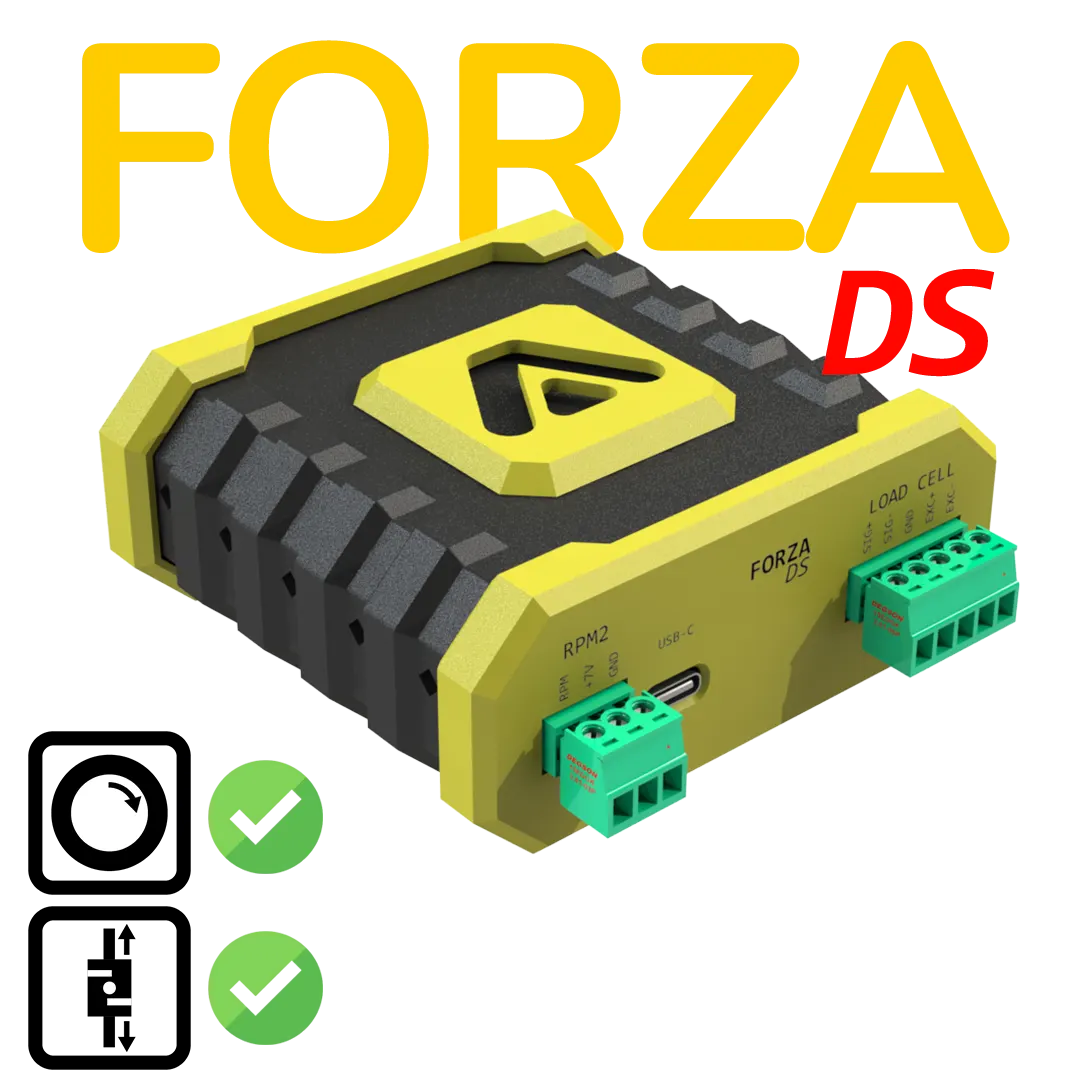
The Forza DS product page describes measurement with a load cell and automatic control through a variable-voltage, PWM or servo command for suitable eddy-current or hydraulic absorbers. A matching eddy-current power supply is not included according to the listing. A hydraulic arrangement needs the appropriate valve actuator, feedback and interface. The control-output guide describes the low-current nature of DS outputs and the use of external switching or amplification.
The product specification describes one load-cell input and, in its hub-dyno FAQ, one dyno-rotation input; check the role of the separate engine RPM input. The supplier says another hub-oriented model uses two rotation and two load-cell inputs: request current availability and details rather than assuming standard Forza DS controls four independent hubs. An inertia channel, torque cell and brake command each require compatible sensors and wiring.

Software and test modes
Accudyno provides PC software for live data, power/torque graphs and test comparisons. Its controller guide describes direct output and PID examples. The version history describes later software features including controller calibration, constant-RPM, acceleration-ramp and road-load modes; hardware, installed release and configured actuator determine whether a particular mode is usable. PID settings shown in examples are not universal brake settings.
For a retrofit, record absorber type and speed, load-cell scaling, sensor wiring and brake current, and ask which sensors and interface are included. Verify calibration and protective controls on the complete machine. A new data logger does not increase the brake's rating or make a passive absorber motor the shaft.
Related: Dynamometer control systems · Factory and aftermarket controller comparison · Dyno measurement.