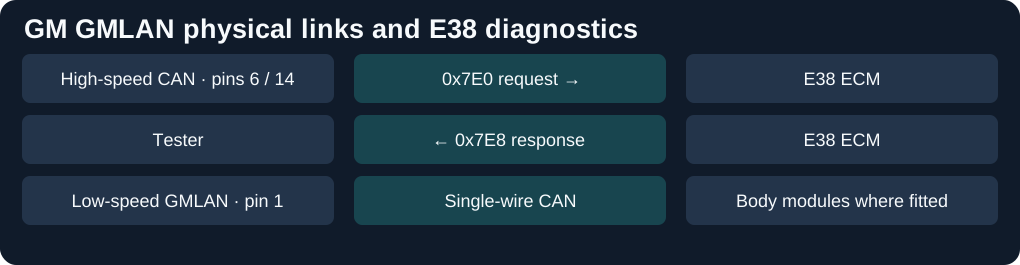
On GM applications with these links, high-speed GMLAN uses differential CAN at 500 kbit/s on diagnostic connector pins 6 and 14. Low-speed GMLAN is a separate single-wire body network, typically 33.3 kbit/s and available on pin 1 where fitted. Use the vehicle wiring to establish whether low-speed GMLAN is present.
CAN identifiers
| 11-bit CAN ID | High-speed example |
|---|---|
0x0C9 | Engine-status broadcast, including engine speed, from the published E38/T43 capture. |
0x7E0 | Physical request ID reported for E38 ECM diagnostics. |
0x7E8 | Physical reply ID reported for E38 ECM diagnostics. |
Example read-only diagnostic requests
For a GMLAN module that supports the VIN identifier, the request payload is 1A 90 and the positive payload starts with 5A 90. An illustrative normal-addressing ISO-TP Single Frame is 02 1A 90 before padding. The E38 CAN IDs and the GMLAN service definition are independently sourced. Confirm service support on the target calibration. A VIN reply is long enough to require multi-frame transport on Classic CAN.
On an emissions OBD implementation supporting VIN readout, 09 02 is the separate generic request and 49 02 starts the positive payload. Both examples read identification data. The IDs above describe the high-speed example.
Related references
- GM GMLAN and Global A CAN ID tables
- OBD-II and UDS diagnostic CAN IDs
- Vehicle diagnostics protocols
- ISO-TP on CAN