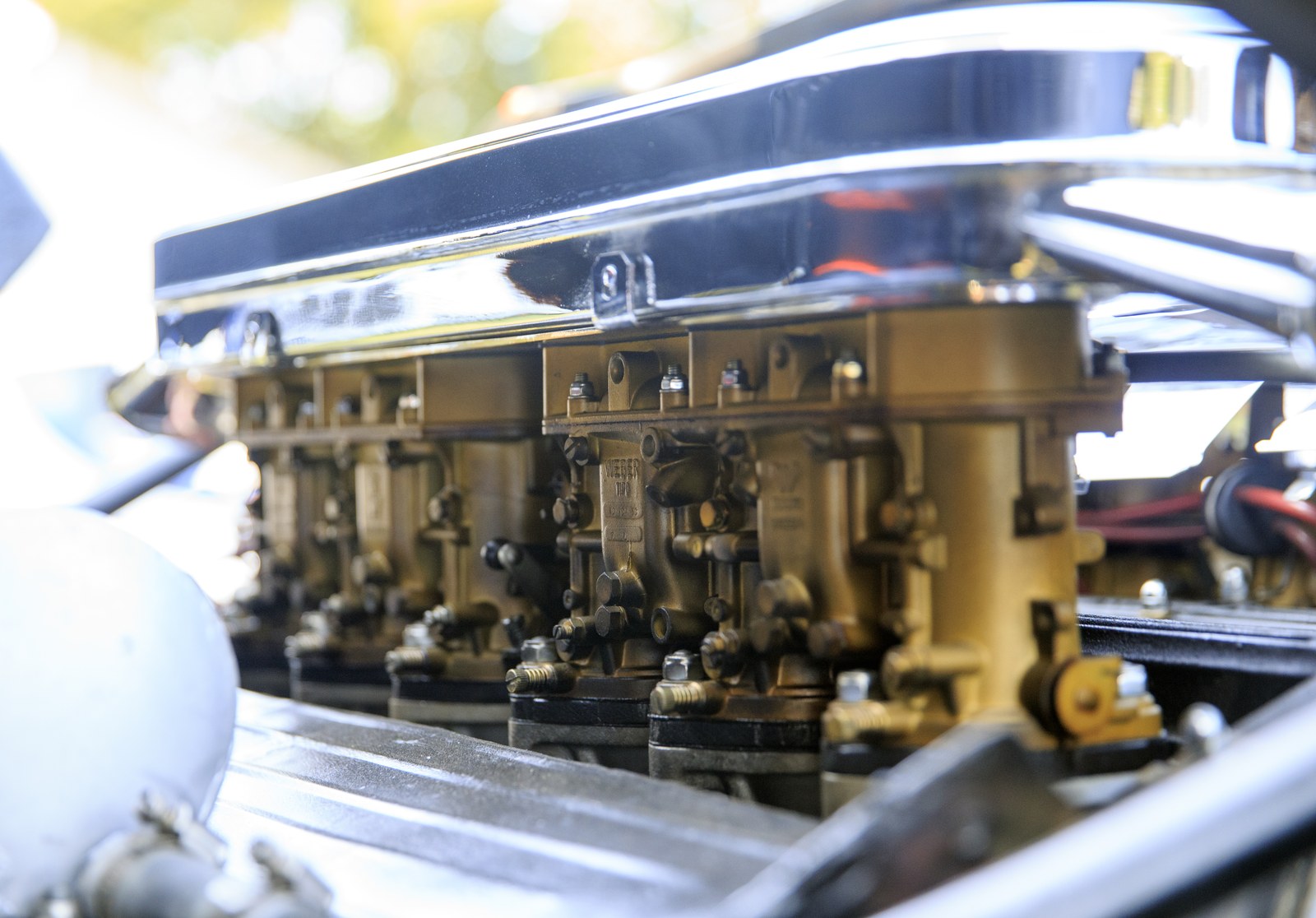
The Weber IDA family exists in two distinct high-flow downdraft configurations: the famous two-barrel 48 IDA (classic air-cooled VW drag/Cal-Look builds and V8 racing manifolds such as the Ford GT40 and AC Cobra) and the three-barrel 40 / 46 IDA 3C (early Porsche 911 and 904 GTS flat-sixes). Unlike DCOE and IDF carburettors, IDA floats sit inside the main body rather than hanging from the top cover.



1. Models & factory baseline jetting
| Model | Barrels | Factory choke / aux | Main jet | Emulsion tube | Air corrector | Idle jet | Pump / bleed |
|---|---|---|---|---|---|---|---|
48 IDA (19030.015) | 2-barrel | 37 mm / 4.5 | 135 | F7 | 120 | 70F10 | 50 / 000 (2.00 needle) |
| 40 IDA 3C / 3C1 | 3-barrel | 28–30 mm / 4.5 | 125 | F26 | 180 | 55 | 50 / 000 (1.75 needle) |
| 46 IDA 3C / 3C1 | 3-barrel | 40 mm / 4.5 | 170 | F24 | 145 | 70 | 50 / 100 (1.75 needle) |
2. Body-retained float adjustment (unique to IDA)
Because the IDA float remains inside the main carburettor body when the top cover is removed, float level cannot be measured off the lid (Weber FL1007 IDA Float Instructions; Weber Performance Float Guide):
- Tools required: needle-and-seat gauge (
98014.200) and spring retainer (98013.800) to hold the float lightly against the needle ball without compressing it. - 48 IDA (2-barrel): set needle-and-seat gauge dimension to
24 mm(24.2 mm), then verify the top of the float protrudes5.5–6.0 mmabove the top face of the main body. - 40 / 46 IDA 3C (3-barrel): set needle-and-seat gauge dimension to
18 mm, then verify float height measures12.5–13.0 mmfrom the top face of the main body. - Fuel pressure: many 48 IDA installations run around
3.5–4.0 psiconstant regulated pressure, ensuring float needles shut off cleanly without aeration.
3. IDA tuning characteristics
- Bleedless
F10idle jets (48 IDA): as Webcon UK notes, the48 IDAuses theF10idle jet series which has no side air bleed, relying instead on the idle jet orifice and progression-hole geometry near the butterfly. - Progression-hole variations: early competition
48 IDAunits often have only two progression holes, giving abrupt race-oriented transition; adding a third progression hole (a common street modification) or tailoring choke size smooths low-RPM transition on street-driven V8s and flat-fours (GT40 48 IDA tuning notes). - Emulsion tube selection (
F7,F11,F2,F4): remember that WeberF-numbers are arbitrary part labels, not sequential richness steps. Smaller outer-diameter tubes leave a larger fuel "reserve curtain" in the well for high-demand engines, while hole placement at the top, waist or bottom shifts main-circuit cut-in and high-RPM air correction.F7brings the main circuit in early and strongly; if mid-range transition runs overly rich before the idle circuit signs off, a tube with higher upper drillings delays main-circuit pickup. - Choke sizing on V8s: starting with slightly smaller venturis helps dial in progression and signal on aggressive-cam V8s before stepping up choke diameter until peak power stops improving.
4. Related pages
- Weber carburettor tuning overview
- Weber IDF carburettors: specs and tuning
- Weber DCOE and DCO-SP carburettors: specs and tuning
- Carburettor fuel circuits and metering