Production: 1948–1985. Model and production reference.
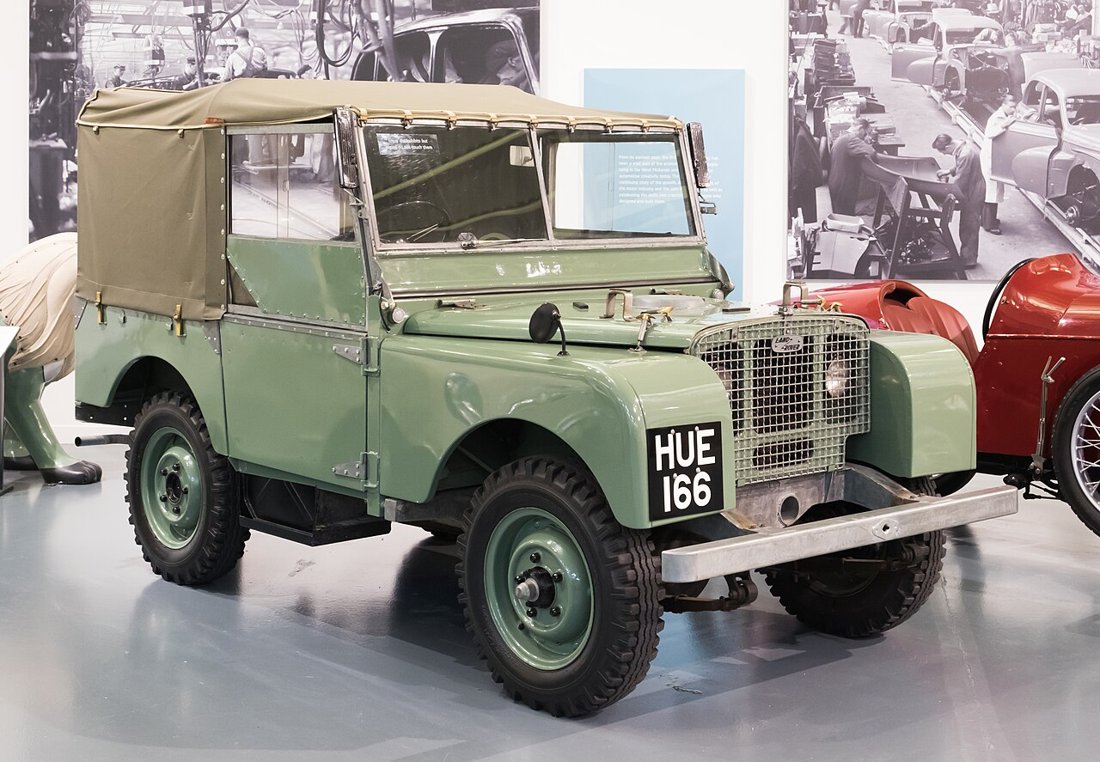

The Series Land Rovers (Series I, II, IIA and III) were Rover and British Leyland's original ladder-frame, leaf-sprung utility 4×4s, preceding the coil-sprung Ninety/One Ten and classic Defender. Built at Solihull with corrosion-resistant Birmabright aluminium-alloy bodywork on boxed-section steel frames, Series models featured part-time four-wheel drive (until the 1979 Stage One V8) and optional mechanical power take-off (PTO) drives. Wikipedia: Land Rover series.
Generations and body configurations
| Model / series | Production | Wheelbases and key changes |
|---|---|---|
| Series I | 1948–1958 | Launched 30 April 1948 in 80-inch wheelbase (with permanent freewheel 4WD initially, later selectable 4WD); updated to 86- and 107-inch (1954), then 88- and 109-inch (1956) to accommodate the 2.0-litre diesel. |
| Series II | 1958–1961 | 88- and 109-inch wheelbases; David Bache "barrel-side" body styling, wider track, rounded roof and curved side windows; introduced the 2.25-litre OHV petrol four and 12-seat 109 Station Wagon. |
| Series IIA | 1961–1971 | Added the 2.25-litre OHV diesel (1962) and 2.6-litre IOE petrol six (1967, including NADA export models); headlamps moved from the grille panel into the front wings from 1968–1969. |
| Series IIA & IIB Forward Control | 1962–1974 | Cab-over-engine load carriers on 109-inch (IIA FC, 1962–1966) and 110-inch (IIB FC, 1966–1974) chassis with heavy-duty ENV axles, 9.00×16 tyres and 2.25/2.6 engines. |
| 1-Ton 109 (Series IIA & III) | 1968–1977 | Heavy-duty standard-bonnet 109 with drop-shackle suspension, lower-ratio transfer case, ENV/Salisbury axles, 9.00×16 tyres and 2.6-litre six (plus 2.25 petrol in TACR1 MoD fire tenders). |
| Series III | 1971–1985 | Most numerous Series model (~440,000 built); all-synchromesh four-speed gearbox, moulded plastic dashboard with driver-side instruments, plastic front grille, five-bearing 2.25 crankshafts (1980) and 24-spline half-shafts (1982). |
| Series III Stage One V8 | 1979–1985 | Transitional 109-inch (and 24 SWB 88-inch) model combining leaf springs with Range Rover's 3.5-litre Rover V8 (detuned to 91 hp), LT95 four-speed gearbox and permanent four-wheel drive. |
Complete factory engine list
Availability, compression ratios, carburettors and outputs varied with model year, emissions market and trim. Verify the engine number prefix and exact vehicle before ordering parts. Wikipedia: Land Rover series; Wikipedia: Land Rover engines.
| Engine | Configuration & displacement | Fuel system / induction | Representative output | Series applications |
|---|---|---|---|---|
| 1.6-litre Rover IOE petrol | 1,595 cc I4, inlet-over-exhaust | Solex carburettor | ~50 hp (37 kW) | Series I (1948–1951) |
| 2.0-litre Rover IOE petrol | 1,997 cc I4, inlet-over-exhaust | Solex carburettor | ~52 hp (39 kW) | Series I (1952–1958) & first ~1,500 SWB Series II |
| 2.0-litre Land Rover diesel | 2,052 cc OHV I4, wet-liner, Ricardo Comet swirl chambers | CAV DPA rotary pump, Pintaux injectors | 51 hp (38 kW) @ 3,500 rpm; 118 N⋅m @ 2,000 rpm | Series I (1957–1958) & Series II (1958–1962) |
| 2.25-litre Land Rover petrol (10H, 11H, 13H) | 2,286 cc OHV I4, dry-liner (3-bearing to 1980; 5-bearing 1980+) | Solex (to 1971), Zenith (to 1983) or Weber 34ICH carburettor | 74 hp (55 kW) @ 4,200 rpm; 163 N⋅m @ 2,000 rpm (8.0:1 CR, non-emissions) | Series II, IIA & III (1958–1985) |
| 2.25-litre Land Rover diesel (10J) | 2,286 cc OHV I4, dry-liner (3-bearing to 1980; 5-bearing 1980+) | CAV DPA rotary pump, Pintaux injectors | 62 hp (46 kW) @ 4,000 rpm; 140 N⋅m @ 1,800 rpm | Series IIA, IIB FC & III (1962–1984) |
| 2.6-litre Rover IOE petrol | 2,625 cc I6, inlet-over-exhaust | SU carburettor | 86 hp (64 kW) | Series IIA export/FC, 1-Ton 109 & Series III LWB (1967–1980) |
| 3.5-litre Rover V8 petrol | 3,528 cc OHV V8, all-aluminium | Dual Stromberg/SU carburettors (restricted) | 91 hp (68 kW) (Stage One detuned spec) | Series III Stage One V8 (1979–1985) |
| 3.9-litre Isuzu 4BD1 diesel (Australia) | 3,856 cc OHV I4 (local JRA option) | Mechanical inline injection | 97 hp (72 kW) | Australian-market Series III Stage One (1982–1985) |
Licensed and overseas derivatives—including Santana (Spain, offering 3.4-litre sixes and a 2.25 turbodiesel), Minerva (Belgium), Tempo (West Germany) and Leyland South Africa (Series IIIS with local R6 petrol and ADE 236 diesel engines)—used distinct regional powertrains. Wikipedia: Land Rover series; Wikipedia: Land Rover engines.
Transmissions, military & specialist variants
- Transmissions: Four-speed manual main gearbox (non-synchromesh 1st/2nd on Series I–IIA; all-synchromesh on Series III and late IIA) with two-speed transfer case and selectable 4WD; Stage One V8 adopted the Range Rover's permanent-4WD LT95 four-speed gearbox.
- Military and specialist builds: Include the air-portable 1/2-ton Lightweight (1968–1984), Series IIA/III 109
FV18067ambulances, SAS Pink Panther (LRDPV) desert patrol conversions, Australian Army 106 mm Gunbuggy, Shorts Shorland armoured patrol cars, Cuthbertson tracked Series II, Roadless Forest Rover, Dunlop rail-road Series IIA, and the Series III V8 Centaur half-track. See Land Rover military, prototype and specialist vehicles.
Sources and related pages
See Land Rover petrol tuning and ECU identification for engine-specific maps, upgrades and validation.
- Wikipedia: Land Rover series — model history, dimensions and variants.
- Wikipedia: Land Rover engines — Solihull four-cylinder engine specifications.
- Land Rover: history and cars and Land Rover Defender classic: models and engines.
- Land Rover military, prototype and specialist vehicles.
Petrol tuning guides: classic Rover V8. Check each guide for engine and ECU applicability.