Removed text is struck through; added text is highlighted.
DYNOmite is the name used by US manufacturer Land & Sea, Inc. for a family of engine, chassis and hub dynamometers, brake absorbers and data-acquisition equipment. The manufacturer's historical literature describes water-brake, eddy-current and electric configurations for a range of engine and vehicle test applications. This article distinguishes dated catalogue examples from equipment currently available: confirm specifications, service and support for the exact serial number and configuration.
In a 2018 announcement, Land & Sea said it had been developing equipment for over 40 years and described manufacturing and electronics work in the USA. Its 2014 DYNOmite catalogue documents a range of systems and controllers. These sources do not establish a precise founding year or current product availability.
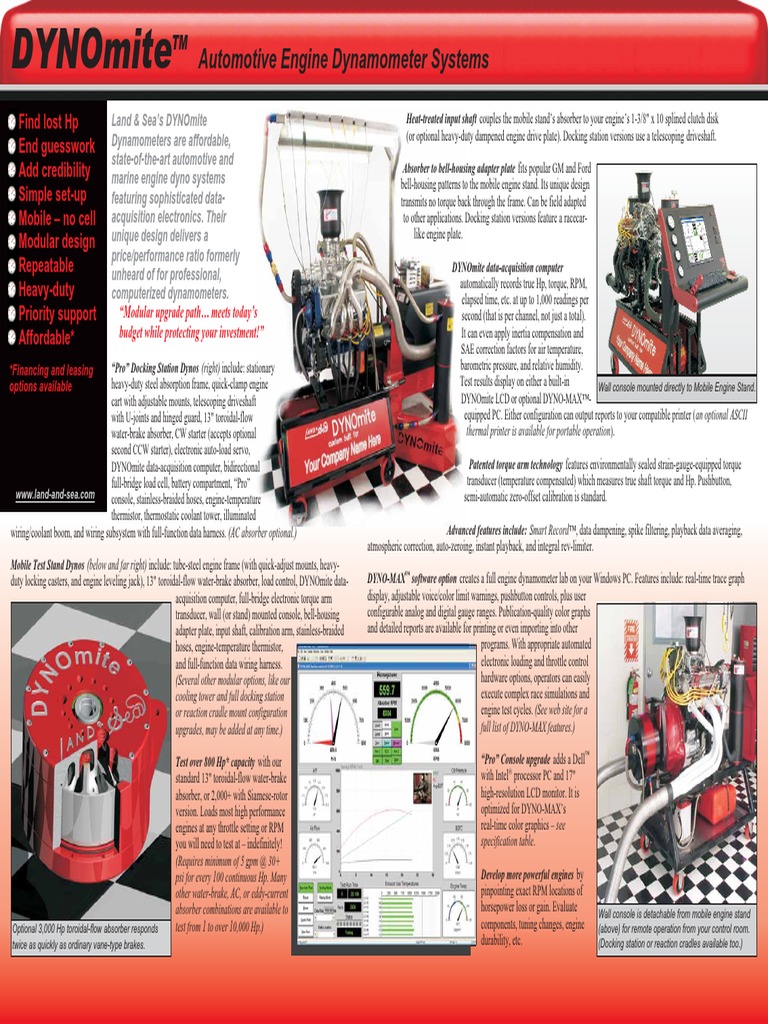
Historic DYNOmite automotive engine dynamometer catalogue illustration, including absorber, test stands and control software. Image: Land & Sea's 2014 catalogue, used with permission. Configuration and availability may have changed.
Engine and vehicle applications
Family or exampleWhat the published configuration describes
Automotive engine dyno, 13-inchThe 2014 catalogue describes an automotive engine test stand with a 13-inch single-rotor toroidal water brake and optional Siamese-rotor configurations. It lists a load control valve, torque transducer, speed pickup and DYNOmite data-acquisition computer. The shaft, couplings, cooling and safety guards must suit the installation.
Heavy-duty diesel engine dyno, 19-inch and largerThe 2014 catalogue describes larger water-brake configurations, including 19-inch single and Siamese rotor and larger tandem options. Brake capacity varies with speed and cooling; the largest stated capacity is not available at every rpm.
Motorcycle / ATV chassis dynoA 2009 K&L catalogue describes a 16-by-50-inch inertia roller, with optional water or eddy-current load control, torque measurement, automated load control and DYNO-MAX software. Specifications are historical and must not be treated as a current offer.
2600-Pro 4WD eddy-current chassis systemA published quotation describes a 2,600 Pro 4WD system with front and rear 13-inch tandem-roll assemblies and eddy-current load control. Exact options and axle compatibility depend on the delivered system.
Axle-hub and marine systemsThe historical catalogue also describes wheel-hub and marine propeller-shaft installations. Their measurement boundaries differ from a chassis roller or direct engine test.
Water-brake principle
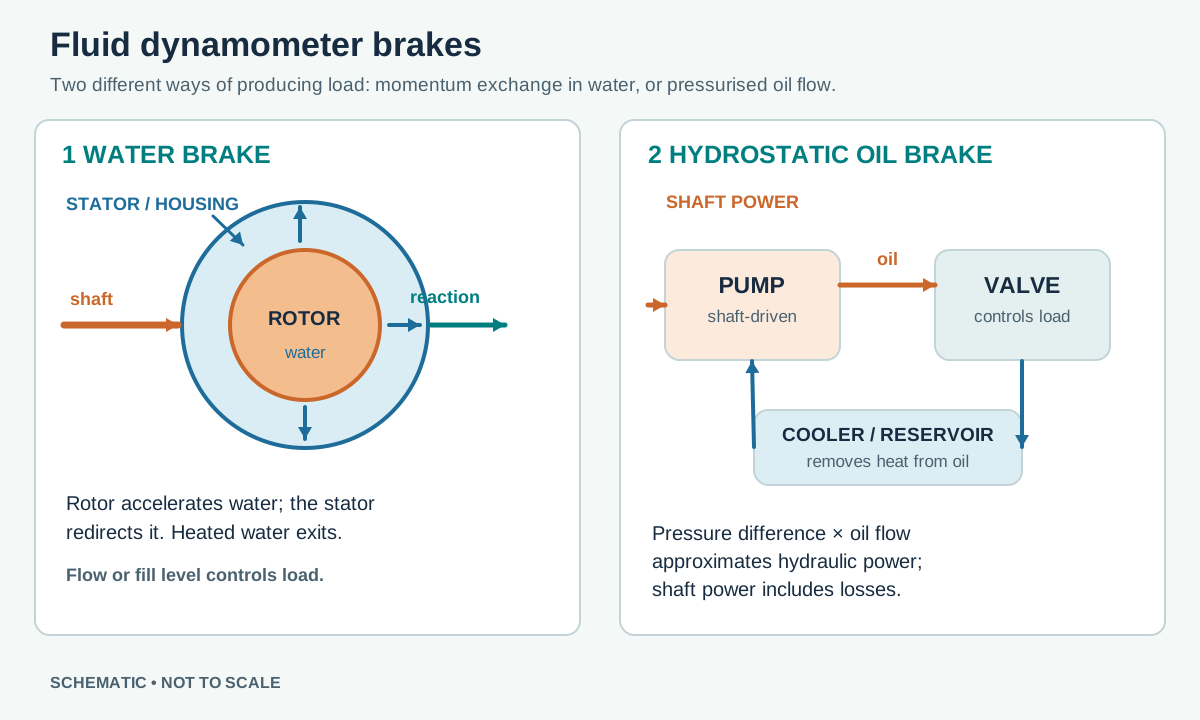
An engine shaft drives a vaned rotor in a water-filled housing. The rotor transfers momentum into the water; interaction with the housing resists rotation and ultimately heats the water. Controlled water flow or fill changes the load. The housing reaction is measured through a torque arm and load cell, while speed is measured separately; power can be calculated from torque and angular speed. In transient work, rotating inertia and the controller's measurement convention affect the reported result. Cooling flow and temperature limits are necessary for sustained operation.
Conceptual water-brake operation. This illustrates the principle, not the internal geometry of a particular DYNOmite absorber. Original diagram for Tuning Wiki, CC BY 4.0.
Other absorbers
Land & Sea's 2014 literature also describes air- and liquid-cooled eddy-current absorbers. Excitation changes a magnetic field; relative motion induces currents in conducting brake parts, producing opposing torque and heat. A coolant circuit can remove heat without making the device a water brake. The catalogue also describes electric and combined configurations. Whether a system can motor, regenerate energy or hold a given load depends on the actual machine, drive and controls, not the brand alone.
DYNOmite data computer and DYNO-MAX
The DYNOmite data computer acquires sensors such as brake torque and rotational speed, while DYNO-MAX software provides displayed and recorded test results. The 2014 catalogue describes Lite and Pro acquisition configurations, with different channel capacity and options. Listed features include configurable sensors, atmospheric correction, test recording and graphing. It also describes optional automatic absorber load and throttle control on compatible systems. Available channels, wiring, software version and operating modes vary with the hardware installed; an acquisition display alone does not establish closed-loop load control.
Examples of external integration include a Daytona Sensors interface note describing a WEGO wideband system connected to a DYNOmite Pro acquisition module through correctly configured analog inputs. The interface requires the documented channels, scaling and wiring; it should not be generalised to every controller generation.
Identifying and maintaining a machine
Record the absorber model, diameter, serial number and whether it is a single, Siamese or tandem rotor, rather than using a horsepower label alone.Obtain the torque–speed absorption curve and the exact water, electrical or cooling requirements. An advertised peak power is not a continuous rating at every speed.Identify the computer, software version, load valve or power driver and channel modules before sourcing spares or planning a retrofit.Check the load cell, speed sensing and calibration, and inspect guards, hoses and bearings according to the applicable manual. A water-cooled eddy brake and a hydraulic water brake need different maintenance arrangements.
See water and hydraulic brakes, eddy-current brakes, controllers and calibration and verification.
Rendered revisions
Open each version to inspect formatting, tables and photographs.
Revision 1: Land and Sea DYNOmite dynamometers
DYNOmite is the name used by US manufacturer Land & Sea, Inc. for a family of engine, chassis and hub dynamometers, brake absorbers and data-acquisition equipment. The manufacturer's historical literature describes water-brake, eddy-current and electric configurations for a range of engine and vehicle test applications. This article distinguishes dated catalogue examples from equipment currently available: confirm specifications, service and support for the exact serial number and configuration.
In a 2018 announcement, Land & Sea said it had been developing equipment for over 40 years and described manufacturing and electronics work in the USA. Its 2014 DYNOmite catalogue documents a range of systems and controllers. These sources do not establish a precise founding year or current product availability.
Historic DYNOmite automotive engine dynamometer catalogue illustration, including absorber, test stands and control software. Image: Land & Sea's 2014 catalogue, used with permission. Configuration and availability may have changed.
Engine and vehicle applications
Family or example
What the published configuration describes
Automotive engine dyno, 13-inch
The 2014 catalogue describes an automotive engine test stand with a 13-inch single-rotor toroidal water brake and optional Siamese-rotor configurations. It lists a load control valve, torque transducer, speed pickup and DYNOmite data-acquisition computer. The shaft, couplings, cooling and safety guards must suit the installation.
Heavy-duty diesel engine dyno, 19-inch and larger
The 2014 catalogue describes larger water-brake configurations, including 19-inch single and Siamese rotor and larger tandem options. Brake capacity varies with speed and cooling; the largest stated capacity is not available at every rpm.
Motorcycle / ATV chassis dyno
A 2009 K&L catalogue describes a 16-by-50-inch inertia roller, with optional water or eddy-current load control, torque measurement, automated load control and DYNO-MAX software. Specifications are historical and must not be treated as a current offer.
2600-Pro 4WD eddy-current chassis system
A published quotation describes a 2,600 Pro 4WD system with front and rear 13-inch tandem-roll assemblies and eddy-current load control. Exact options and axle compatibility depend on the delivered system.
Axle-hub and marine systems
The historical catalogue also describes wheel-hub and marine propeller-shaft installations. Their measurement boundaries differ from a chassis roller or direct engine test.
Water-brake principle
An engine shaft drives a vaned rotor in a water-filled housing. The rotor transfers momentum into the water; interaction with the housing resists rotation and ultimately heats the water. Controlled water flow or fill changes the load. The housing reaction is measured through a torque arm and load cell, while speed is measured separately; power can be calculated from torque and angular speed. In transient work, rotating inertia and the controller's measurement convention affect the reported result. Cooling flow and temperature limits are necessary for sustained operation.
Conceptual water-brake operation. This illustrates the principle, not the internal geometry of a particular DYNOmite absorber. Original diagram for Tuning Wiki, CC BY 4.0.
Other absorbers
Land & Sea's 2014 literature also describes air- and liquid-cooled eddy-current absorbers. Excitation changes a magnetic field; relative motion induces currents in conducting brake parts, producing opposing torque and heat. A coolant circuit can remove heat without making the device a water brake. The catalogue also describes electric and combined configurations. Whether a system can motor, regenerate energy or hold a given load depends on the actual machine, drive and controls, not the brand alone.
DYNOmite data computer and DYNO-MAX
The DYNOmite data computer acquires sensors such as brake torque and rotational speed, while DYNO-MAX software provides displayed and recorded test results. The 2014 catalogue describes Lite and Pro acquisition configurations, with different channel capacity and options. Listed features include configurable sensors, atmospheric correction, test recording and graphing. It also describes optional automatic absorber load and throttle control on compatible systems. Available channels, wiring, software version and operating modes vary with the hardware installed; an acquisition display alone does not establish closed-loop load control.
Examples of external integration include a Daytona Sensors interface note describing a WEGO wideband system connected to a DYNOmite Pro acquisition module through correctly configured analog inputs. The interface requires the documented channels, scaling and wiring; it should not be generalised to every controller generation.
Identifying and maintaining a machine
Record the absorber model, diameter, serial number and whether it is a single, Siamese or tandem rotor, rather than using a horsepower label alone.
Obtain the torque–speed absorption curve and the exact water, electrical or cooling requirements. An advertised peak power is not a continuous rating at every speed.
Identify the computer, software version, load valve or power driver and channel modules before sourcing spares or planning a retrofit.
Check the load cell, speed sensing and calibration, and inspect guards, hoses and bearings according to the applicable manual. A water-cooled eddy brake and a hydraulic water brake need different maintenance arrangements.