Removed text is struck through; added text is highlighted.
MAHA is a German manufacturer of vehicle-testing and workshop equipment based in Haldenwang. Its performance-measurement range includes chassis dynamometer roller sets for passenger cars and commercial vehicles, as well as the LPS 3000 control desk. MAHA also makes equipment such as brake testers and vehicle lifts; a brake-inspection tester should not be confused with a power-measuring chassis dynamometer. MAHA dynamometer range.
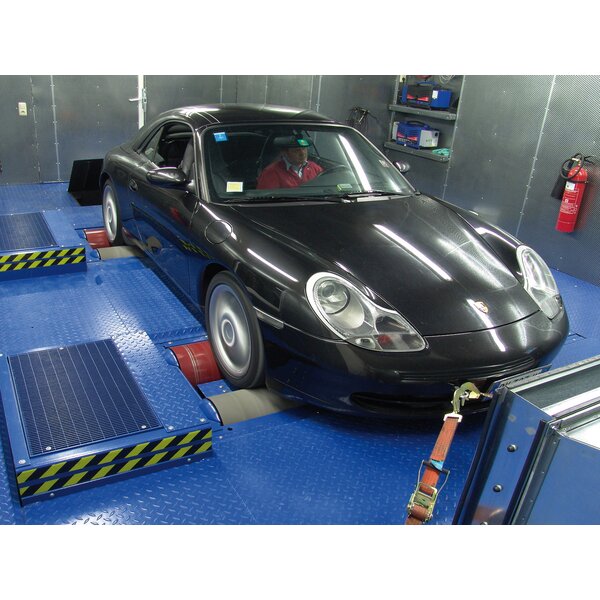
Roller installation pictured in MAHA's R 100/1 gallery. Photograph: MAHA, used with permission.
Company history
MAHA's timeline records the development of a car brake tester in 1968, followed by the company's founding by Winfried Rauch and Josef Schilling in 1969. It identifies Haldenwang as its German base and records the establishment of MAHA USA in 1999. Its work spans vehicle testing and lifting equipment, not just performance dynamometers. MAHA milestones.
How the chassis systems work
The vehicle's driven tyres turn rollers. In the R 100/1, an eddy-current brake provides controllable resistance; the controller uses measured speed and load to make static measurements at selected operating points or dynamic tests. Tyre, roller and drivetrain losses are part of the overall measurement chain. The LPS 3000 system can report calculated engine power alongside wheel power and loss; the engine value depends on its procedure and is not a direct crankshaft torque-sensor measurement. See rolling-road dynamometers and interpreting results.
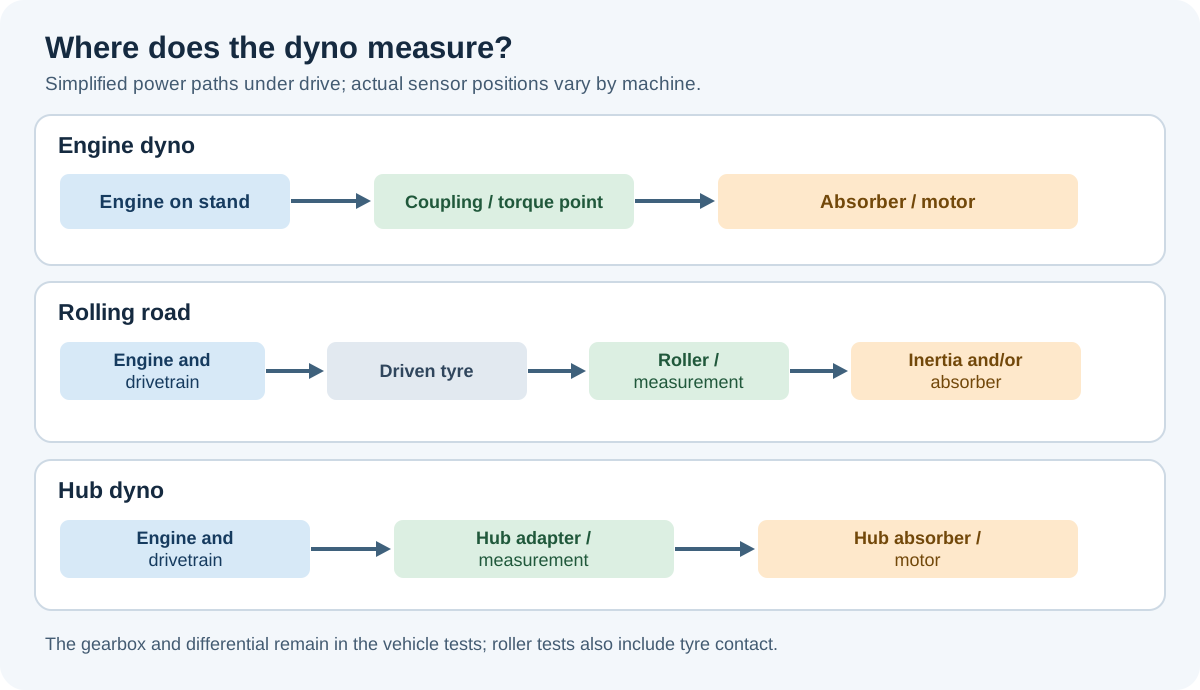
General measurement boundaries for three dynamometer layouts; the rolling road is in the middle. Diagram: original illustration created for Tuning Wiki, CC BY 4.0.
Representative models and roller sets
ModelLayout and published examples
R 100/1Double-roller passenger-car set with eddy-current brake and pneumatic lifting bar. The listed version has a 2,500 kg axle load, 260 kW maximum static wheel power, dynamic peak above 520 kW and maximum 260 km/h test speed. Static and dynamic figures describe different test conditions.
MSR 500/2 CAR 4WD, LPS 3000Single-roller 4WD layout with one eddy-current brake and an electric motor per roller set, electronic roller-speed synchronisation and adjustable wheelbase. MAHA lists up to 300 km/h, 260 kW maximum static wheel power per axle and a dynamic peak above 1,000 kW per axle. Its product text and technical table differ on axle load (2.4 t and 2,500 kg respectively), so confirm the installed machine's rating.
R 200/2 dividedCommercial-vehicle double-roller set; published data lists 15,000 kg axle load and two 150 kW eddy-current brakes, with optional higher-power configuration. Verify the exact variant and duty limits.
Numbers are manufacturer examples for particular configurations, not a guarantee that every machine with a similar name has the same capacity. Check roller and tyre speed, torque, axle loads, installation and continuous operating envelope before a test.
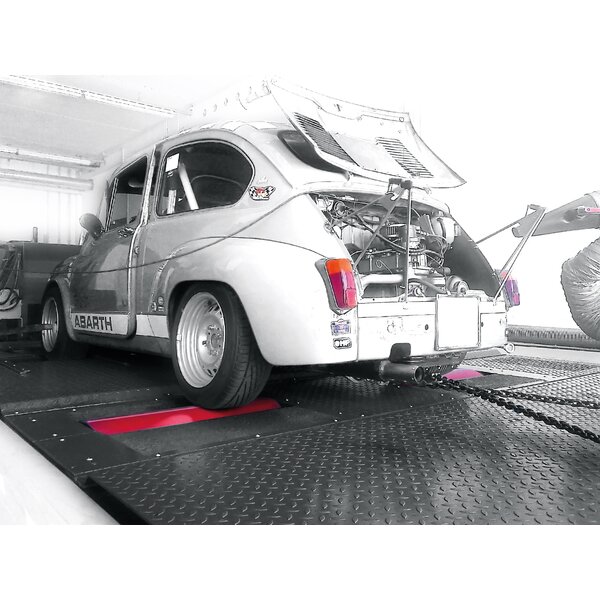
Vehicle pictured in MAHA's MSR 500/2 gallery. Photograph: MAHA, used with permission.
LPS 3000 control desk
The LPS 3000 desk is described as a central control system for R 100 car and R 200 truck roller sets. Published modes include constant rpm, speed or tractive force, and adjustable-acceleration dynamic tests. Optional programmable load and driving profiles and analogue sensor modules extend the system; features and interfaces depend on the installed options. The radio remote controls the dynamometer and fan. MAHA describes towing-power measurement and correction standards, but correction and reported engine power should be documented when comparing tests.
See also dynamometer controllers, eddy-current brakes and test setup and safety.
Rendered revisions
Open each version to inspect formatting, tables and photographs.
Revision 1: MAHA dynamometers
MAHA is a German manufacturer of vehicle-testing and workshop equipment based in Haldenwang. Its performance-measurement range includes chassis dynamometer roller sets for passenger cars and commercial vehicles, as well as the LPS 3000 control desk. MAHA also makes equipment such as brake testers and vehicle lifts; a brake-inspection tester should not be confused with a power-measuring chassis dynamometer. MAHA dynamometer range.
Roller installation pictured in MAHA's R 100/1 gallery. Photograph: MAHA, used with permission.
Company history
MAHA's timeline records the development of a car brake tester in 1968, followed by the company's founding by Winfried Rauch and Josef Schilling in 1969. It identifies Haldenwang as its German base and records the establishment of MAHA USA in 1999. Its work spans vehicle testing and lifting equipment, not just performance dynamometers. MAHA milestones.
How the chassis systems work
The vehicle's driven tyres turn rollers. In the R 100/1, an eddy-current brake provides controllable resistance; the controller uses measured speed and load to make static measurements at selected operating points or dynamic tests. Tyre, roller and drivetrain losses are part of the overall measurement chain. The LPS 3000 system can report calculated engine power alongside wheel power and loss; the engine value depends on its procedure and is not a direct crankshaft torque-sensor measurement. See rolling-road dynamometers and interpreting results.
General measurement boundaries for three dynamometer layouts; the rolling road is in the middle. Diagram: original illustration created for Tuning Wiki, CC BY 4.0.
Double-roller passenger-car set with eddy-current brake and pneumatic lifting bar. The listed version has a 2,500 kg axle load, 260 kW maximum static wheel power, dynamic peak above 520 kW and maximum 260 km/h test speed. Static and dynamic figures describe different test conditions.
Single-roller 4WD layout with one eddy-current brake and an electric motor per roller set, electronic roller-speed synchronisation and adjustable wheelbase. MAHA lists up to 300 km/h, 260 kW maximum static wheel power per axle and a dynamic peak above 1,000 kW per axle. Its product text and technical table differ on axle load (2.4 t and 2,500 kg respectively), so confirm the installed machine's rating.
Commercial-vehicle double-roller set; published data lists 15,000 kg axle load and two 150 kW eddy-current brakes, with optional higher-power configuration. Verify the exact variant and duty limits.
Numbers are manufacturer examples for particular configurations, not a guarantee that every machine with a similar name has the same capacity. Check roller and tyre speed, torque, axle loads, installation and continuous operating envelope before a test.
Vehicle pictured in MAHA's MSR 500/2 gallery. Photograph: MAHA, used with permission.
LPS 3000 control desk
The LPS 3000 desk is described as a central control system for R 100 car and R 200 truck roller sets. Published modes include constant rpm, speed or tractive force, and adjustable-acceleration dynamic tests. Optional programmable load and driving profiles and analogue sensor modules extend the system; features and interfaces depend on the installed options. The radio remote controls the dynamometer and fan. MAHA describes towing-power measurement and correction standards, but correction and reported engine power should be documented when comparing tests.