Froude supplies dynamometer controllers and test-cell data acquisition for hydraulic water-brake, eddy-current and electric dynamometers. Its Texcel and InCell systems are engineered for different testing applications and absorber interfaces; a controller name alone does not establish its compatibility with a particular dyno. See Froude dynamometers.
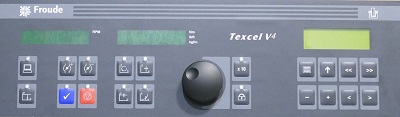
Controller models
| Model | Documented application | Features and limitations |
|---|---|---|
| Texcel V4-H / V4-HE | Hydraulic dynamometers; HE adds engine control. | The maker describes digital control and configurable inlet-valve actuators, including servo-hydraulic, motorised and pneumatic types. Engine variant adds throttle actuation. V4 details. |
| Texcel V4-EC / V4-ECE | Eddy-current dynamometers; ECE adds engine control. | Requires the appropriate power module, wiring and brake interface for the specific absorber. V4 details. |
| Texcel V12 PRO | Configured AC, hydraulic and eddy-current engine-test systems. | Manual control or test-sequence automation, configurable displays, data acquisition and optional ECU/emissions interfaces. V12 PRO. |
| Texcel VX200 | Hydraulic dynamometers in engine and gas-turbine test cells. | Desktop control and industrial PC with speed, torque, position and power-law control modes. Maker describes an upgrade path from VX100, excluding custom software; ask about non-Froude compatibility. VX200. |
| InCell Qube / rackmount | Configured AC, hydraulic and eddy-current dynos. | Embedded real-time control and expandable I/O; Froude describes CANopen and EtherCAT compatibility. InCell. |
How control and measurement work
A speed pickup and torque measurement feed the controller; a digital demand drives a suitable power module or valve actuator. Engine-control versions can command a throttle actuator as well as the dynamometer. In a speed-hold test, load is adjusted against engine output; automatic sequences require compatible sensors, actuators and software. The following diagram is illustrative and is not wiring for a particular Texcel model.

Compatible machines and brakes
The V4 families explicitly distinguish hydraulic and eddy-current versions. Froude lists V12 PRO and InCell for AC, hydraulic and eddy-current machines when configured with appropriate hardware. VX200 is intended for hydraulic test systems and the manufacturer invites enquiries about non-Froude hydraulic dynos. Water-brake inlet/outlet arrangement, valve type, speed and torque sensors, load-cell interface, eddy brake coil and power driver, or AC drive interface must be assessed case by case. V4; VX200.
An AC-capable controller does not make a passive water or eddy brake motor the engine or recover energy. Those functions depend on the complete electrical machine and drive. A manufacturer's stated test-cell feature should not be assumed to work on a third-party chassis or hub dyno without an engineered integration.
Software and test-cell integration
The V12 PRO describes configurable screens, manual control, automatic sequences, alarm checks, data logging and reporting, with ECU communication and emissions features as options. The InCell uses a Qube or rackmount base with embedded control and expandable I/O. Features and interfaces depend on the actual equipment supplied.
Upgrade and service checks
Identify dyno and controller model, absorber, speed and torque sensors, valve and power electronics, software/firmware and any existing interlocks. For a conversion, request a documented hardware, wiring, calibration, support and commissioning scope. Use the appropriate load, speed, temperature and cooling limits, and verify the complete control chain after installation. Related: dynamometer control systems and factory and aftermarket comparison.