Removed text is struck through; added text is highlighted.
Country of origin: Germany. Part of Car makes and the history of the motor car.
History and development
Audi's history includes the early Audi company and Auto Union, whose four-ring emblem represents four previously independent marques. The modern Audi brand developed as part of Volkswagen's post-war passenger-car business. Wikipedia: Audi history.
Audi has built front-wheel-drive and quattro all-wheel-drive cars, with petrol and diesel engines and later electric models. Its five-cylinder and TDI engines are particularly relevant to the forced-induction timeline.
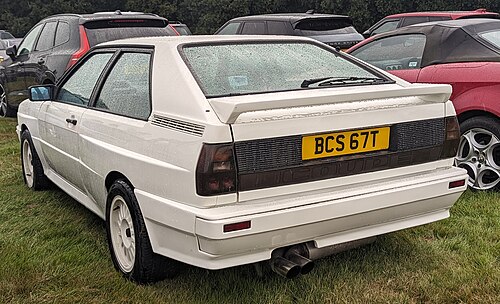
A 1985 Audi quattro 2.1. Photo: Calreyn88, Wikimedia Commons, CC BY-SA 4.0; resized.
Selected cars and engines
Examples are selected rather than a complete production list. Engine and equipment specifications can vary with year and market.
CarWhy it mattersEvidencequattro (1980)The original road car used a 2.1-litre turbocharged, intercooled inline-five and permanent four-wheel drive.Illustrated turbo historyAudi 100 TDI (1989)The launch TDI combined a 2.5-litre five-cylinder turbo diesel with direct injection and electronic management.Illustrated turbo historyS4/S5 3.0 TFSI, selected B8 versionsThe EA837 3.0-litre V6 used a factory mechanically driven Eaton TVS R1320; later engines carrying similar badges need checking.Eaton fitment guideA3 / A4Long-running compact and executive model families offered with many petrol, diesel and electrified powertrains.Model reference
More models and representative engines
These are specific examples rather than every engine offered. Equipment, output and capacity can change with model year and market; identify the exact vehicle before ordering parts.
An Audi RS2 Avant. Photo: Calreyn88, Wikimedia Commons, CC BY 4.0; resized and re-encoded.
Model and versionEngine or powertrainEvidenceRS2 Avant (1994)2.2-litre 20-valve turbocharged inline-five with quattro all-wheel drive.Manufacturer sourceTT 1.8T (first generation)1.8-litre 20-valve turbocharged inline-four; power and driven wheels vary by version.Manufacturer sourceR8 4.2 FSI (first generation)4.2-litre naturally aspirated V8; later R8 variants also used V10 engines.Manufacturer sourceRS6 (C5)4.2-litre twin-turbo V8 in the first-generation RS6.Manufacturer source
Identifying a car and engine
Use the VIN, market, model year and engine code when researching servicing, tuning or parts. A model badge may cover naturally aspirated, turbocharged, supercharged, hybrid or electric versions depending on the particular vehicle. Factory fitment and aftermarket conversions are distinguished in the linked guides.
Sources and related reading
Wikipedia: Audi — marque history and further references.Tuning Wiki: illustrated turbocharged-car timeline.Tuning Wiki: supercharger types and Eaton guides.
Text is unchanged; formatting, links or images changed. Compare the rendered revisions below.
Rendered revisions
Open each version to inspect formatting, tables and photographs.
Audi's history includes the early Audi company and Auto Union, whose four-ring emblem represents four previously independent marques. The modern Audi brand developed as part of Volkswagen's post-war passenger-car business. Wikipedia: Audi history.
Audi has built front-wheel-drive and quattro all-wheel-drive cars, with petrol and diesel engines and later electric models. Its five-cylinder and TDI engines are particularly relevant to the forced-induction timeline.
These are specific examples rather than every engine offered. Equipment, output and capacity can change with model year and market; identify the exact vehicle before ordering parts.
Use the VIN, market, model year and engine code when researching servicing, tuning or parts. A model badge may cover naturally aspirated, turbocharged, supercharged, hybrid or electric versions depending on the particular vehicle. Factory fitment and aftermarket conversions are distinguished in the linked guides.