Removed text is struck through; added text is highlighted.
Country of origin: Germany. Part of Car makes and the history of the motor car.
History and development
Mercedes-Benz brings together the histories of Benz and Daimler. Their predecessor businesses joined in 1926; earlier Benz and Mercedes vehicles helped shape the young motor industry. Wikipedia: Mercedes-Benz history.
The marque has built luxury cars, sports cars, diesels and commercial vehicles. Kompressor, CDI and AMG badges span many different engines, so check the model, year and engine code before identifying the induction system.
Examples are selected rather than a complete production list. Engine and equipment specifications can vary with year and market.
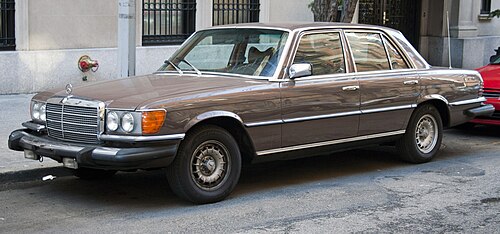
CarWhy it mattersEvidence300 SD W116 (1978)The North American-market 3.0-litre OM617 five-cylinder was an early production turbo-diesel passenger car.Illustrated turbo historySLK 200/230 Kompressor, specified M111 versionsA factory supercharged four-cylinder application. The Eaton M45 guide gives the documented examples and cautions on housing differences.Eaton fitment guideAMG SL 43 (2022)The 2.0-litre M139 uses an electrically assisted exhaust turbocharger and a 48-volt electrical system.Illustrated turbo historyS-ClassThe flagship saloon family includes many generations with six-, eight- and twelve-cylinder, diesel and hybrid variants.Model referenceC 180 Kompressor S203, specified M271.946 applicationA 1.8-litre supercharged four. The M65 pairing is inferred from two application sources and needs confirmation against the blower part number.Eaton M65 fitment guide
More models and representative engines
These are specific examples rather than every engine offered. Equipment, output and capacity can change with model year and market; identify the exact vehicle before ordering parts.
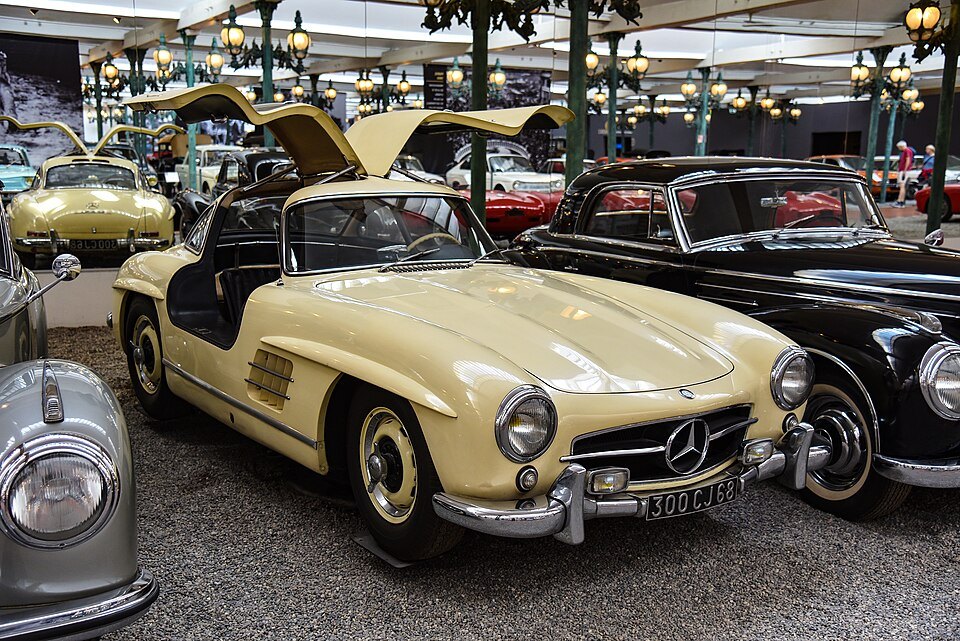
A Mercedes-Benz 300 SL Gullwing. Photo: Alan Raine from Cheshire, Wikimedia Commons, CC BY 2.0; resized and re-encoded.
Model and versionEngine or powertrainEvidence300 SL Gullwing (W198)3.0-litre M198 inline-six with mechanical direct petrol injection.Manufacturer source190 E 2.3-16 (W201)2.3-litre naturally aspirated 16-valve inline-four in the sporty W201 saloon.Manufacturer source500 E (W124)5.0-litre naturally aspirated V8 in the early 1990s performance saloon.Manufacturer sourceC 63 AMG (W204)The M156 naturally aspirated V8 is approximately 6.2 litres; the 6.3 badge is a model designation.California engine applicability documentModel and versionEngine or powertrainEvidence300 SL Gullwing (W198)3.0-litre M198 inline-six with mechanical direct petrol injection.Manufacturer source190 E 2.3-16 (W201)2.3-litre naturally aspirated 16-valve inline-four in the sporty W201 saloon.Manufacturer source500 E (W124)5.0-litre naturally aspirated V8 in the early 1990s performance saloon.Manufacturer sourceC 63 AMG (W204)The M156 naturally aspirated V8 is approximately 6.2 litres; the 6.3 badge is a model designation.Manufacturer source
Identifying a car and engine
Use the VIN, market, model year and engine code when researching servicing, tuning or parts. A model badge may cover naturally aspirated, turbocharged, supercharged, hybrid or electric versions depending on the particular vehicle. Factory fitment and aftermarket conversions are distinguished in the linked guides.
Sources and related reading
Wikipedia: Mercedes-Benz — marque history and further references.Tuning Wiki: illustrated turbocharged-car timeline.Tuning Wiki: supercharger types and Eaton guides.
Rendered revisions
Open each version to inspect formatting, tables and photographs.
Mercedes-Benz brings together the histories of Benz and Daimler. Their predecessor businesses joined in 1926; earlier Benz and Mercedes vehicles helped shape the young motor industry. Wikipedia: Mercedes-Benz history.
The marque has built luxury cars, sports cars, diesels and commercial vehicles. Kompressor, CDI and AMG badges span many different engines, so check the model, year and engine code before identifying the induction system.
These are specific examples rather than every engine offered. Equipment, output and capacity can change with model year and market; identify the exact vehicle before ordering parts.
A Mercedes-Benz 300 SL Gullwing. Photo: Alan Raine from Cheshire, Wikimedia Commons, CC BY 2.0; resized and re-encoded.
Model and version
Engine or powertrain
Evidence
300 SL Gullwing (W198)
3.0-litre M198 inline-six with mechanical direct petrol injection.
Use the VIN, market, model year and engine code when researching servicing, tuning or parts. A model badge may cover naturally aspirated, turbocharged, supercharged, hybrid or electric versions depending on the particular vehicle. Factory fitment and aftermarket conversions are distinguished in the linked guides.
Mercedes-Benz brings together the histories of Benz and Daimler. Their predecessor businesses joined in 1926; earlier Benz and Mercedes vehicles helped shape the young motor industry. Wikipedia: Mercedes-Benz history.
The marque has built luxury cars, sports cars, diesels and commercial vehicles. Kompressor, CDI and AMG badges span many different engines, so check the model, year and engine code before identifying the induction system.
These are specific examples rather than every engine offered. Equipment, output and capacity can change with model year and market; identify the exact vehicle before ordering parts.
A Mercedes-Benz 300 SL Gullwing. Photo: Alan Raine from Cheshire, Wikimedia Commons, CC BY 2.0; resized and re-encoded.
Use the VIN, market, model year and engine code when researching servicing, tuning or parts. A model badge may cover naturally aspirated, turbocharged, supercharged, hybrid or electric versions depending on the particular vehicle. Factory fitment and aftermarket conversions are distinguished in the linked guides.