Removed text is struck through; added text is highlighted.
Between 1959 and 1969 The Daimler Company of Coventry built four models around Edward Turner's hemi-head V8s. These were the SP250 sports car, the Majestic Major saloon, the DR450 limousine and the 2.5 V8 / V8-250 saloon. The SP250 and Majestic Major were Daimler's own designs from the end of BSA ownership. The DR450 was the last complete car the company designed. The 2.5 V8 used a Jaguar Mk 2 body after Jaguar bought Daimler in 1960, and it became the best-selling Daimler of the period. All four ended when British Leyland dropped the Daimler V8s in 1968–1969. The engines are covered in Daimler V8 engines and the company in Daimler: history and cars.
ModelYearsEngineGearboxBuilt
SP250 sports car1959–19642,548 cc V8, 140 bhp4-speed manual (overdrive provision) or Borg-Warner 3-speed automaticabout 2,650
Majestic Major (DQ450) saloon1960–19684,561 cc V8, 220 bhpBorg-Warner DG250M 3-speed automatic1,180
DR450 limousine1961–19684,561 cc V8, 220 bhpBorg-Warner DG250M automatic864
2.5 V8 / V8-250 saloon1962–19692,548 cc V8, 140 bhpAutomatic as standard. A manual-overdrive option is reported for the V8-250 but is not confirmed in the sources used here.17,620
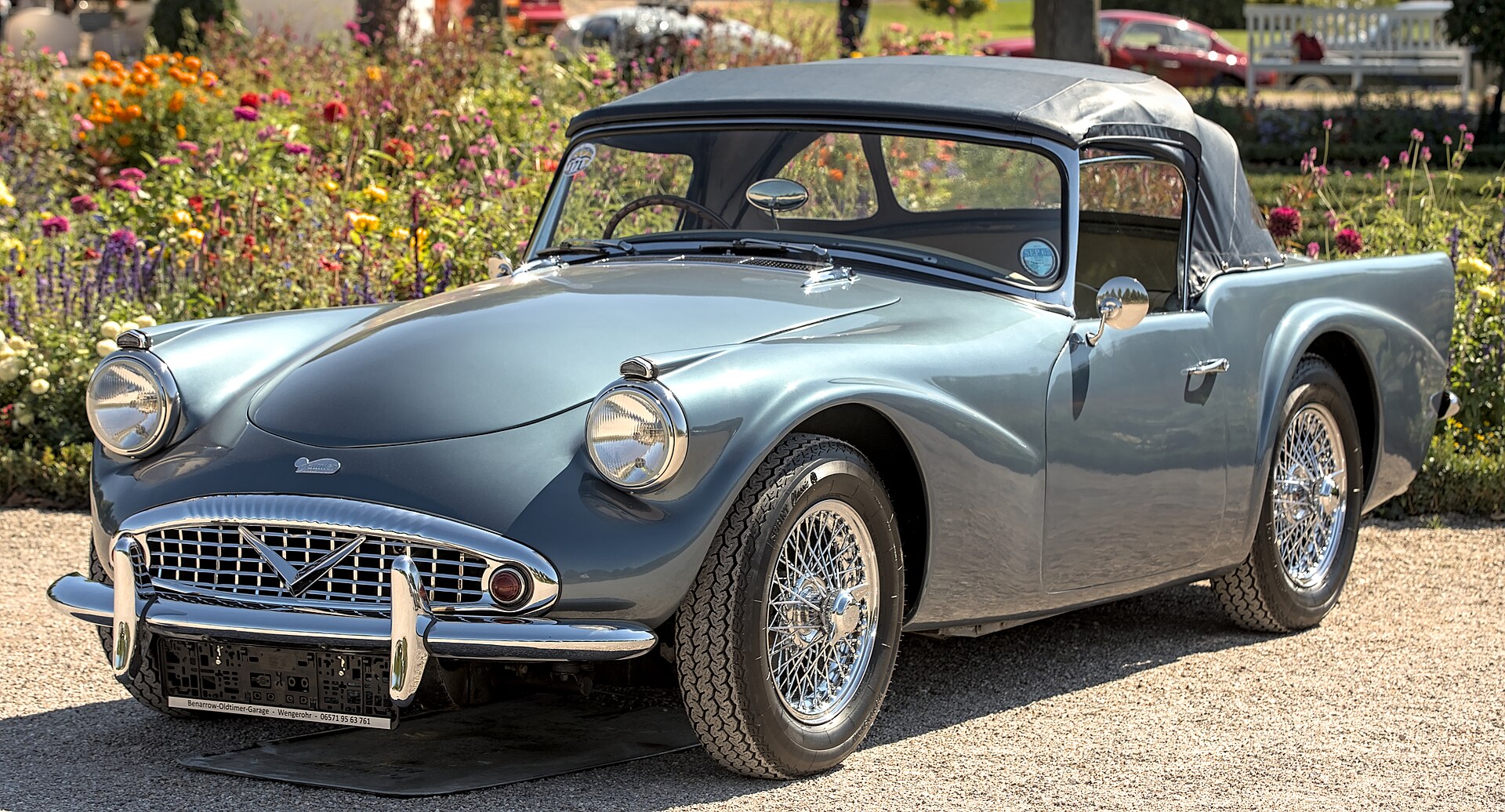
SP250
A 1959 Daimler SP250. Photo: Alexander Migl, Wikimedia Commons, CC BY-SA 4.0.
The SP250 was a glass-fibre two-seat sports car aimed at the US market. It was launched as the Daimler Dart at the New York Motor Show in April 1959. Chrysler's Dodge division held the "Dart" trademark and threatened legal action, so Daimler sold the car under its project number, SP250.
Chassis: a 14-gauge ladder frame with cruciform bracing, based on the Triumph TR3. It has coil-spring independent front suspension and a leaf-sprung live rear axle. Girling disc brakes are fitted on all four wheels.
Gearbox: the four-speed manual was derived from the Standard gearbox of the TR3A, with synchromesh on the top three ratios. A three-speed automatic was optional.
Dimensions: 92 in wheelbase, 165 in long, and a kerb weight of about 2,070 lb (940 kg). The car is sometimes described as a 2+2, with a small bench behind the seats.
Performance: The Motor tested a hardtop in 1960 and recorded 123.7 mph and 0–60 mph in 8.9 seconds, at about 25 mpg (imperial).
Three specifications were built:
A-spec was the original car. The early chassis flexed enough that doors could open on the move.
B-spec was introduced after Jaguar took over in 1960. It added chassis outriggers, a hoop between the A-posts and an adjustable steering column.
C-spec, from April 1963, made the heater, a trickle-charge socket and the cigar lighter standard.
Between 26 and 30 black SP250s served with the London Metropolitan Police traffic department, most with the Borg-Warner Model 8 automatic. Other UK, Australian and New Zealand forces also used the car. Several derivatives were built as prototypes but not produced: the DP250 sports saloon, the Ogle SX250 coupé and the SP252, a single car re-styled under William Lyons. Total production was about 2,650. Published figures are 2,645, 2,648 and 2,654.
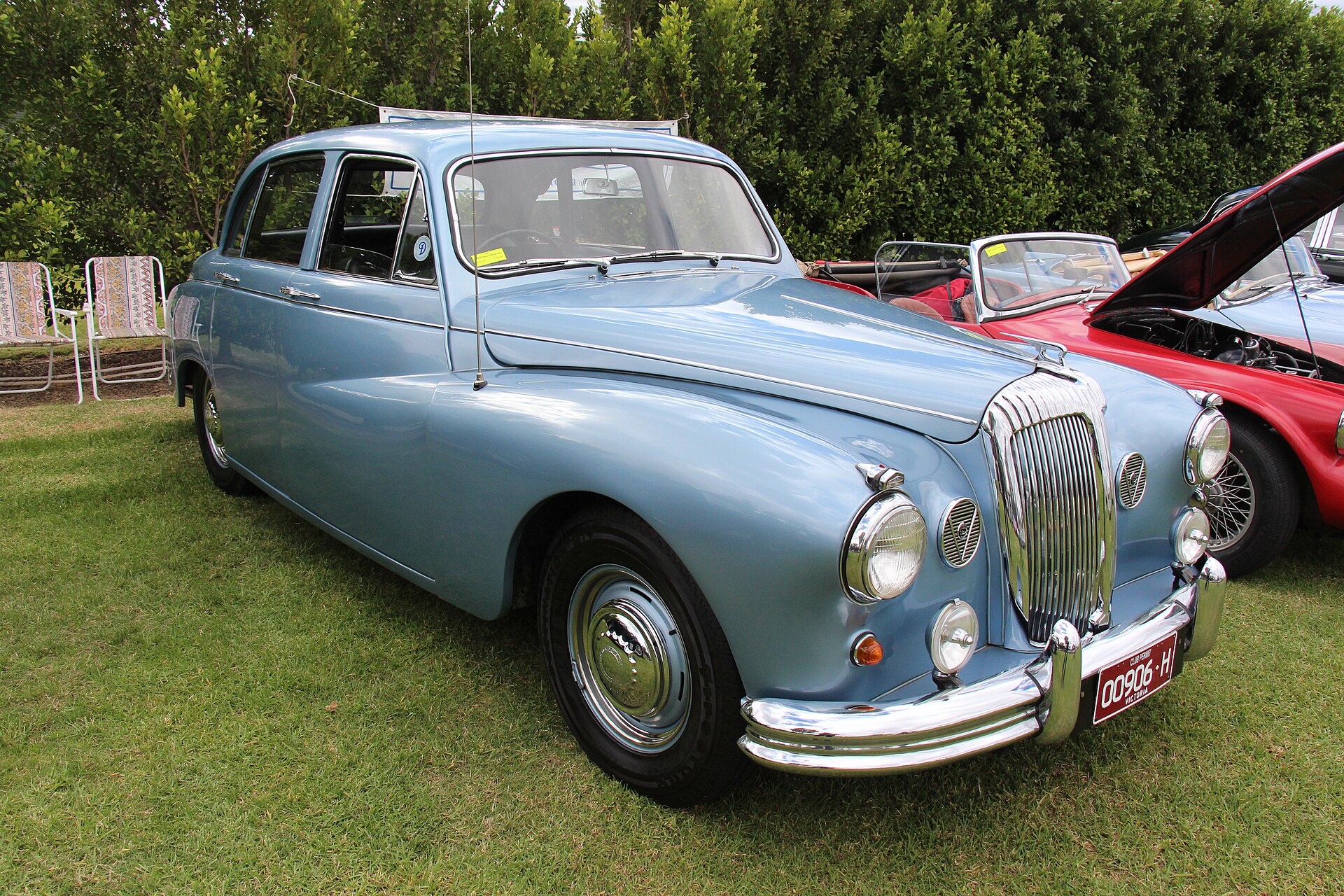
Majestic Major (DQ450)
A 1964 Daimler Majestic Major DQ450. Photo: Sicnag, Wikimedia Commons, CC BY 2.0.
The Majestic Major was a longer, V8-engined development of the six-cylinder Majestic of 1958. It was shown as a prototype at the London Motor Show on 20 October 1959, and production began in November 1960. Its separate chassis descends from the 1937 New Fifteen design. The box-section frame is cruciform-braced, with coil-spring independent front suspension and a live rear axle on semi-elliptic springs. It has Dunlop disc brakes on all four wheels with a vacuum servo. Carbodies and Park Sheet Metal built the steel bodies.
Dimensions: 114 in wheelbase, 202 in long and a kerb weight of about 4,090 lb (1,854 kg).
Gearbox: the Borg-Warner DG250M three-speed automatic was the only transmission.
Later changes: power steering was optional at first and standard from October 1964. Late cars gained a limited-slip differential and an alternator.
Performance: The Motor recorded 122.3 mph and 0–60 mph in 9.7 seconds in 1961. The Times recorded 123 mph and 0–60 in 10 seconds in 1963, against 12.1 seconds for a Jaguar Mark X.
1,180 were built. Some summaries date the model 1959–1968, counting from the show car rather than from the start of production.
DR450 limousine
The DR450 is an eight-seat, chauffeur-driven limousine built on a Majestic Major chassis lengthened by 24 in. It has a 138 in wheelbase, an overall length of 5.74 m and a kerb weight of about 2,120 kg. It used the same 4.5 V8 and DG250M automatic, with Hydrosteer power steering. Autocar (January 1963) recorded a mean top speed of 113.5 mph. In October 1961 it cost £3,995, against £2,393 for a Jaguar Mark X. 864 were built from 1961 to 1968. It was the last complete car designed by The Daimler Company before Jaguar-based models took over. It was replaced as Daimler's limousine by the DS420 (1968).
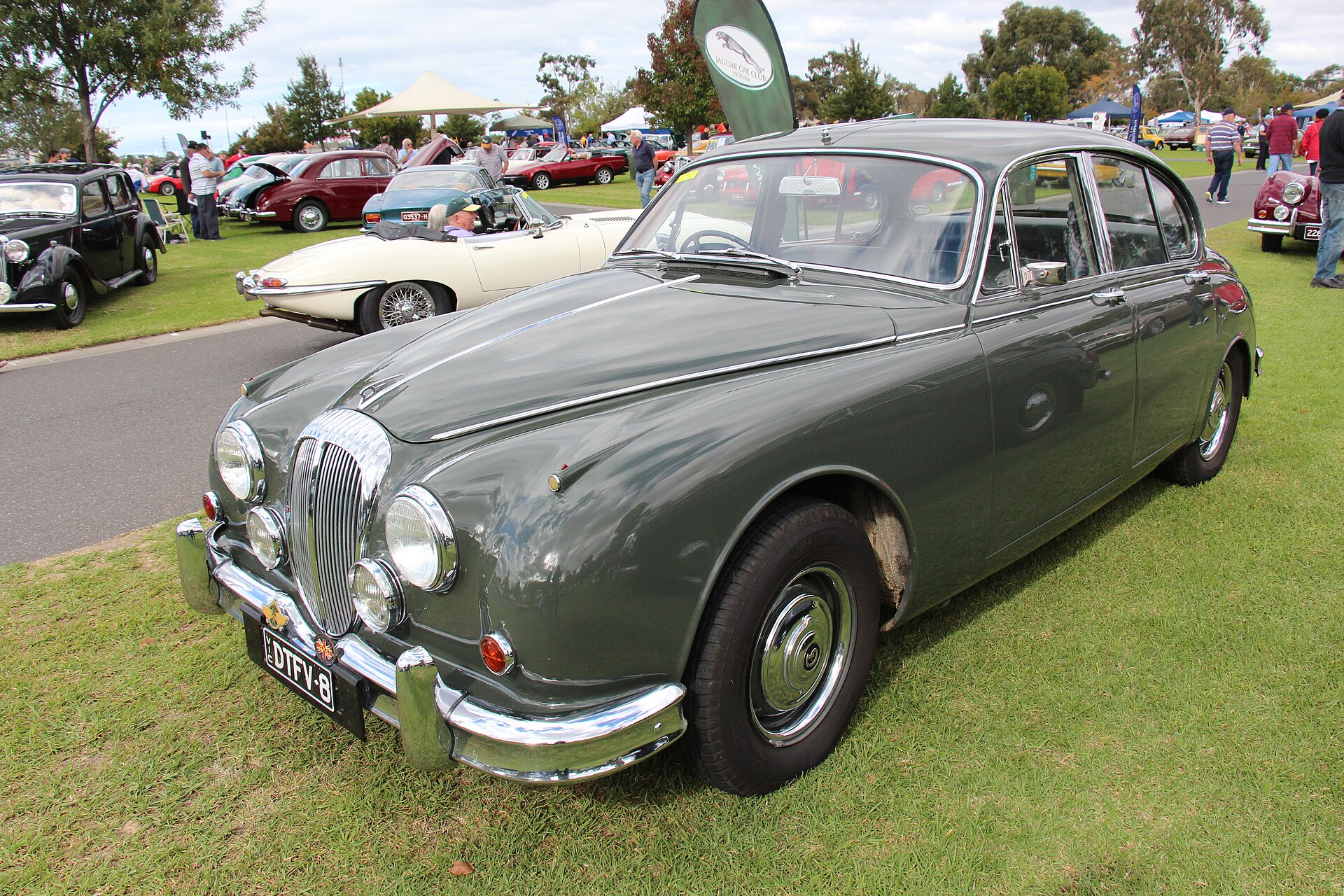
2.5 V8 and V8-250
A 1964 Daimler 2.5 V8. Photo: Sicnag, Wikimedia Commons, CC BY 2.0.
The 2.5 V8 was introduced in 1962. It combined the body of the Jaguar Mk 2 with the SP250 engine, a fluted Daimler grille and a more luxurious trim. The V8 is lighter and more compact than Jaguar's 2.4 XK six, which the car replaced in Daimler form, and it gave more power. It was renamed V8-250 in 1967, in line with the Jaguar 240/340 update. 17,620 were built up to 1969, which made it the best-selling Daimler of its era. The Mk 2 platform and its XK-engined Jaguar relatives are covered in Jaguar classic saloons.
Identification and buying notes
Every car in this group has the Turner V8. A Daimler Sovereign or a later Daimler with the fluted grille uses a Jaguar XK six or a V12 instead.
A V8-engined Mk 2-shape car with a fluted grille is a 2.5 V8 or V8-250, not a re-badged Jaguar.
Many 2.5 V8 engines have been removed for SP250 restorations and racing, and SP250 chassis specifications differ between A, B and C cars. Check engine and chassis numbers against club records. The number ranges were not established in the sources used here.
Sources
Daimler SP250, Wikipedia contributors, revision of 8 June 2026, CC BY-SA 4.0. Accessed 2026-11-19.
Daimler Majestic Major, Wikipedia contributors, revision of 15 October 2026. Accessed 2026-11-19.
Daimler DR450, Wikipedia contributors, revision of 13 April 2026. Accessed 2026-11-19.
Daimler V8 engines, Wikipedia contributors, revision of 3 April 2026. Accessed 2026-11-19.
List of Daimler cars, Wikipedia contributors, revision of 25 October 2025. Accessed 2026-11-19.
Rendered revisions
Open each version to inspect formatting, tables and photographs.
Revision 1: Daimler SP250, Majestic Major, DR450 and 2.5 V8: models and engines
Between 1959 and 1969 The Daimler Company of Coventry built four models around Edward Turner's hemi-head V8s. These were the SP250 sports car, the Majestic Major saloon, the DR450 limousine and the 2.5 V8 / V8-250 saloon. The SP250 and Majestic Major were Daimler's own designs from the end of BSA ownership. The DR450 was the last complete car the company designed. The 2.5 V8 used a Jaguar Mk 2 body after Jaguar bought Daimler in 1960, and it became the best-selling Daimler of the period. All four ended when British Leyland dropped the Daimler V8s in 1968–1969. The engines are covered in Daimler V8 engines and the company in Daimler: history and cars.
Model
Years
Engine
Gearbox
Built
SP250 sports car
1959–1964
2,548 cc V8, 140 bhp
4-speed manual (overdrive provision) or Borg-Warner 3-speed automatic
about 2,650
Majestic Major (DQ450) saloon
1960–1968
4,561 cc V8, 220 bhp
Borg-Warner DG250M 3-speed automatic
1,180
DR450 limousine
1961–1968
4,561 cc V8, 220 bhp
Borg-Warner DG250M automatic
864
2.5 V8 / V8-250 saloon
1962–1969
2,548 cc V8, 140 bhp
Automatic as standard. A manual-overdrive option is reported for the V8-250 but is not confirmed in the sources used here.
The SP250 was a glass-fibre two-seat sports car aimed at the US market. It was launched as the Daimler Dart at the New York Motor Show in April 1959. Chrysler's Dodge division held the "Dart" trademark and threatened legal action, so Daimler sold the car under its project number, SP250.
Chassis: a 14-gauge ladder frame with cruciform bracing, based on the Triumph TR3. It has coil-spring independent front suspension and a leaf-sprung live rear axle. Girling disc brakes are fitted on all four wheels.
Gearbox: the four-speed manual was derived from the Standard gearbox of the TR3A, with synchromesh on the top three ratios. A three-speed automatic was optional.
Dimensions: 92 in wheelbase, 165 in long, and a kerb weight of about 2,070 lb (940 kg). The car is sometimes described as a 2+2, with a small bench behind the seats.
Performance:The Motor tested a hardtop in 1960 and recorded 123.7 mph and 0–60 mph in 8.9 seconds, at about 25 mpg (imperial).
Three specifications were built:
A-spec was the original car. The early chassis flexed enough that doors could open on the move.
B-spec was introduced after Jaguar took over in 1960. It added chassis outriggers, a hoop between the A-posts and an adjustable steering column.
C-spec, from April 1963, made the heater, a trickle-charge socket and the cigar lighter standard.
Between 26 and 30 black SP250s served with the London Metropolitan Police traffic department, most with the Borg-Warner Model 8 automatic. Other UK, Australian and New Zealand forces also used the car. Several derivatives were built as prototypes but not produced: the DP250 sports saloon, the Ogle SX250 coupé and the SP252, a single car re-styled under William Lyons. Total production was about 2,650. Published figures are 2,645, 2,648 and 2,654.
The Majestic Major was a longer, V8-engined development of the six-cylinder Majestic of 1958. It was shown as a prototype at the London Motor Show on 20 October 1959, and production began in November 1960. Its separate chassis descends from the 1937 New Fifteen design. The box-section frame is cruciform-braced, with coil-spring independent front suspension and a live rear axle on semi-elliptic springs. It has Dunlop disc brakes on all four wheels with a vacuum servo. Carbodies and Park Sheet Metal built the steel bodies.
Dimensions: 114 in wheelbase, 202 in long and a kerb weight of about 4,090 lb (1,854 kg).
Gearbox: the Borg-Warner DG250M three-speed automatic was the only transmission.
Later changes: power steering was optional at first and standard from October 1964. Late cars gained a limited-slip differential and an alternator.
Performance:The Motor recorded 122.3 mph and 0–60 mph in 9.7 seconds in 1961. The Times recorded 123 mph and 0–60 in 10 seconds in 1963, against 12.1 seconds for a Jaguar Mark X.
1,180 were built. Some summaries date the model 1959–1968, counting from the show car rather than from the start of production.
DR450 limousine
The DR450 is an eight-seat, chauffeur-driven limousine built on a Majestic Major chassis lengthened by 24 in. It has a 138 in wheelbase, an overall length of 5.74 m and a kerb weight of about 2,120 kg. It used the same 4.5 V8 and DG250M automatic, with Hydrosteer power steering. Autocar (January 1963) recorded a mean top speed of 113.5 mph. In October 1961 it cost £3,995, against £2,393 for a Jaguar Mark X. 864 were built from 1961 to 1968. It was the last complete car designed by The Daimler Company before Jaguar-based models took over. It was replaced as Daimler's limousine by the DS420 (1968).
The 2.5 V8 was introduced in 1962. It combined the body of the Jaguar Mk 2 with the SP250 engine, a fluted Daimler grille and a more luxurious trim. The V8 is lighter and more compact than Jaguar's 2.4 XK six, which the car replaced in Daimler form, and it gave more power. It was renamed V8-250 in 1967, in line with the Jaguar 240/340 update. 17,620 were built up to 1969, which made it the best-selling Daimler of its era. The Mk 2 platform and its XK-engined Jaguar relatives are covered in Jaguar classic saloons.
Identification and buying notes
Every car in this group has the Turner V8. A Daimler Sovereign or a later Daimler with the fluted grille uses a Jaguar XK six or a V12 instead.
A V8-engined Mk 2-shape car with a fluted grille is a 2.5 V8 or V8-250, not a re-badged Jaguar.
Many 2.5 V8 engines have been removed for SP250 restorations and racing, and SP250 chassis specifications differ between A, B and C cars. Check engine and chassis numbers against club records. The number ranges were not established in the sources used here.
Sources
Daimler SP250, Wikipedia contributors, revision of 8 June 2026, CC BY-SA 4.0. Accessed 2026-11-19.
Daimler Majestic Major, Wikipedia contributors, revision of 15 October 2026. Accessed 2026-11-19.
Daimler DR450, Wikipedia contributors, revision of 13 April 2026. Accessed 2026-11-19.
Daimler V8 engines, Wikipedia contributors, revision of 3 April 2026. Accessed 2026-11-19.
List of Daimler cars, Wikipedia contributors, revision of 25 October 2025. Accessed 2026-11-19.