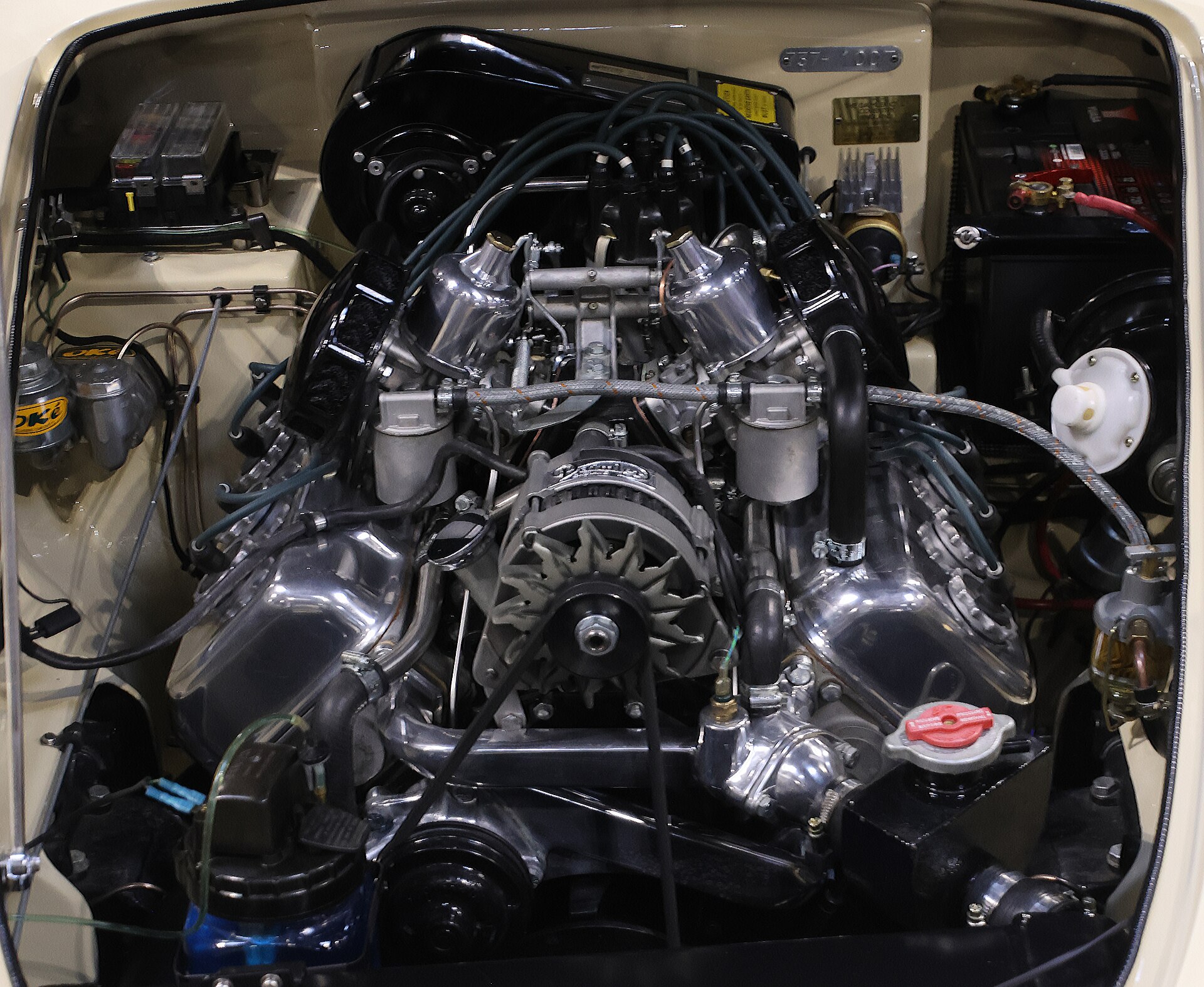
The Daimler V8 engines are two pushrod V8s with hemispherical combustion chambers, designed by Edward Turner for The Daimler Company of Coventry (then part of the BSA group). Daimler built them from 1959 to 1969: a 2.5-litre (2,548 cc) unit for the SP250 sports car and the 2.5 V8 / V8-250 saloon, and a 4.5-litre (4,561 cc) unit for the Majestic Major saloon and DR450 limousine. They are unrelated to the German Daimler-Benz company. About 22,000 were built in total. Production ended after Daimler passed through Jaguar into British Leyland. The small engine went on to a second life in British drag racing. It is compact, light and has a true hemi head, and supercharged, nitromethane-burning 2.5-litre Daimlers became some of the quickest cars in Europe with a British engine. A Daimler-engined dragster made the first quarter-mile pass under eight seconds by a British-engined car (1980). The first six-second pass by a British-engined car was also made with a Daimler (1989). See also Daimler: history and cars and the engine index.

Origin and design
Edward Turner had made his name at Ariel and Triumph motorcycles, where his designs included the Triumph Speed Twin. He became managing director of BSA's automotive division, which included Daimler, in 1956. Daimler's post-war saloons were heavy, slow-selling straight-sixes and straight-eights, and Turner was asked for a modern V8 for a new saloon. The design engineer was Jack Wickes, and much of the prototype development was done by Dr J. N. H. Tait. Turner kept the layout simple to hold down cost. It has a single camshaft and pushrods, and the cylinder head is derived from Triumph motorcycle practice, with the hemispherical chamber of Turner's motorcycle engines. The two sizes share their basic architecture. The 2.5 is the more refined design per litre. The 4.5 has a much larger bore and stroke.
- Layout: 90° V8. The cast-iron block has a short, stiff, five-main-bearing crankshaft, dynamically balanced, with a torsional damper on the nose.
- Heads: light-alloy cylinder heads with part-hemispherical combustion chambers and two inclined valves per cylinder. The valve layout and twin rocker shafts are often compared to a scaled-down early Chrysler Hemi.
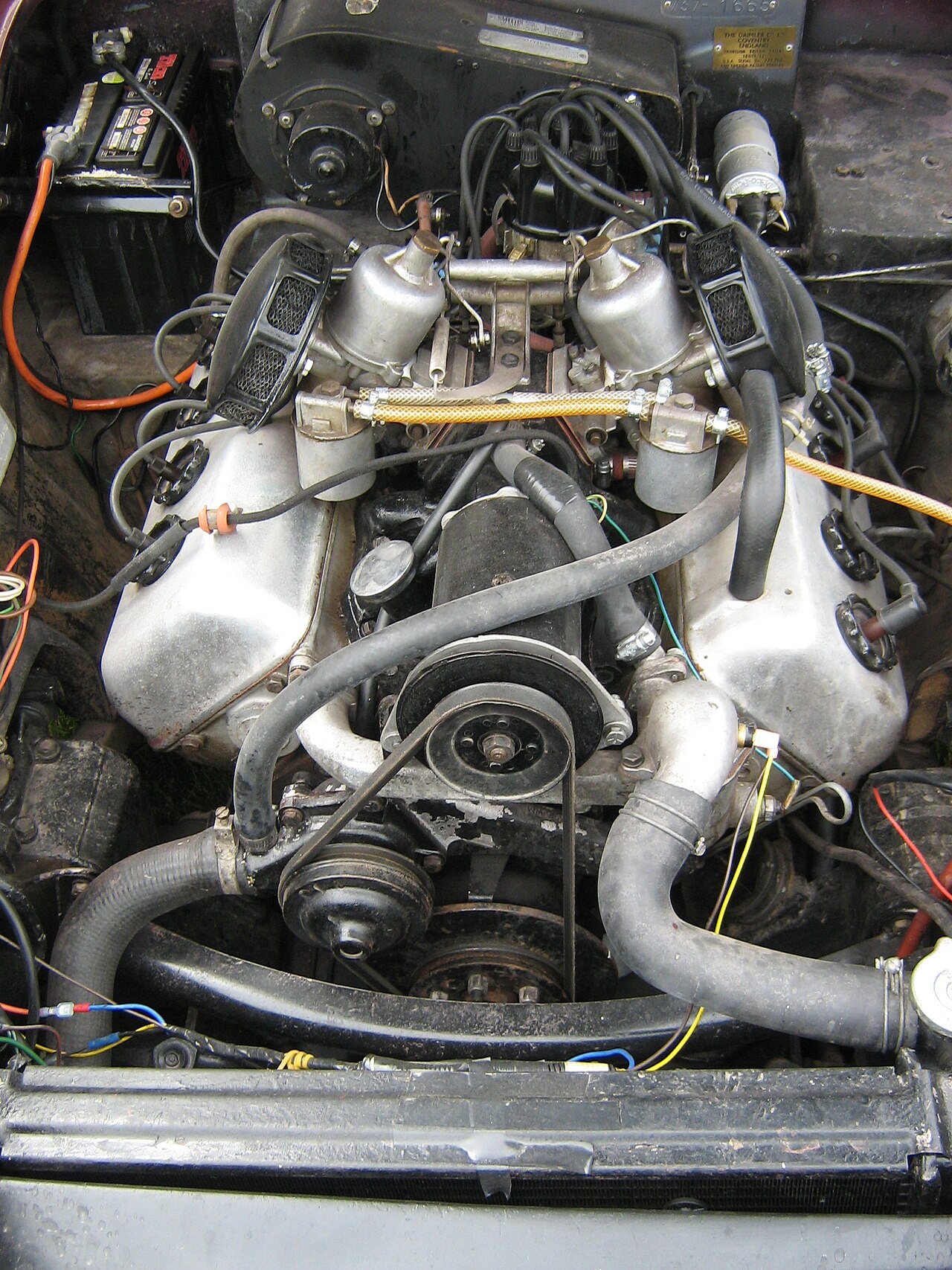
- Valvetrain: a single chain-driven camshaft mounted centrally and high in the vee, operating the valves through short pushrods and rockers. The distributor is driven from the rear of the camshaft and sits high behind the carburettors.
- Ancillaries: light-alloy rocker covers, tappet blocks, sump and inlet manifolds, and a separate exhaust system for each bank. A belt drives the water pump and the dynamo, which on the 2.5 sits between the banks.
Tooling was limited. The 2.5 line was laid out for a maximum of about 140 engines a week, a rate the factory never reached, and the 4.5 was only ever built in small numbers.
Specifications
| 2.5 litre | 4.5 litre | |
|---|---|---|
| Bore × stroke | 76.2 × 69.85 mm (3.00 × 2.75 in) | 95.25 × 80.01 mm (3.75 × 3.15 in) |
| Capacity | 2,548 cc (155 cu in). Often quoted as 2,547 cc or "153 cu in". | 4,561 cc (278 cu in). Often quoted as "275 cu in". |
| Compression ratio | 8.2:1 | 8.0:1 |
| Quoted power | 140 bhp at 5,800 rpm | 220 bhp at 5,500 rpm |
| Quoted torque | 150–155 lb ft at 3,600 rpm (sources differ) | 283 lb ft at 3,200 rpm |
| Carburettors | Twin SU HD6, semi-downdraught | Twin SU HD8, SU electric fuel pump |
| Dry weight | 419 lb (190 kg), excluding flywheel | 498 lb (226 kg) |
| Overall size (L × W × H) | 30 × 24 × 27 in | 31.25 × 25.5 × 31 in |
| Built | 1959–1969 | 1959–1968 |
The power and torque figures are period factory figures. No source states whether they are gross or net. For the SP250 engine, the Daimler V8 reference gives 150 lb ft and the SP250 reference gives 155 lb ft. Both agree on 140 bhp. Carburettor and fuelling background is on SU carburettors: types, sizing and models.
Cars fitted and production
| Engine | Vehicle | Years | Number built |
|---|---|---|---|
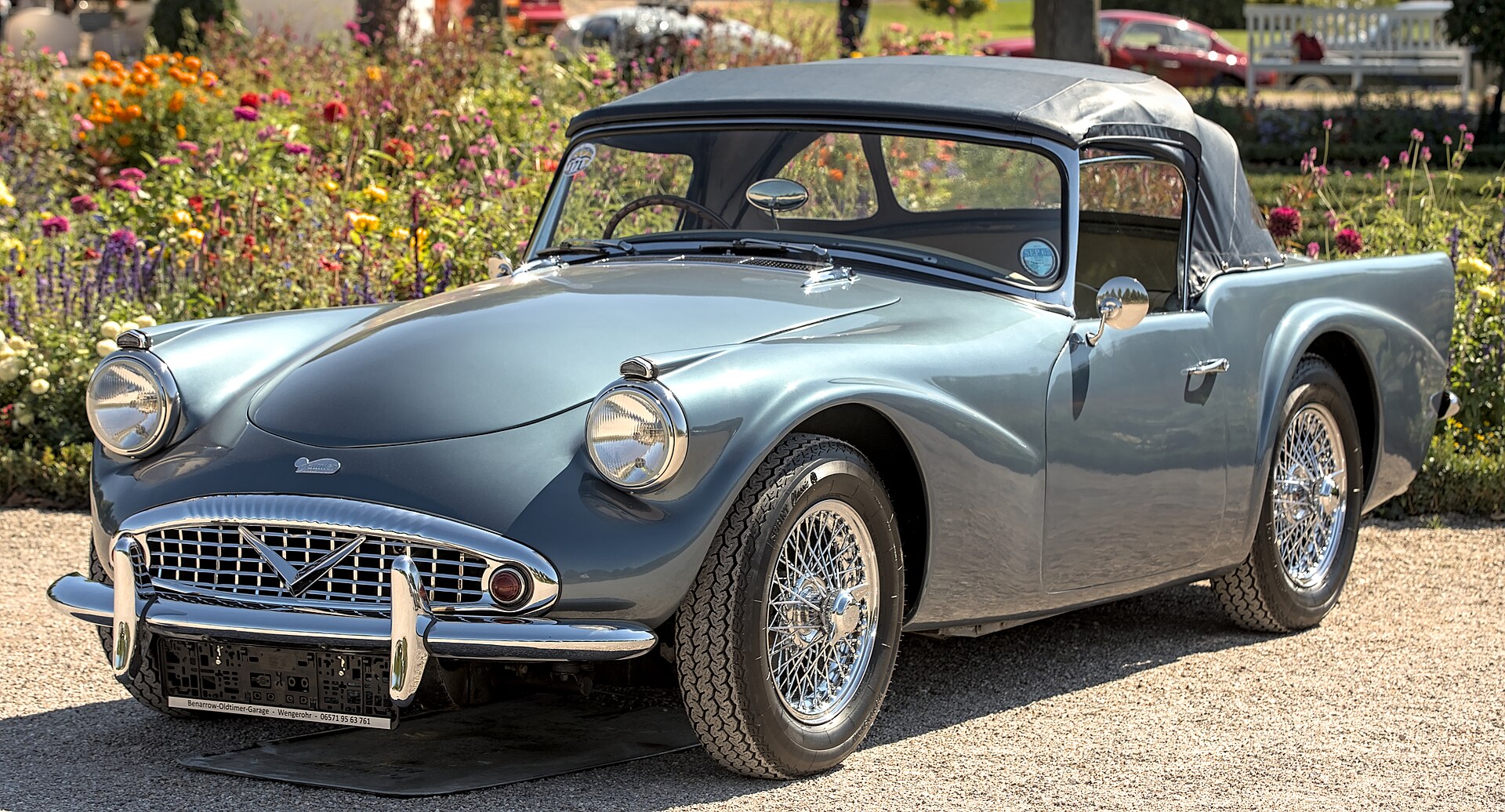
| 2.5 litre | SP250 (shown as the "Dart") glass-fibre sports car, manual or automatic | 1959–1964 | About 2,650. Totals of 2,645, 2,648 and 2,654 are all published. |
| 2.5 V8, renamed V8-250 in 1967: a Jaguar Mk 2 body with the Daimler engine and fluted grille | 1962–1969 | 17,620 | |
| 4.5 litre | Majestic Major (DQ450) saloon, automatic only | 1960–1968 | 1,180 |
| DR450 eight-seat limousine, a long-wheelbase Majestic Major | 1961–1968 | 864 |
That makes roughly 20,270 of the 2.5 and 2,044 of the 4.5. Marine versions of the 2.5 were announced in December 1961. A 4.5 was tried in a Jaguar Mark X after Jaguar bought Daimler in 1960. A top speed of 133 mph at MIRA has been reported for that car but is not authenticated. The engine was not adopted, most likely because of the limited production capacity. The cars are covered in more detail in Daimler SP250, Majestic Major, DR450 and 2.5 V8: models and engines.

End of production
Jaguar bought Daimler from BSA in May 1960 and kept both V8s in production. Jaguar merged with BMC in 1966, and the group became part of British Leyland in 1968. BL chairman Sir Donald Stokes judged the engines too costly to build alongside Jaguar's XK six and ordered them discontinued. The Majestic Major and DR450 ended in 1968 and the V8-250 in 1969. Later Daimlers used Jaguar's XK six and V12.
Drag racing
In Britain the small Daimler V8 became the main British-built engine in fuel dragsters. It offered a genuine hemispherical head and alloy heads in a block that weighs well under 200 kg dressed. Its short stroke also suited high engine speed. Racers ran it with a Roots supercharger on methanol or nitromethane, usually in rear-engined chassis. It is the engine behind both of the British-engined milestones in European drag racing. These were the first runs under eight and under seven seconds by a car with a British engine. Period British Leyland advice, as recalled by Russ Carpenter's team, was that the engine became unreliable beyond about 200 hp. Supercharged racing versions have run on largely stock castings at many times that figure.
Early cars (late 1960s to early 1970s)
- Opus One, driven by Cliff Jones, is recorded in period Santa Pod photographs as "powered by a V8 Daimler hemi". The year, capacity and times are not recorded in the caption.
- Trouble / More Trouble belonged to Tony Anderson. Anderson ran a Ford V6-engined dragster called Trouble in 1969. With Russ Carpenter he then built a rear-engined chassis around a supercharged Daimler V8, one of the first rear-engined dragsters built in the UK. It first ran as More Trouble in March 1972. A caption from the 4th Internationals (1973, HMS Daedalus, Gosport) describes "a 2500cc blown and injected V8 Daimler".
Glacier Grenade (Russ Carpenter and Tony Anderson)
Carpenter drove the Anderson–Carpenter car from 1975. It was renamed Glacier Grenade in 1979, when AE Autoparts (Hepolite Glacier) began sponsoring it. The engine stayed largely stock internally, including Triumph TR6 pistons, even as the nitro percentage rose. The team fabricated its own fuel system and slider clutch, adapted a B&J transmission, and later fitted a Ford nine-inch rear axle.
- July 1980: the car became the first British-engined car, and the first car under five litres anywhere, to cover the quarter mile in under eight seconds. The team presents these as two world records.
- Best: 7.2 seconds at 180 mph.
- Power: Carpenter calculated about 400 hp for the early configuration. The team says the engine eventually made over 1,000 hp, and a figure of 1,400 bhp is also published. Neither is supported by a published dyno sheet.
- Results: the car won the European (Euro Series) championship twice in the 1980s, raced at Mantorp Park, Sweden, and was placed in Top Fuel at Le Mans in 1983. Small nitro cars were excluded from the Euro Series in 1989. Carpenter kept the car and has exhibited it since. He was inducted into the British Drag Racing Hall of Fame in 2014.
Robin Read (Team Triple R)
Robin Read's family team has run Daimler-engined dragsters since 1981. It holds the quickest and fastest figures for a British-engined car.
| Year | Car or milestone | Result |
|---|---|---|
| 1981 | First rear-engined Daimler, supercharged and fuel-injected, on methanol | None recorded |
| 1986 | "Half car", new chassis and rear axle, on nitromethane | None recorded |
| 1987 | New self-built car | Won its debut meeting |
| 1989 | Euro Series champion, with a series record of 7.04 s / 184 mph | 6.97 s at 187 mph at the Santa Pod finals, the first six-second run by a car with a British engine |
| 1992 | None recorded | 6.81 s at 189 mph |
| 2012 | Car recommissioned after a static display at Dragstalgia 2011 | 7.08 s at 187 mph on its second pass |
| 2017 | None recorded | 6.69 s at 199.89 mph |
| 2020 onward | New dragster, Spirit of Le Patron | Best 6.37 s at about 209 mph at Santa Pod |
One feature article dates Read's first British-engined six-second run to 1984. The team's own timeline places it at the 1989 Euro Series finals, which fits the 7.04-second series record set the same year. This page follows the team timeline. The Read family was inducted into the British Drag Racing Hall of Fame in 2008.
The current car is described in some detail in a 2022 feature. Its chassis was built in 2020 by Wayne Allman to SFI 2.5C, on a 250-inch wheelbase, and weighs a reported 1,765 lb. The engine keeps a production 2.5 cast-iron block, with these changes:
- Block and crank: the original block is reinforced with custom four-bolt billet main caps and ARP studs, and its cam tunnel is opened out for larger cam bearings. It carries a billet steel crankshaft.
- Rods and pistons: hybrid billet-aluminium rods with steel Daimler caps, and forged Venolia pistons.
- Heads and valvetrain: billet aluminium straight-port heads with titanium inlet valves and a fabricated shaft-rocker system. A Kent Cams flat-tappet camshaft with oversize journals runs titanium pushrods.
- Induction: a Littlefield 4-71 supercharger stretched with 6-71 rotors, on about 88% nitromethane. The fuel is delivered by an Enderle 1200 pump through a carbon-fibre injector.
- Driveline: a three-disc clutch, a Lenco CS4 transmission and a Strange Ford-modular rear end.
The article quotes a 3.030 in bore and a 2.800 in stroke. That would give about 2.65 litres, not the factory 2.55 litres, so the engine may be slightly enlarged. The article also calls it "153 cubic inches", which does not match those dimensions. The exact racing capacity is therefore not established.
Hillclimb and road tuning
- Felday-Daimler: Peter Westbury's hillclimb special used a supercharged 2.5 with a 2 in SU carburettor and a Roots blower. He won the 1963 RAC Hillclimb Championship with it and set course records at Craigantlet and Dyrham Park.
- Vintage-racing SP250: a 2026 feature documents a rebuilt 2.5 in a 1962 SP250. On a chassis dynamometer it went from 133 to 183 rear-wheel hp, about 38% more. The rebuild used 12.5:1 forged pistons, a billet crankshaft with main caps made by Robin Read, Manley I-beam rods and a cam with 0.310 in lobe lift (stock 0.294 in). It also used shaft-mounted roller rockers at 1.6:1 (stock 1.56:1), ported heads and a single two-barrel Holley 350 cfm carburettor. Before the rebuild the tired, near-stock engine had measured 87.5 rear-wheel hp on a chassis dyno. These are rear-wheel figures and are not comparable with the factory gross-or-net crank ratings.
- Common themes: the racing and vintage builds all reinforce the main bearing caps, replace the crankshaft and rods for high loads, and replace or revise the rocker gear. The stock heads and block are retained or copied where class rules require them.

Not established
- Whether the factory power figures are gross or net. Factory valve sizes, cam timing and firing order were not found in the sources consulted.
- Engine-number prefixes for distinguishing SP250, saloon, marine and 4.5 engines.
- Verified dyno power for the supercharged drag engines, and the exact capacity of the current Read engine.
- The capacity, years and times of Cliff Jones's Opus One.
Sources
- Daimler V8 engines, Wikipedia contributors, revision of 3 April 2026 (oldid 1346901033), CC BY-SA 4.0. Design history, specifications, production totals, end of production, Felday-Daimler. Accessed 2026-11-19.
- Daimler SP250, Wikipedia contributors, revision of 8 June 2026. Accessed 2026-11-19.
- Daimler Majestic Major and Daimler DR450, Wikipedia contributors, revisions of 15 October 2026 and 13 April 2026. Accessed 2026-11-19.
- Bill Holland, "Drag Racing Diversity: The Nitro-Burning Daimler Dragster", Dragzine, 25 July 2022. Robin Read car and engine specification. Accessed 2026-11-19.
- Bill Holland, "Rebuilding A Vintage Daimler 2.5L V8 And Picking Up Big Power On The Dyno", EngineLabs, 14 July 2026. Accessed 2026-11-19.
- Russ Carpenter, British Drag Racing Hall of Fame (inducted 2014), undated. Accessed 2026-11-19.
- Russ Carpenter: the racer, Russ Carpenter Racing, undated. This is the team's own account and closely follows the Hall of Fame text. Accessed 2026-11-19.
- Robin Read Dragster, Bexhill 100 Motoring Club, undated team timeline. Accessed 2026-11-19.
- Roger Phillips Collection: 1973 4th Internationals, The Acceleration Archive, posted 29 July 2013. Caption for Tony Anderson's Trouble. Accessed 2026-11-19.
- The Peter Quinn Collection, page 1, The Acceleration Archive, undated. Caption for Cliff Jones's Opus One. Accessed 2026-11-19.