Engine types and cycles · Rotary aero engines
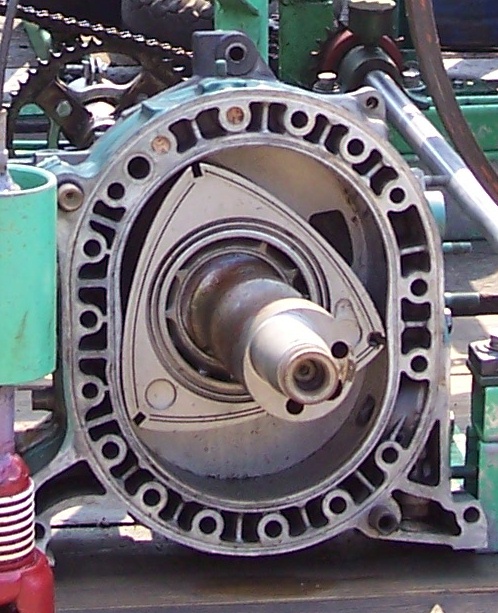

A triangular rotor turns in a fixed housing and carries the mixture through intake, compression, combustion and exhaust. Felix Wankel proved the idea. Hanns-Dieter Paschke designed the engine that could be built. In basic petrol form it has lower thermal efficiency and higher exhaust emissions than a four-stroke piston engine, and it is smaller, smoother and has fewer parts. A rotary aero engine is a piston engine whose cylinders spin. This is the other machine.
| Use | Chainsaws, auxiliary power units, aircraft, watercraft, snowmobiles, motorcycles, racing cars and range extenders. On the road, NSU and then Mazda. Mazda’s first was the 1967 Cosmo 110S, and the company then kept the engine for sports cars, including the Renesis in the RX-8 from 2003. The cutaway is an RX-7 engine. |
|---|---|
| First | Wankel patented a pistonless eccentric rotary engine in 1954. The Wankel article dates the engine’s introduction to the 1960s. |
| Widest use | Mazda’s sports-car years, from the late 1960s through the RX-8. |
| Now | Mazda ended rotary production in 2012 after the engine failed Euro 5. In March 2023 it launched the MX-30 R-EV, whose 830 cc single-rotor Wankel, rated at 55 kW, charges the battery and does not drive the wheels. The 31 October 2026 revision still records that car. The RX-7 engine in the photograph is out of production. |
Sources
Curated reference notes. Hardware testing by this wiki is not implied. Wikipedia text is adapted from the cited revisions under CC BY-SA 4.0.
- Wankel engine, rev. 1383005055, 2026-10-31.
- History of the internal combustion engine, rev. 1377939080, 2026-10-02. The 1954 patent.