Engine types and cycles · Wankel engines
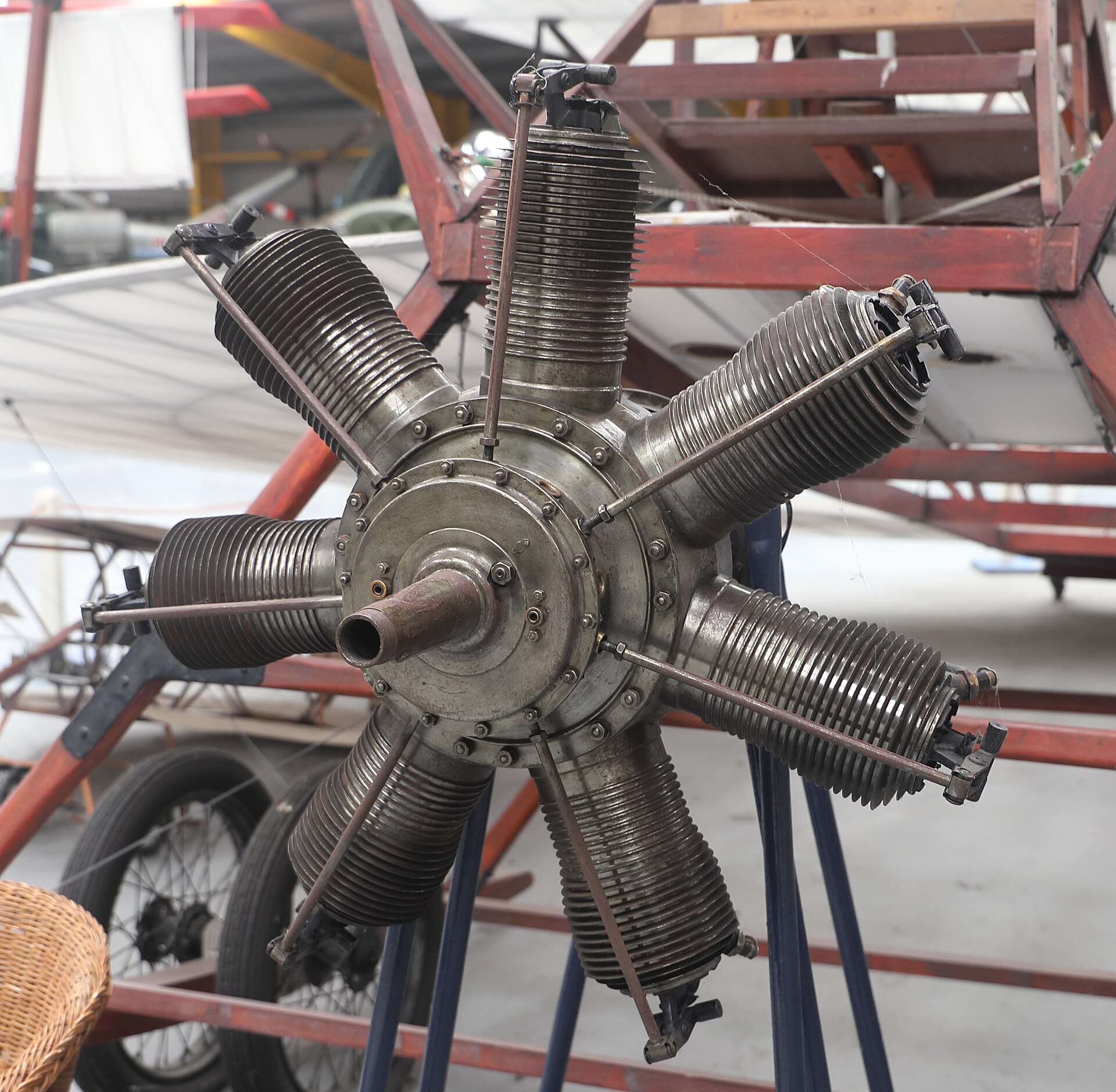

A piston engine on the Otto cycle, with the crankshaft fixed to the airframe and the cylinders and crankcase spinning around it. The propeller is bolted to the crankcase. An odd number of cylinders was usual. The spinning mass changes lubrication, ignition, fuel admission and cooling. This is a different machine from a Wankel.
The Gnome 7 Omega in the photograph is about 8 litres and 37 kW (50 hp). The exhaust valve is in the head. The inlet valve is in the piston crown and opens by inertia. There is no throttle: the pilot switches the ignition off and on.
| Use | Aircraft in the First World War and the years just before it, and some motorcycles and cars. A Gnome Omega still flies in the Shuttleworth Collection’s 1912 Blackburn Monoplane. |
|---|---|
| First | Shown at the Paris Aero Salon in December 1908 and first flown in 1909. The Omega article calls it the first aviation rotary produced in quantity. The prototype is at the National Air and Space Museum. |
| Widest use | The First World War. |
| Now | Largely replaced by the early 1920s. Preserved engines and the Shuttleworth aeroplane remain. The Newark engine in the photograph is one of the survivors. |
Sources
Curated reference notes. Hardware testing by this wiki is not implied. Wikipedia text is adapted from the cited revisions under CC BY-SA 4.0.
- Rotary engine, rev. 1383358564, 2026-11-02.
- Gnome Omega, rev. 1348640622, 2026-04-13.