What a vane measures
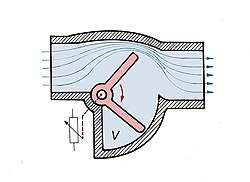
A vane airflow meter, also called an air-flow meter or flap meter, measures the volume of air entering the engine. Intake air pushes a measuring plate against a return spring. The angle of the plate follows the volume. A shaft turns a wiper across a potentiometer, and the voltage sent to the control unit follows that angle. On Bosch L-Jetronic that voltage is the main load signal: the control unit combines it with engine speed, then trims it for air temperature, engine temperature and throttle position, and opens the injectors for the resulting time.
Volume is not mass. The same plate angle on a cold morning is more oxygen than the same angle on a hot afternoon. The meter therefore carries an intake-air temperature sensor, and the control unit uses it. A mass-air sensor does that correction inside the element itself. That is the practical difference between a vane and a hot wire or a hot film.
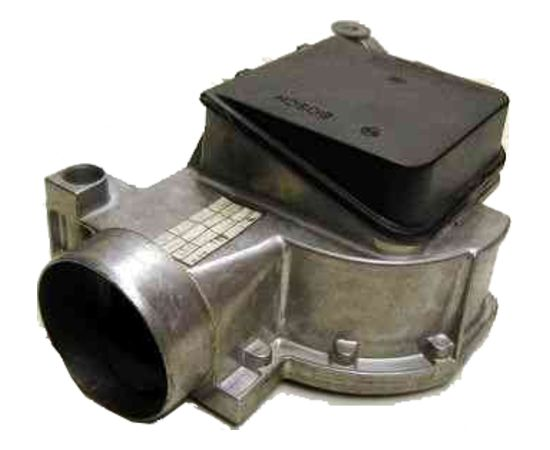
What is inside the housing
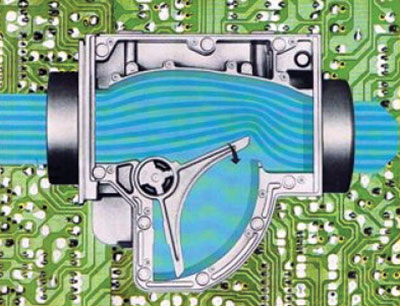
- Measuring plate. The flap in the intake bore.
- Return spring. Sets how far a given volume pushes the plate. Spring preload is a calibration, not a mixture screw.
- Compensation plate. Fixed to the same shaft, sitting in a damping chamber. It stops the measuring plate fluttering as the intake pulses.
- Potentiometer. The wiper and the resistive track. A second resistor in parallel with the main track keeps a signal available if the main track goes open, so a failing meter can still run, badly, rather than die at once.
- Bypass passage. A small air path around the plate. On many meters the idle mixture is a screw in that bypass, set at the factory and covered by a tamper plug. There is no published reset procedure once the plug has been disturbed.
- Fuel-pump switch. On the Bosch and Toyota meters that have one, the switch closes once the plate has moved off its stop, and holds the pump on after the engine has started. A plate that never moves, or a switch that never closes, is a stall immediately after start.
- Intake-air temperature sensor. An NTC in the same housing, with its own signal and, on the Toyota arrangement, its own ground, separate from the meter ground.
The K-Jetronic airflow plate looks similar and is not this device. On K-Jetronic the plate moves a fuel-distributor plunger. There is no potentiometer and no injector pulse derived from a voltage.
Which way the voltage moves
Early vanes run from battery voltage. The signal rises as the plate opens, over a range that can reach about 0 to 9 V. Later meters run from a regulated 5 V reference. Some of those rise from 0 V toward 5 V as the plate opens. Some fall from about 5 V toward 0 V. Ford and Bosch both used more than one of these directions. The direction is a property of that part number.
Identify it on the car. Duct off, ignition on, engine stopped, voltmeter negative on chassis ground. Push the plate by hand. Only one wire changes. Record it fully closed and fully open. That pair is the range any later conversion has to stay inside. A mass-air sensor fitted in place of the vane, without a calibrator that rebuilds this curve, will not match it. The procedure is AFM to MAF conversion.
How they fail
The wiper wears a groove in the track. Output voltage then drops out at particular plate angles, which the driver feels as a flat spot, a stutter or a loss of power at one load, and which can fail an emissions test while idle still looks normal. The compensation chamber can stick, so the plate lags or oscillates and the signal hunts. A torn boot or a split hose after the meter admits air the plate never measured, and the mixture goes lean. The temperature sensor can fail on its own: the plate signal is then fine and the warm-up or hot-running correction is not.
Do not move the spring stop to richen a tired meter. The spring sets the whole curve. Mixture adjustment, where the car has one, is the bypass screw, and only after leaks, fuel pressure and the track have been ruled out.
Who used them
Bosch L-Jetronic and the digital L3 variant are the volume this design is known for. Toyota, Nissan and Ford used the same flap-and-potentiometer idea on early electronic injection, with their own voltage directions and their own temperature sensors. Bosch dropped the vane for a hot wire on LH-Jetronic. Later Bosch petrol systems use the hot-film meters. The vane did not disappear everywhere at the same time: some markets kept a flap well into the 1990s.