Start with the complete system
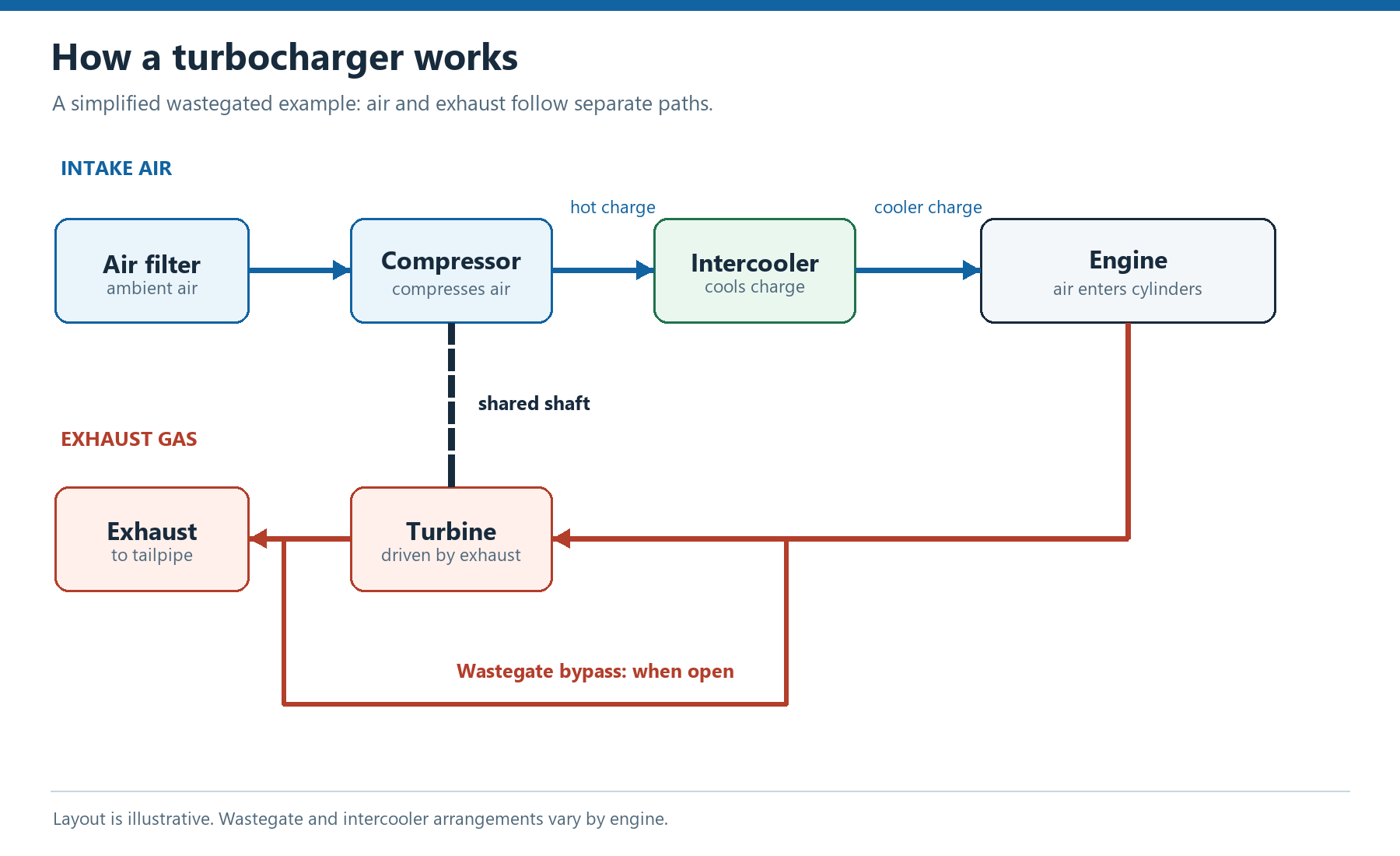
An uprated turbocharger can supply more air over some part of the engine's operating range. It does not make its advertised power on its own: the engine, fuel system, charge cooling, exhaust and calibration must be able to use that air. Decide the usable power and torque range, fuel, response and intended duty before selecting hardware. A larger compressor can move more air at high engine speed, but a larger rotating assembly or turbine may take longer to accelerate. The result depends on the complete match, not compressor diameter alone.
For the development of turbochargers, motorsport and notable production cars, see the history of turbochargers and turbocharged cars.
Turbocharger types, makes and trade-offs
The labels below describe different things: scroll and variable geometry describe the turbine housing, a hybrid describes a modification, and twin or compound describes an arrangement. They can overlap. Examples identify real products or installations, not a guarantee of fitment or a particular power gain. Select a turbo for the engine, target airflow, exhaust energy and intended use.
| Type or arrangement | Example makes or products | Benefits | Drawbacks |
|---|---|---|---|
| Fixed geometry, single scroll | BorgWarner EFR with open turbine housing; many Garrett performance turbos. | Broad choice and relatively simple exhaust housing; can suit many applications when correctly sized. | One fixed housing is a compromise between low-speed response and high-flow capacity; wastegate and manifold still need matching. |
| Twin scroll | BorgWarner EFR divided housings; Mitsubishi twin-scroll cutaway pictured below. | Separates exhaust-pulse groups to help preserve pulse energy and improve response with a suitable manifold. | Requires correct cylinder pairing and divided manifold, and may need more complicated wastegate plumbing. Twin scroll means one turbine housing with two passages, not necessarily two turbos. |
| Variable geometry (VGT/VNT/VTG) | Garrett VNT; Holset VGT. | Changes turbine flow geometry to support useful response and flow across a wider operating range. | More complex mechanism and actuator control; deposits, exhaust temperature and calibration are application-specific. Designs are used on both diesel and suitable petrol engines. |
| Hybrid or uprated stock frame | Turbo Technics hybrid upgrades. | Can increase flow while retaining some original housings or connections, potentially making installation easier. | “Hybrid” does not define the internal parts or guarantee a bolt-on fit. Housing limits, balancing, actuator, fuelling and calibration still matter. |
| Parallel twin turbo | Garrett normal and reverse-rotation turbos can be used in twin layouts. | Two units share engine airflow; packaging can suit separate cylinder banks and a pair of smaller units can be selected for the intended response and flow. | Two turbos and duplicated connections can add cost and packaging work. Correct sizing and control still determine the result. |
| Two-stage / compound | BorgWarner R2S, including a Mercedes-Benz OM 654 diesel application. | Stages work in series, with controls managing the stages to cover a broad operating range and provide a higher combined pressure ratio. | More pipework, heat management, bypass valves and calibration. A series arrangement is different from a parallel twin setup. |
| Electric-assisted turbo | Garrett E-Turbo. | A motor on the turbo shaft can assist acceleration and, where designed for it, recover energy. | Requires matched electrical supply, power electronics, cooling and control; it is a system-level integration, not a universal drop-in turbo. |
Bearings are another choice. Journal and ball-bearing centre housings can be found across different turbo configurations. They have different oil-supply requirements and can affect transient behaviour, but neither bearing type by itself establishes a turbo's power or fitment. Follow the manufacturer's instructions for the specific unit.
Pictures: turbocharger examples
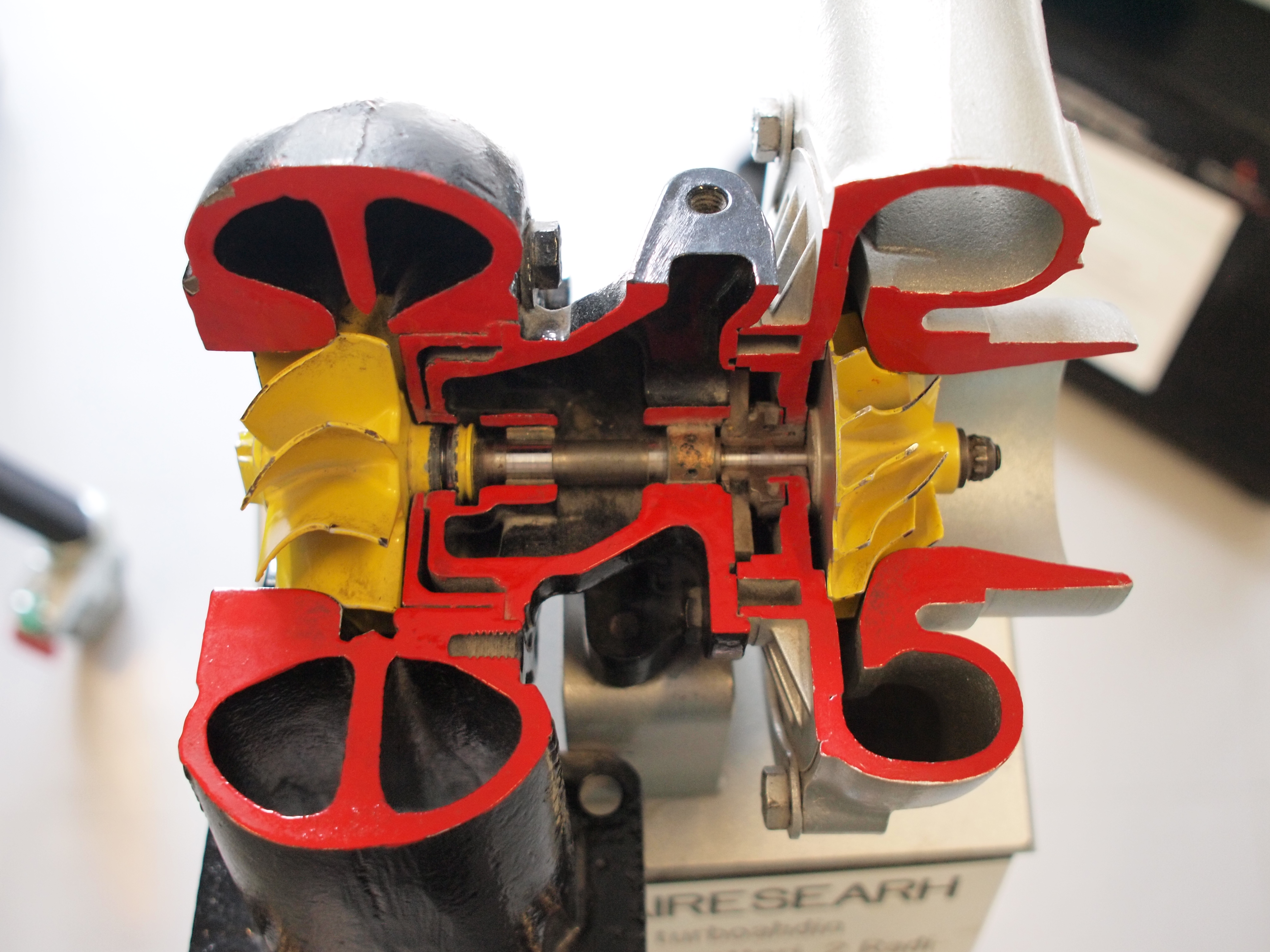

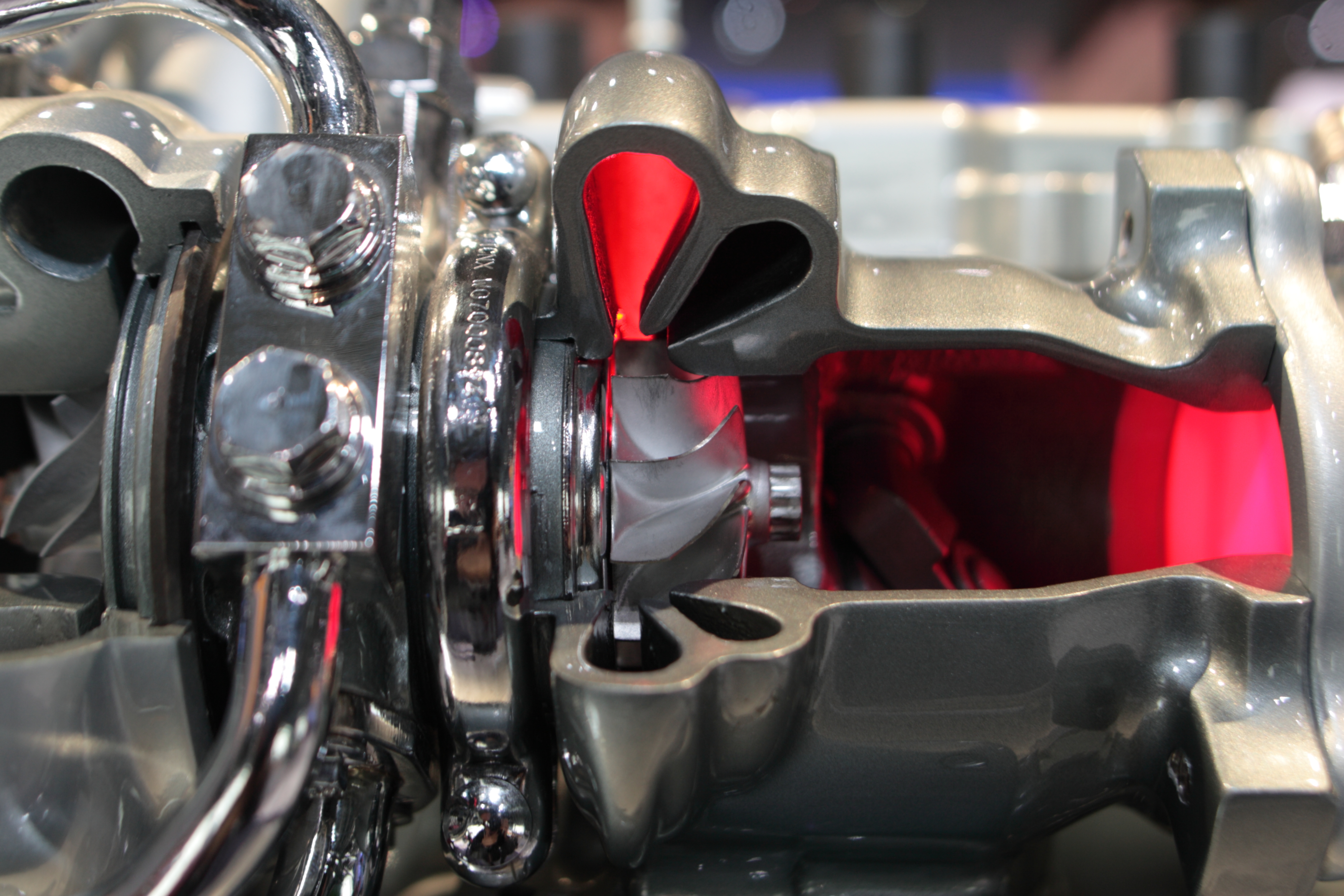

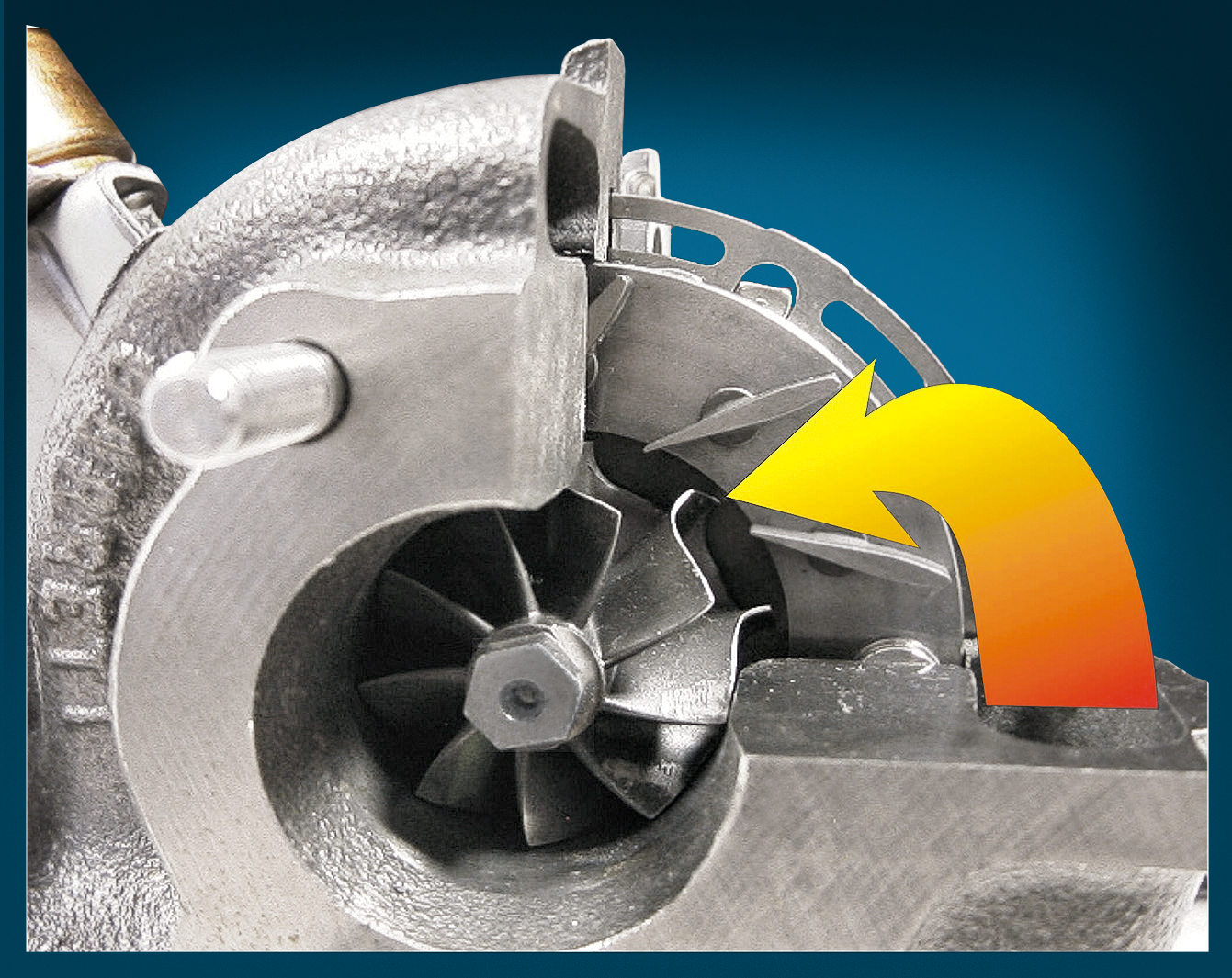

Stock-frame, hybrid and larger-frame turbos
A stock-frame upgrade aims to retain some original connections or housings. A hybrid combines different or modified components, often starting with an original application. Turbo Technics describes changes that can include a larger or differently shaped compressor wheel, machined compressor cover, different turbine, altered housings, bearings and actuator. A hybrid might be a modest change or a substantially redesigned unit; the word does not define its flow, reliability or exact fit. Check the supplier's complete specification, actuator, oil and coolant connections, and any required intake or exhaust adapters.
A larger-frame turbo usually offers more room for larger wheels and housings but can require a manifold, downpipe and other pipework changes. A billet compressor wheel is a manufacturing choice, not a guaranteed power gain. Wheel geometry, housing clearances, turbine capacity and bearing system all matter. Cutting back turbine blades or enlarging a housing without a tested match can trade response and efficiency for flow. Shaft-speed and temperature limits still apply.
Compressor maps and turbine matching
A compressor map plots corrected air mass flow against compressor pressure ratio, with efficiency regions, speed lines and surge and choke boundaries. Pressure ratio is absolute compressor outlet pressure divided by absolute compressor inlet pressure, not boost gauge pressure divided by atmospheric pressure. For illustration only, 1.0 bar gauge in the manifold is roughly 2.0 bar absolute at 1.0 bar atmospheric pressure. The compressor ratio is approximately 2.0 only if inlet restriction and pressure loss between compressor and manifold are ignored; real losses increase the required ratio. Altitude changes the calculation too.
Plot more than the peak-power point. Low-flow, high-pressure operation can cross the surge line; operation at excessive flow approaches choke and may demand excessive shaft speed. Garrett's map guidance explains the boundaries and why speed monitoring is valuable. A ported shroud can widen the usable range on an appropriately designed compressor; it cannot correct an otherwise unsuitable match. Separately consider turbine wheel and housing, exhaust manifold, wastegate capacity and the exhaust pressure required to drive the compressor. An early boost threshold and transient response are related, but they are not the same measurement.
Supporting changes and calibration
- Fuel and engine: Check pump, injectors, fuel pressure and fuel quality against the intended air mass. Petrol calibration must keep mixture and knock under control; diesel calibration must respect air, smoke and exhaust-temperature limits. Pistons, rods, head sealing, clutch and gearbox may limit usable torque.
- Air and heat: Check inlet restriction, manifold and exhaust flow, intercooler pressure drop and charge temperature. A bigger intercooler or pipe is useful only when the complete installation improves the operating conditions.
- Oil and coolant: Use the turbo manufacturer's specified oil supply, drain, cooling and restrictor arrangements. Diagnose oil starvation, contamination and drain restrictions before replacing a failed turbo. A universal restrictor or drain arrangement is not correct for every bearing design.
- Control: Match the wastegate or variable-geometry actuator, boost-control valve, sensors and ECU calibration to the hardware. Preserve functional engine protection. An actuator spring or boost controller is not a substitute for calibration.
For practical checks see turbocharger actuators, N75 and boost control, charge cooling and fuel system upgrades.
What to measure
Compare logs at the same engine speed, load and operating conditions. Useful signals include requested and actual manifold pressure, intake temperature, engine speed, boost-control command, fuel pressure, and suitable mixture and knock measurements on a petrol engine. Exhaust temperature, drive pressure and turbo speed are valuable where correctly instrumented. A boost gauge alone cannot show compressor efficiency, turbine backpressure or shaft overspeed. Investigate leaks or control faults before asking the turbo to work harder.
Sources
- What is a hybrid performance turbo? Turbo Technics. Hybrid components, trade-offs and supporting changes. Accessed 2026-11-14.
- Compressor maps. Garrett Motion. Pressure ratio, corrected flow, surge, choke, speed and efficiency. Accessed 2026-11-14.
- Turbo system optimization. Garrett Motion. System restriction, measurement and supporting systems. Accessed 2026-11-14.
- Turbo oil restrictors and oil supply. Garrett Motion. Oil requirements differ by bearing type. Accessed 2026-11-14.
- EFR turbocharger technical training guide. BorgWarner. Open and divided turbine housings, bearings and matching. Accessed 2026-11-14.
- VNT turbochargers. Garrett Motion. Variable-nozzle operation and applications. Accessed 2026-11-14.
- Regulated two-stage turbocharging on the OM 654. BorgWarner. Accessed 2026-11-14.
- Electric turbocharger technology. Garrett Motion. Electric assistance and recovery. Accessed 2026-11-14.