Production: March 1961 – June 1974 (sold in North America as the Jaguar XK-E). Production and model history.
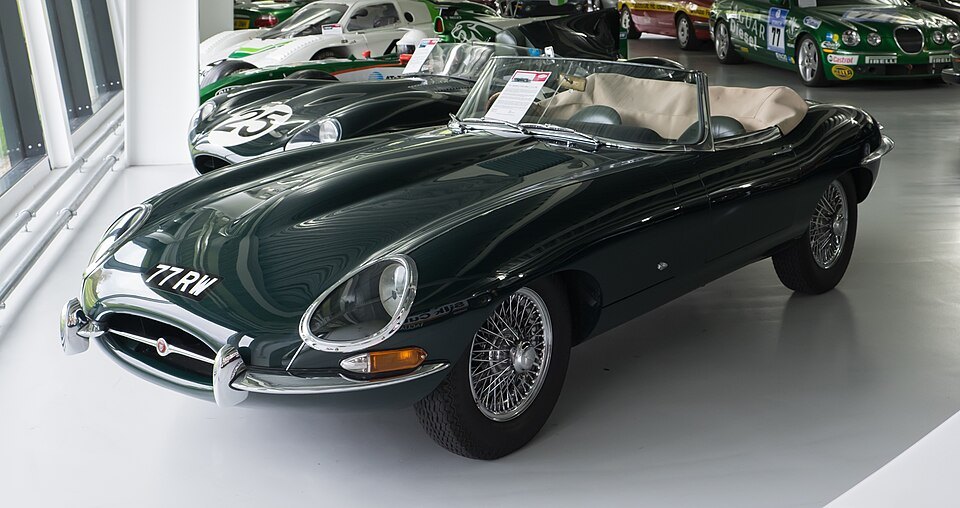

Derived structurally from Jaguar's Le Mans-winning D-Type, the Malcolm Sayer-styled E-Type paired monocoque tub construction and a bolted front subframe with all-round independent suspension, rack-and-pinion steering and four-wheel disc brakes (inboard at the rear). Offered in two-seat Fixed Head Coupé (FHC), Open Two Seater (OTS) roadster and lengthened 2+2 coupé configurations across three series. Wikipedia: Jaguar E-Type.
Series, concepts and competition variants
| Series / variant | Production | Key mechanical & body distinctions |
|---|---|---|
| Prototypes: E1A & E2A | 1957 & 1960 | E1A (1957) tested monocoque construction and IRS with the XK engine; E2A (1960) was a steel-chassis/aluminium-body Le Mans racer with a 3.0-litre Lucas fuel-injected XK engine. |
| Series 1 (3.8) | 1961–1964 | Covered headlamps, 3.8-litre XK6 with triple SU HD8 carburettors, Moss 4-speed gearbox (non-synchromesh 1st); earliest ~500 had flat floors and external bonnet latches. |
| Series 1 (4.2) & transitional "Series 1.5" | 1964–1968 | Enlarged 4.2-litre XK6, all-synchromesh Jaguar 4-speed gearbox, alternator and negative-earth electrics; 2+2 coupé added in 1966 (with optional Borg-Warner 3-speed auto). 1967–1968 Series 1.5 adopted open headlamps and, in US spec, twin Zenith-Stromberg carburettors. |
| Series 2 | 1968–1971 | Open headlamps worldwide, larger front grille and twin cooling fans, wrap-around bumpers and relocated tail lamps; 4.2-litre XK6 (triple SU in UK/Europe; twin Stromberg in North America). |
| Series 3 | 1971–1974 | Adopted the 5.3-litre SOHC Jaguar V12 with four Zenith-Stromberg 175CD2SE carburettors, wider track, flared arches, vented front discs and 2+2 / OTS bodies only (SWB FHC dropped). |
| Lightweight E-Type & Low Drag Coupé | 1963–1964 (plus 6 JLR Classic builds in 2014) | Twelve competition Lightweights (out of 18 planned) built with aluminium blocks/panels and Lucas mechanical fuel injection (plus the one-off Malcolm Sayer Low Drag Coupé). |
| E-Type Concept Zero | 2017 (halted 2019) | Jaguar Classic 40 kWh electric-conversion concept based on a 1968 Series 1.5 roadster. |
Complete factory engine list
Power ratings and carburettor specifications varied by market (especially North American emissions-tuned models from 1968 onwards). Wikipedia: Jaguar E-Type.
| Engine | Displacement & layout | Carburation / induction | Representative factory output | Series |
|---|---|---|---|---|
| 3.8-litre XK6 | 3,781 cc DOHC I6 | Triple SU HD8 carburettors | 265 bhp (198 kW) @ 5,500 rpm; 325 N⋅m (240 lb⋅ft) | Series 1 (1961–1964) |
| 4.2-litre XK6 (triple SU) | 4,235 cc DOHC I6 | Triple SU HD8 carburettors | 265 bhp (198 kW) @ 5,400 rpm; 384 N⋅m (283 lb⋅ft) | Series 1 (1964–1968) & non-US Series 2 (1968–1971) |
| 4.2-litre XK6 (twin Stromberg, US spec) | 4,235 cc DOHC I6 | Twin Zenith-Stromberg carburettors | 246 bhp (183 kW); 357 N⋅m (263 lb⋅ft) | US Series 1.5 & US Series 2 (1968–1971) |
| 5.3-litre Jaguar V12 | 5,343 cc SOHC V12 (2-valve) | Four Zenith-Stromberg 175CD2SE carburettors; Lucas Opus electronic ignition | ~272 bhp (203 kW) | Series 3 (1971–1974) |
Sources and related pages
- Wikipedia: Jaguar E-Type — series history, production counts and specifications.
- Jaguar: history and cars and Jaguar XJ-S and XJS: models and engines.
- SU carburettors: types, sizing and models.