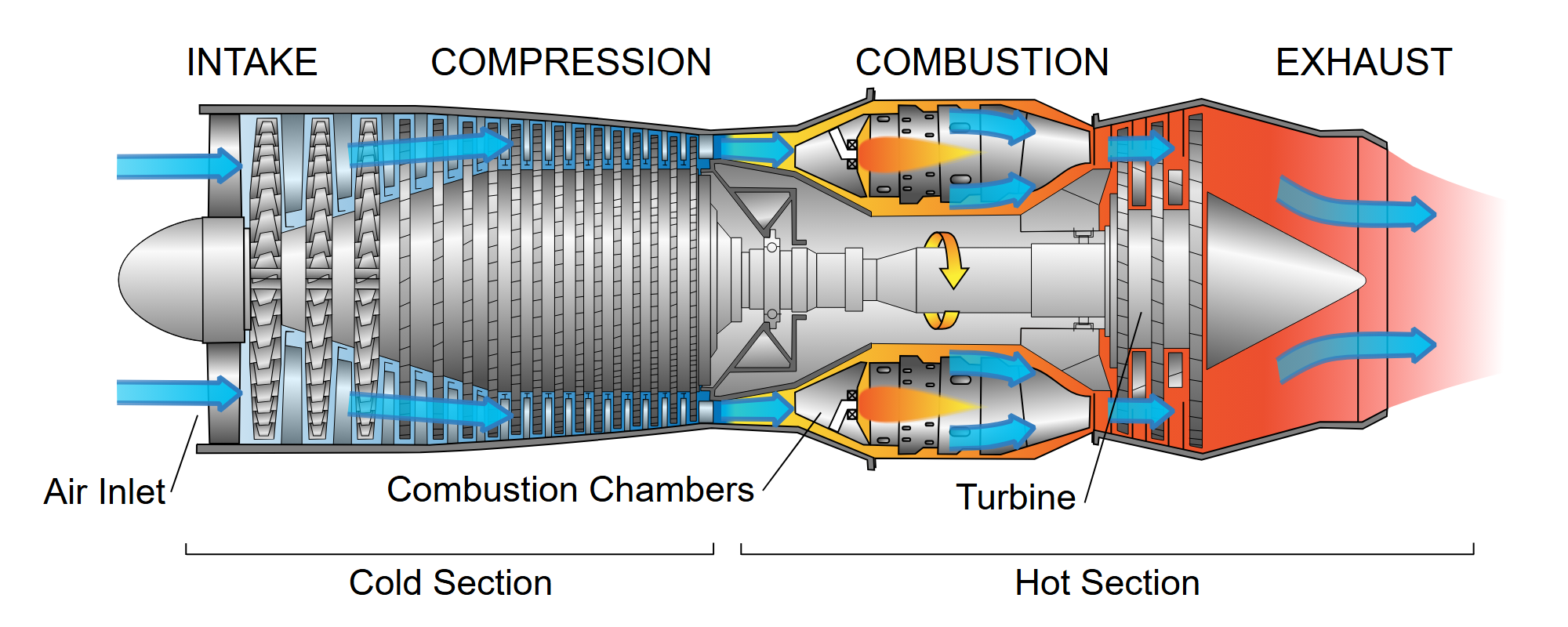


Air is compressed, fuel burns in it, and the gas expands through a turbine that drives the compressor. The idealised model is the Brayton cycle, heat added at constant pressure. An open-cycle engine exhausts to the atmosphere. A turbocharger has a turbine and a compressor, and the hot gas comes from a separate piston engine: it has no combustor of its own. A steam turbine expands steam from a boiler, which is the Rankine cycle.
| Arrangement | Where the power goes |
|---|---|
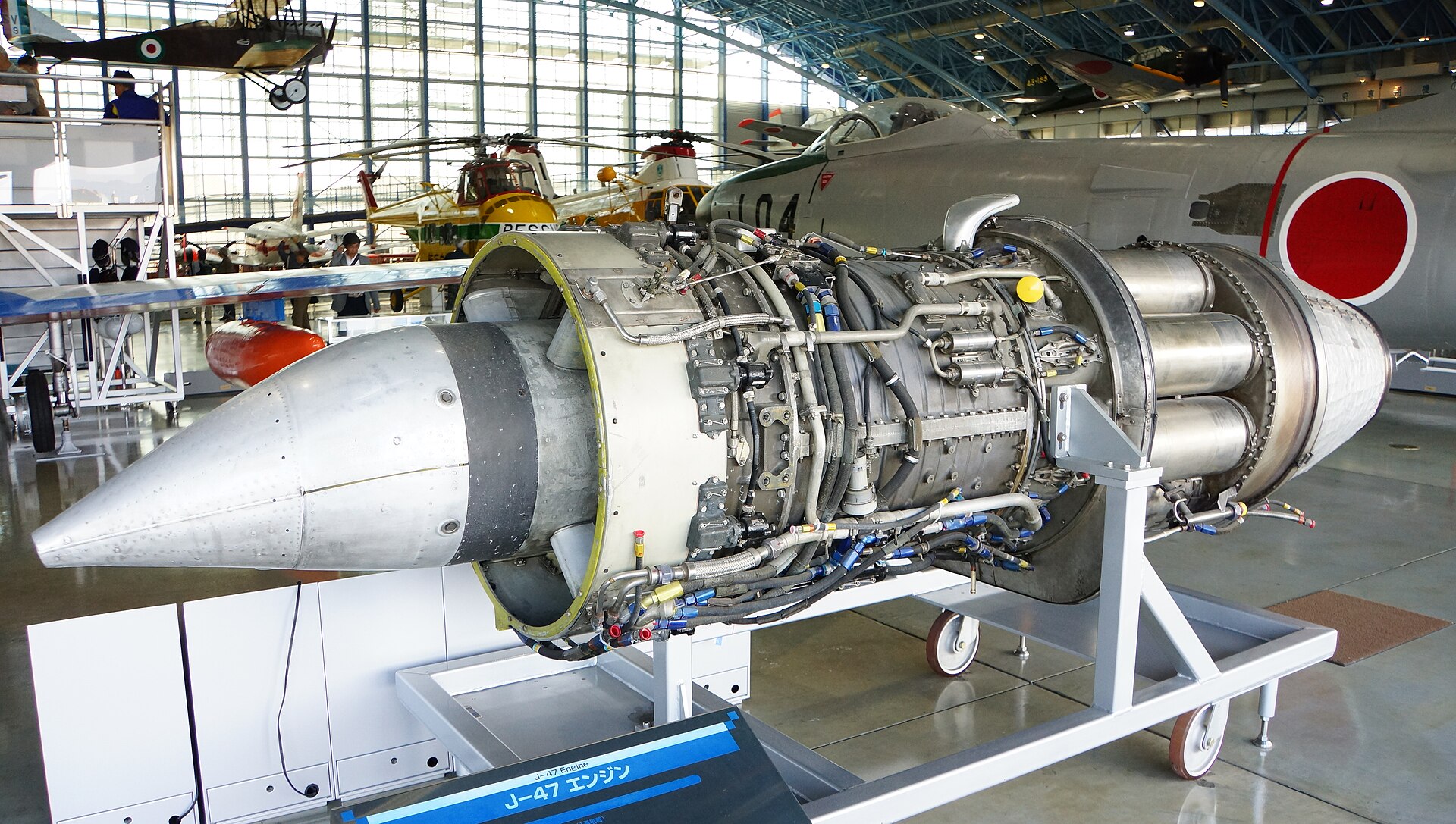
| Turbojet | The turbine drives the compressor. The remaining energy leaves as a jet. The J47 above is one of these. |
| Turbofan | Further turbine work drives a fan, and some energy can still leave as jet thrust. |
| Turboprop | A propeller does the useful work. The gas-turbine article, citing the FAA handbook, gives about 90% of the thrust from the propeller at sea level on a standard day. |
| Turboshaft | A shaft drives a helicopter rotor, a generator, a pump or a marine propeller. In a free turbine the power turbine is not geared to the compressor. |
| Use | Aircraft, electric power, ships, industry, and some land vehicles. The 9 November 2026 gas-turbine article still describes those as current uses. |
|---|---|
| First | John Barber’s patent, 1791. The Heinkel He 178, in 1939, was the first aircraft to fly on a turbojet. |
| Widest use | From the 1940s the gas turbine took over the aircraft work that radial piston engines had done. The cited articles describe a spread across aircraft, power stations and ships, and they do not give one production-volume peak. |
| Now | Still built for the uses above. The J47 in the photograph is a museum engine. |
Sources
Curated reference notes. Hardware testing by this wiki is not implied. Wikipedia text is adapted from the cited revisions under CC BY-SA 4.0.
- Gas turbine, rev. 1384714322, 2026-11-09.
- History of the internal combustion engine, rev. 1377939080, 2026-10-02. Barber, 1791, and the He 178.
- Radial engine, rev. 1373937428, 2026-09-08.
- DieselNet: Engine Fundamentals. Accessed 2026-11-11.