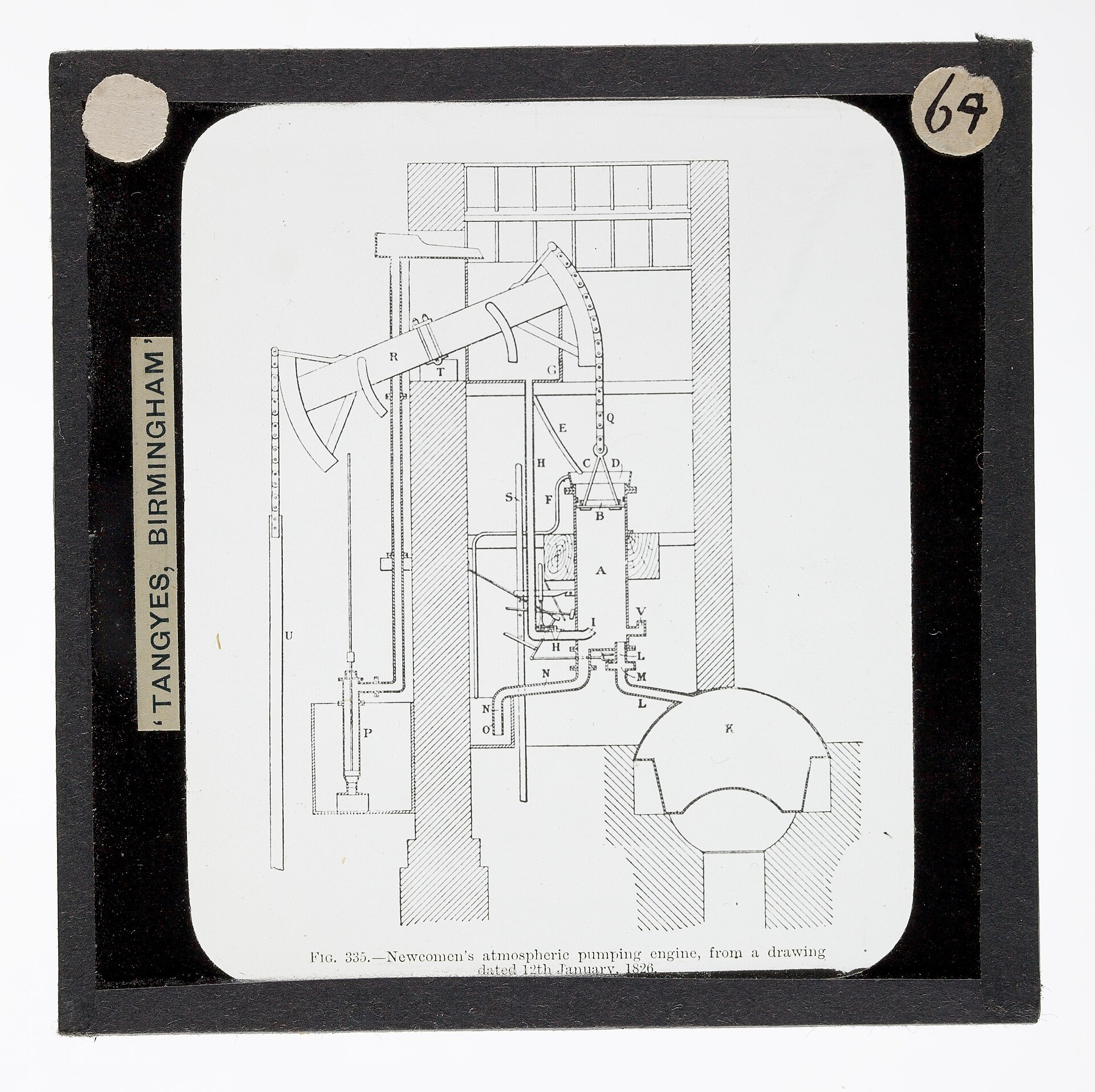

Fuel burns under a boiler. Steam does the work in a cylinder or a turbine, and the combustion gases stay outside that cylinder. The Rankine cycle is a pump, a boiler, an engine or turbine, and a condenser. The circuit can be closed, or the engine can exhaust to the atmosphere.
Newcomen’s engine, drawn above, condensed steam in the cylinder to make a partial vacuum, and atmospheric pressure pushed the piston. It was a mine pump. From 1764 James Watt moved the condensation into a separate vessel. The Newcomen article says that change roughly doubled the fuel efficiency.
| Use | Mines, then nineteenth-century factories, paddle steamers and locomotives. Jerónimo de Ayanz patented a steam mine pump in 1606. Thomas Savery sold a commercial steam pump. Steam cars in the United States ran from 1900 to 1916 and were gone by 1924. British steam lorries lasted into the mid-1930s. DieselNet gives the size of the boiler and the controls as the reason steam left mobile work. |
|---|---|
| First | Devices of the aeolipile type were known in the first century AD. Newcomen’s 1712 engine was the first commercial engine that could pass continuous power to a machine. |
| Widest use | Reciprocating steam dominated until the early twentieth century. Turbines then replaced reciprocating engines in power stations, because at that scale they cost less, ran faster and were more efficient. The steam-engine article records that in the 1990s Rankine cycles produced about 90% of the world’s electricity. This page does not update that share. |
| Now | The 7 November 2026 steam-engine article still records large reciprocating steam engines manufactured in Germany. Steam turbines remain the machines of power stations. The Newcomen engine in the drawing is an eighteenth-century pump. |
Sources
Curated reference notes. Hardware testing by this wiki is not implied. Wikipedia text is adapted from the cited revisions under CC BY-SA 4.0.
- Steam engine, rev. 1384187452, 2026-11-07.
- Newcomen atmospheric engine, rev. 1383819613, 2026-11-05.
- DieselNet: Engine Fundamentals. Steam cars, lorries and the boiler plant. Accessed 2026-11-11.