Removed text is struck through; added text is highlighted.
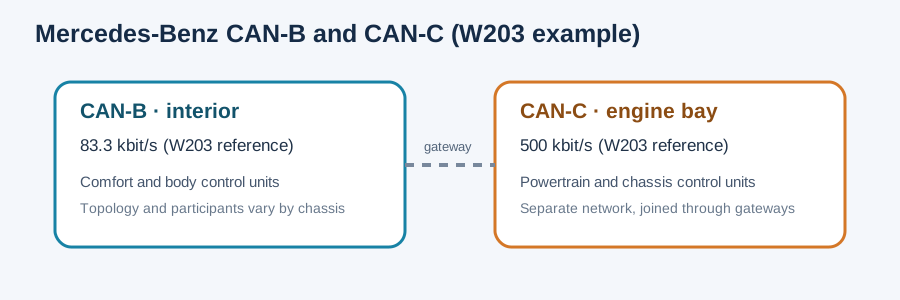
Mercedes-Benz uses multiple CAN networks rather than one universal vehicle bus. In the cited W203 documentation, CAN-B is the interior network at about 83.3 kbit/s and CAN-C is the engine-compartment network at 500 kbit/s. They carry different groups of vehicle traffic and communicate through the vehicle’s gateway architecture. These figures are scoped to the cited W203 material; rates and topology vary by chassis and year.
Conceptual network split based on Mercedes-Benz W203 service information. Original Tuning Wiki diagram; module membership is vehicle-specific.
IDs and diagnostic examples
CAN identifiers are message- and platform-specific; the cited W203 network descriptions establish the bus roles and bit rates, but do not provide a reliable, general-purpose CAN-ID list or a confirmed read-only request/reply pair. No example CAN IDs or diagnostic frames are asserted here. For diagnostics, use the applicable chassis wiring diagrams and XENTRY/STAR procedures, and capture only on the target vehicle.
Do not confuse CAN-B with the later use of CAN FD terms, and do not assume a CAN-C diagnostic frame can be replayed across model lines. An OBD connector may expose a gateway path rather than direct access to either bus.
Sources
Mercedes-Benz W203 CAN Data Bus Applications, GF54.00-P-0005-04A (CAN-B and CAN-C application/speed reference).Mercedes-Benz W203 overall network (GVN) function. Consult chassis-specific documentation before applying rates or topology to another model.
Rendered revisions
Open each version to inspect formatting, tables and photographs.
Revision 1: Mercedes-Benz CAN-B and CAN-C
Mercedes-Benz uses multiple CAN networks rather than one universal vehicle bus. In the cited W203 documentation, CAN-B is the interior network at about 83.3 kbit/s and CAN-C is the engine-compartment network at 500 kbit/s. They carry different groups of vehicle traffic and communicate through the vehicle’s gateway architecture. These figures are scoped to the cited W203 material; rates and topology vary by chassis and year.
Conceptual network split based on Mercedes-Benz W203 service information. Original Tuning Wiki diagram; module membership is vehicle-specific.
IDs and diagnostic examples
CAN identifiers are message- and platform-specific; the cited W203 network descriptions establish the bus roles and bit rates, but do not provide a reliable, general-purpose CAN-ID list or a confirmed read-only request/reply pair. No example CAN IDs or diagnostic frames are asserted here. For diagnostics, use the applicable chassis wiring diagrams and XENTRY/STAR procedures, and capture only on the target vehicle.
Do not confuse CAN-B with the later use of CAN FD terms, and do not assume a CAN-C diagnostic frame can be replayed across model lines. An OBD connector may expose a gateway path rather than direct access to either bus.