Removed text is struck through; added text is highlighted.
Production: 2004–2006 (4,038 units, MY 2005–2006) and December 2016 – December 2022 (1,350 planned road cars + track-only Mk II and Mk IV editions; Wikipedia: Ford GT). Inspired by the 1964–1969 Le Mans–winning Ford GT40 (which won Le Mans four times consecutively in 1966–1969), both modern Ford GT generations are mid-engined, rear-wheel-drive supercars.
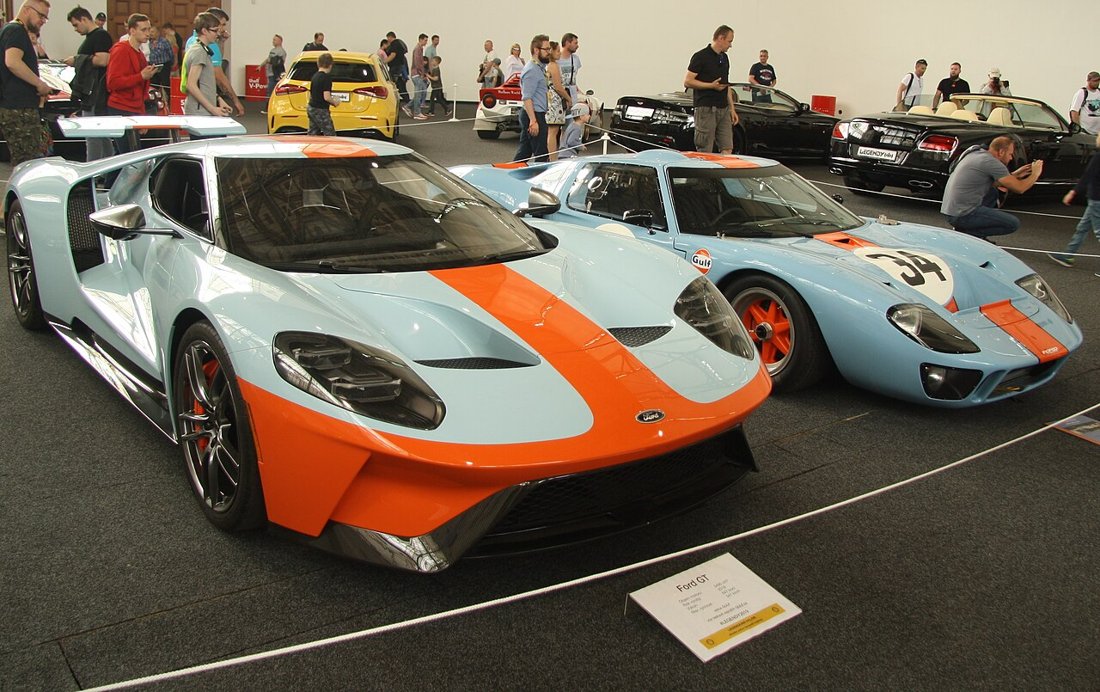
A 2018 Ford GT in the foreground, beside an earlier GT40. Photo: Jiří Sedláček, Wikimedia Commons, CC BY-SA 4.0; resized and re-encoded.
Generations, engines and transmissions
GenerationYears & assemblyEngine & inductionOutput & transmission
1st Gen Ford GT2004–2006 (4,038 built; chassis by MVS, painted by Saleen SSV, engine Romeo, final at Wixom SVT)5.4L (329.5 cu in) dry-sump all-aluminium Modular DOHC 32v V8 with Lysholm 2.3L screw-type supercharger (built in cooperation with Whipple/Lysholm; dual fuel injectors per cylinder)550 hp (410 kW) @ 6,500 rpm; 500 lb⋅ft @ 4,500 rpm; 6-speed Ricardo M7003GT manual transaxle with helical LSD; 205 mph top speed. (Also 100 Genaddi GTX1 targa conversions and Matech GT1/Doran GT2-R Cammer 5.0/5.3 NA race cars.)
2nd Gen Ford GT2016–2022 (Multimatic, Markham, Ontario; carbon-fibre monocoque, pushrod suspension & active aero)3,496 cc (3.5L) twin-turbocharged dry-sump EcoBoost D35 DOHC 24v V6 (port + direct dual injection; Akrapovič titanium exhaust from 2020)647 hp (2017–19) / 660 hp (2020–22) & 550 lb⋅ft; 7-speed Getrag 7DCL750 dual-clutch; 216 mph top speed; 2016 Le Mans GTE-Pro class winner.
GT Mk II (track-only)2019–2022 (45 built by Multimatic)3.5L twin-turbo EcoBoost V6 with roof-mounted intake & outboard intercoolers700+ hp (522+ kW); 7-speed DCT; fixed rear wing (+400% downforce) & 200 lb weight reduction.
GT Mk IV (track-only)2023+ (67 built by Multimatic)Stretched-wheelbase longtail carbon body with twin-turbo EcoBoost V6800+ hp target; racing sequential gearbox; Multimatic ASV suspension.
1960s GT40 ancestor summary
GT40 Mk I (1964–69): Slough-built Lola Mk6 derivative; 4.2L (255), 4.7L (289) & 4.9L (302) small-block V8s with Colotti then ZF 5-speed transaxle; JWA Gulf chassis P/1075 won Le Mans in 1968 and 1969.
GT40 Mk II & Mk IV (1966–67): Kar-Kraft / Shelby / Holman-Moody 7.0L (427 cu in) FE big-block V8s with Kar-Kraft 4-speed transaxle; 1-2-3 finish at 1966 Le Mans (Mk II) and all-American win in 1967 (Mk IV).
Sources and related pages
Wikipedia: Ford GT and Wikipedia: Ford GT40.
Ford Historical GT Collection reference.
Ford racing cars, prototypes and concepts and Ford: history and cars.
Rendered revisions
Open each version to inspect formatting, tables and photographs.
Revision 2: Ford GT: generations and engines
Production: 2004–2006 (4,038 units, MY 2005–2006) and December 2016 – December 2022 (1,350 planned road cars + track-only Mk II and Mk IV editions; Wikipedia: Ford GT). Inspired by the 1964–1969 Le Mans–winning Ford GT40 (which won Le Mans four times consecutively in 1966–1969), both modern Ford GT generations are mid-engined, rear-wheel-drive supercars.
A 2018 Ford GT in the foreground, beside an earlier GT40. Photo: Jiří Sedláček, Wikimedia Commons, CC BY-SA 4.0; resized and re-encoded.
Generations, engines and transmissions
Generation
Years & assembly
Engine & induction
Output & transmission
1st Gen Ford GT
2004–2006 (4,038 built; chassis by MVS, painted by Saleen SSV, engine Romeo, final at Wixom SVT)
5.4L (329.5 cu in) dry-sump all-aluminium Modular DOHC 32v V8 with Lysholm 2.3L screw-type supercharger (built in cooperation with Whipple/Lysholm; dual fuel injectors per cylinder)
550 hp (410 kW) @ 6,500 rpm; 500 lb⋅ft @ 4,500 rpm; 6-speed Ricardo M7003GT manual transaxle with helical LSD; 205 mph top speed. (Also 100 Genaddi GTX1 targa conversions and Matech GT1/Doran GT2-R Cammer 5.0/5.3 NA race cars.)
Stretched-wheelbase longtail carbon body with twin-turbo EcoBoost V6
800+ hp target; racing sequential gearbox; Multimatic ASV suspension.
1960s GT40 ancestor summary
GT40 Mk I (1964–69): Slough-built Lola Mk6 derivative; 4.2L (255), 4.7L (289) & 4.9L (302) small-block V8s with Colotti then ZF 5-speed transaxle; JWA Gulf chassis P/1075 won Le Mans in 1968 and 1969.
GT40 Mk II & Mk IV (1966–67): Kar-Kraft / Shelby / Holman-Moody 7.0L (427 cu in) FE big-block V8s with Kar-Kraft 4-speed transaxle; 1-2-3 finish at 1966 Le Mans (Mk II) and all-American win in 1967 (Mk IV).