Removed text is struck through; added text is highlighted.
COSBER Technology makes vehicle inspection equipment and chassis dynamometers. Its DYNOCOSBER name identifies a family of rolling roads for vehicle performance testing. Individual machines differ in their roller layout, absorber, driven-axle configuration and control hardware. Related: Dynamometers and the manufacturers and suppliers directory.
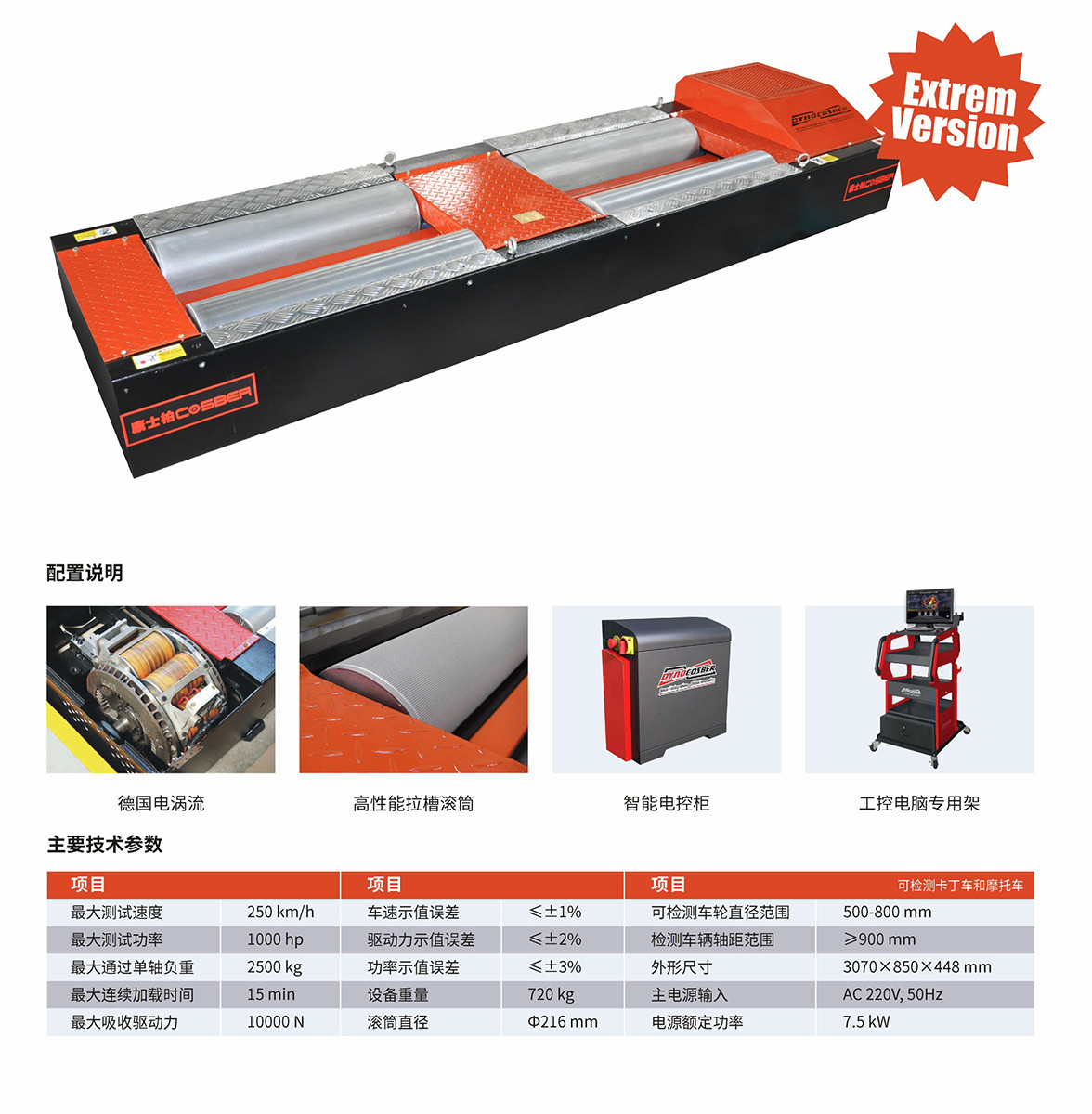
COSBER's Dynocosber promotional graphic, showing a roller assembly and associated components. Image: COSBER, used with permission. Its pictured specifications apply to the illustrated configuration; confirm the exact model and current documentation.
Company history
Cosber GmbH's company history states that Cosber Technology was founded in Shenzhen, China, in 1999, and that its German subsidiary became active in 2017. COSBER identifies DYNOCOSBER as its performance-dyno division. A 2012 COSBER exhibition report documents a Dynocosber 4000S 4WD model. Those dates describe the company and a documented product, not the introduction dates of every current model.
Representative chassis dynamometers
The manufacturer's car-dyno comparison lists these representative models:
KDC-3GT: a 2WD unit shown with flywheel inertia in the source's retarder row. Do not assume it has the same absorber configuration as the braked systems.
Dynocosber 1000P: a 2WD roller system with an eddy-current retarder.
Dynocosber 2000P: a four-wheel-drive roller system listed as not mechanically linked in the manufacturer's comparison, with separate listed retarders.
Dynocosber X4000: a 4WD system described as linked by a Z-shaft with adjustable wheelbase.
Model names and ratings are not interchangeable: the maker's product comparison and its 2026 exhibition listing differ on some X4000 dimensions and axle-load details. Obtain the specification and operating manual for the exact delivered unit and verify braking duty, power, torque, axle weight and 4WD compatibility.
COSBER's equipment catalogue also illustrates the Dynocosber M500 motorcycle chassis dynamometer. The manufacturer lists emissions-test and EV-test dynamometers separately; these are different testing applications and configurations.
Controls and software
COSBER's Dynocosber catalogue describes manufacturer-developed control hardware and Windows software, a handheld controller, test database, real-time graphs, acceleration control and PID load control. The controller commands the particular installed retarder; an inertia-only system cannot hold an arbitrary load merely because software is present. Features and operating-system support depend on version and installed equipment.
The cited manufacturer materials describe controls supplied with Dynocosber machines. They do not establish a separately sold universal aftermarket retrofit controller for other makes; ask COSBER or its distributor about a particular upgrade. Existing machines may instead have separately retrofitted electronics. Identify the installed frame, retarder, sensors, power module and software before ordering parts. See dynamometer control systems.
Based on linked manufacturer and exhibitor sources checked 17 November 2026. Product versions, specifications and availability may change.
Rendered revisions
Open each version to inspect formatting, tables and photographs.
Revision 1: COSBER dynamometers
COSBER Technology makes vehicle inspection equipment and chassis dynamometers. Its DYNOCOSBER name identifies a family of rolling roads for vehicle performance testing. Individual machines differ in their roller layout, absorber, driven-axle configuration and control hardware. Related: Dynamometers and the manufacturers and suppliers directory.
COSBER's Dynocosber promotional graphic, showing a roller assembly and associated components. Image: COSBER, used with permission. Its pictured specifications apply to the illustrated configuration; confirm the exact model and current documentation.
Company history
Cosber GmbH's company history states that Cosber Technology was founded in Shenzhen, China, in 1999, and that its German subsidiary became active in 2017. COSBER identifies DYNOCOSBER as its performance-dyno division. A 2012 COSBER exhibition report documents a Dynocosber 4000S 4WD model. Those dates describe the company and a documented product, not the introduction dates of every current model.
KDC-3GT: a 2WD unit shown with flywheel inertia in the source's retarder row. Do not assume it has the same absorber configuration as the braked systems.
Dynocosber 1000P: a 2WD roller system with an eddy-current retarder.
Dynocosber 2000P: a four-wheel-drive roller system listed as not mechanically linked in the manufacturer's comparison, with separate listed retarders.
Dynocosber X4000: a 4WD system described as linked by a Z-shaft with adjustable wheelbase.
Model names and ratings are not interchangeable: the maker's product comparison and its 2026 exhibition listing differ on some X4000 dimensions and axle-load details. Obtain the specification and operating manual for the exact delivered unit and verify braking duty, power, torque, axle weight and 4WD compatibility.
COSBER's equipment catalogue also illustrates the Dynocosber M500 motorcycle chassis dynamometer. The manufacturer lists emissions-test and EV-test dynamometers separately; these are different testing applications and configurations.
Controls and software
COSBER's Dynocosber catalogue describes manufacturer-developed control hardware and Windows software, a handheld controller, test database, real-time graphs, acceleration control and PID load control. The controller commands the particular installed retarder; an inertia-only system cannot hold an arbitrary load merely because software is present. Features and operating-system support depend on version and installed equipment.
The cited manufacturer materials describe controls supplied with Dynocosber machines. They do not establish a separately sold universal aftermarket retrofit controller for other makes; ask COSBER or its distributor about a particular upgrade. Existing machines may instead have separately retrofitted electronics. Identify the installed frame, retarder, sensors, power module and software before ordering parts. See dynamometer control systems.
Based on linked manufacturer and exhibitor sources checked 17 November 2026. Product versions, specifications and availability may change.