PEREK supplies dynamometer data acquisition, controllers and brake interfaces for new builds and retrofits. Its systems can be configured for engine, rolling-road and hub installations; the controller and power electronics must be matched to the existing dynamometer hardware. See Dynamometers and the manufacturers directory.
History and role
Ronald Perek states that he founded PEREK in 2019 after mechatronics and electronics work at ECUMASTER. The company describes its work as dyno measurement and control, including upgrades of existing equipment from other makers. A conversion can retain the original frame and brake while changing controller components; the dyno's name does not necessarily identify the controller fitted today. PEREK: company and applications.
Systems and applications
PEREK describes its controller system for inertial and braked engine, chassis, hub and power-take-off dynos. Its peripheral guide specifies different speed-sensor counts for different layouts and identifies the separate absorber, load cell and brake supply needed for an absorption dyno. PEREK lists partner builders for complete machines; these are distinct companies, not PEREK dyno model names.
Controller and brake-interface models
- DC1E4: an earlier controller identified by PEREK in documented retrofit examples, including a Bosch FLA206 upgrade.
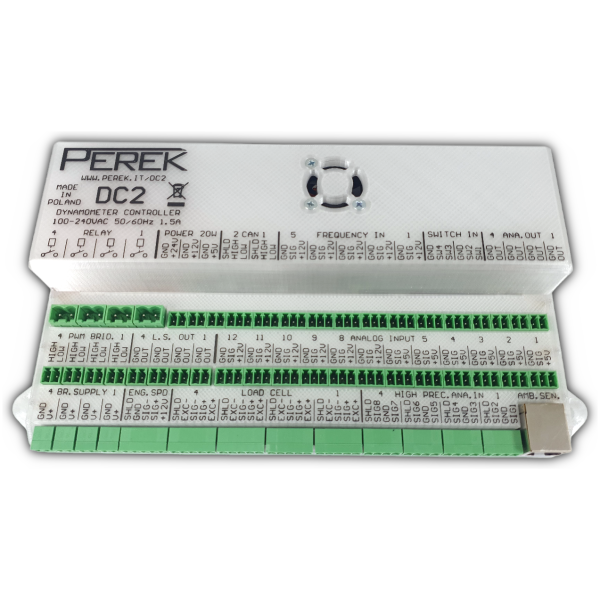
- DC2: an integrated computer and controller; the maker lists support for unsynchronised 4WD chassis and 4WD hub systems with appropriate peripherals.
- DC2L: a lower-specification DC2-series variant for less complex applications, including mechanically synchronised 4WD chassis systems.
- BD3.1: an eddy-current brake power interface. Its electrical supply and brake compatibility must be checked for the installation.
The DC2 specification distinguishes the two variants and identifies the DC2 as a development of the earlier DC1E4. Dyno2 software supplies test display, recording and analysis; exact operating modes depend on the complete configured system.
Checking a retrofit
Record brake model, torque and speed limits, controller, software, power supply, sensor scaling, calibration and interlock arrangements. A capable controller cannot make an absorber motor a shaft or operate safely beyond its own cooling and mechanical limits. See dynamometer control systems.
Details are based on the linked company documentation checked 17 November 2026; verify present configurations and support with the supplier.