Removed text is struck through; added text is highlighted.
Country of origin: France. Part of Car makes and the history of the motor car.
History and development
Ettore Bugatti founded his car-making business at Molsheim in 1909. Its early racing and luxury cars made the name famous; later companies revived the marque in different eras. Wikipedia: Bugatti history.
The Italian-built EB110 revival and the later Molsheim-based Veyron and Chiron represent distinct chapters with different engines and ownership histories.
Bugatti EB110. Photo: Rutger van der Maar, Wikimedia Commons, CC BY 2.0; resized.
Selected cars and engines
Examples are selected rather than a complete production list. Engine and equipment specifications can vary with year and market.
CarWhy it mattersEvidenceEB110 (1991)The 3.5-litre V12 used four turbochargers and four-wheel drive. GT and Super Sport variants had different outputs.Illustrated turbo historyType 35A light Grand Prix racing car and one of the early marque's most recognisable designs.Model referenceVeyronA modern hypercar with an 8.0-litre W16 engine and four turbochargers.Model referenceChironA later W16 quad-turbo hypercar; it is a different model from the Veyron.Model reference
More models and representative engines
These are specific examples rather than every engine offered. Equipment, output and capacity can change with model year and market; identify the exact vehicle before ordering parts.
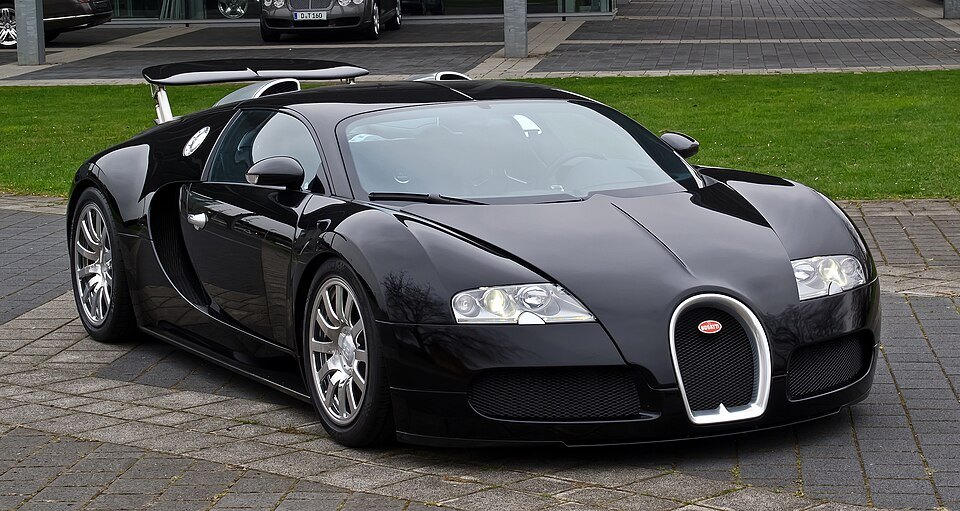
A Bugatti Veyron 16.4. Photo: M 93, Wikimedia Commons, CC BY-SA 3.0 de; resized and re-encoded.
Model and versionEngine or powertrainEvidenceType 35 BA 2.3-litre mechanically supercharged inline-eight in the Type 35 B racing car.Manufacturer or technical sourceType 57 SC AtlanticA 3.3-litre inline-eight; individual Atlantics have different histories, including later supercharger changes.Manufacturer or technical sourceVeyron 16.4An 8.0-litre W16 engine with four turbochargers.Manufacturer or technical sourceChironAn 8.0-litre W16 with four turbochargers; distinct from the Veyron's engine and installation.Manufacturer or technical source
Identifying a car and engine
Use the VIN, market, model year and engine code when researching servicing, tuning or parts. A model badge may cover naturally aspirated, turbocharged, supercharged, hybrid or electric versions depending on the particular vehicle. Factory fitment and aftermarket conversions are distinguished in the linked guides.
Sources and related reading
Wikipedia: Bugatti — marque history and further references.Tuning Wiki: illustrated turbocharged-car timeline.Tuning Wiki: supercharger types and Eaton guides.
Rendered revisions
Open each version to inspect formatting, tables and photographs.
Ettore Bugatti founded his car-making business at Molsheim in 1909. Its early racing and luxury cars made the name famous; later companies revived the marque in different eras. Wikipedia: Bugatti history.
The Italian-built EB110 revival and the later Molsheim-based Veyron and Chiron represent distinct chapters with different engines and ownership histories.
These are specific examples rather than every engine offered. Equipment, output and capacity can change with model year and market; identify the exact vehicle before ordering parts.
Use the VIN, market, model year and engine code when researching servicing, tuning or parts. A model badge may cover naturally aspirated, turbocharged, supercharged, hybrid or electric versions depending on the particular vehicle. Factory fitment and aftermarket conversions are distinguished in the linked guides.