Removed text is struck through; added text is highlighted.
Production: 2004–2006 (4,038 units, MY 2005–2006) and December 2016 – December 2022 (1,350 planned road cars + track-only Mk II and Mk IV editions; Wikipedia: Ford GT). Inspired by the 1964–1969 Le Mans–winning Ford GT40 (which won Le Mans four times consecutively in 1966–1969), both modern Ford GT generations are mid-engined, rear-wheel-drive supercars.Production: 2004–2006; 2016–2022. Model and production reference.
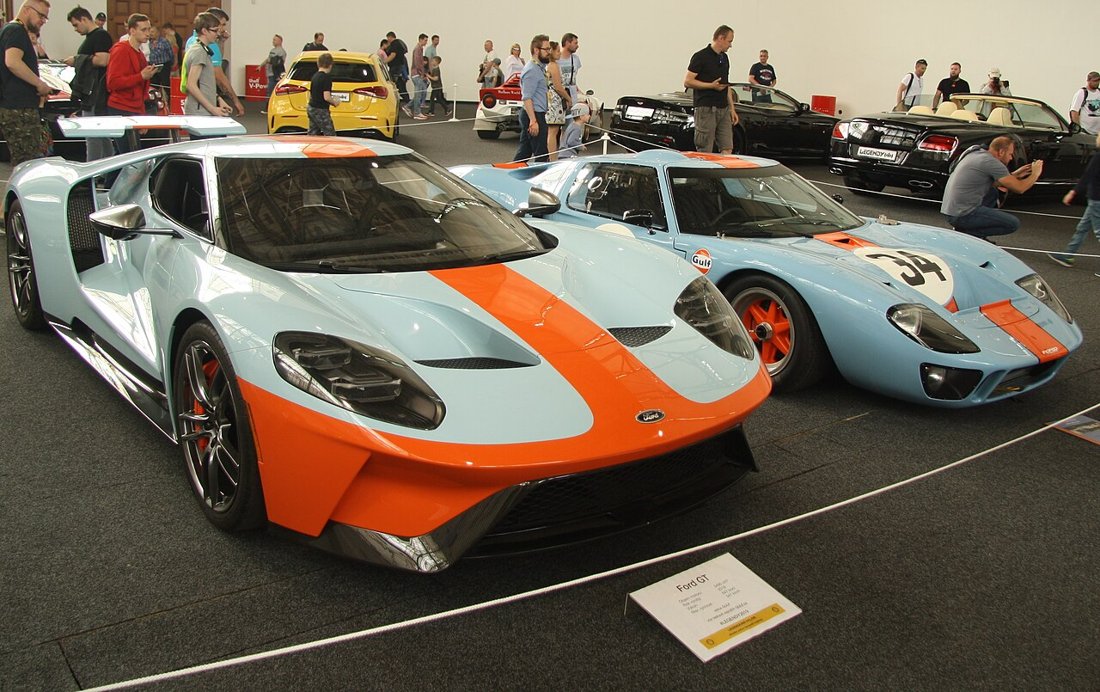
A 2018 Ford GT in the foreground, beside an earlier GT40. Photo: Jiří Sedláček, Wikimedia Commons, CC BY-SA 4.0; resized and re-encoded.
Generations, engines and transmissionsGenerationYears & assemblyEngine & inductionOutput & transmission
1st Gen Ford GT2004–2006 (4,038 built; chassis by MVS, painted by Saleen SSV, engine Romeo, final at Wixom SVT)5.4L (329.5 cu in) dry-sump all-aluminium Modular DOHC 32v V8 with Lysholm 2.3L screw-type supercharger (built in cooperation with Whipple/Lysholm; dual fuel injectors per cylinder)550 hp (410 kW) @ 6,500 rpm; 500 lb⋅ft @ 4,500 rpm; 6-speed Ricardo M7003GT manual transaxle with helical LSD; 205 mph top speed. (Also 100 Genaddi GTX1 targa conversions and Matech GT1/Doran GT2-R Cammer 5.0/5.3 NA race cars.)
2nd Gen Ford GT2016–2022 (Multimatic, Markham, Ontario; carbon-fibre monocoque, pushrod suspension & active aero)3,496 cc (3.5L) twin-turbocharged dry-sump EcoBoost D35 DOHC 24v V6 (port + direct dual injection; Akrapovič titanium exhaust from 2020)647 hp (2017–19) / 660 hp (2020–22) & 550 lb⋅ft; 7-speed Getrag 7DCL750 dual-clutch; 216 mph top speed; 2016 Le Mans GTE-Pro class winner.
GT Mk II (track-only)2019–2022 (45 built by Multimatic)3.5L twin-turbo EcoBoost V6 with roof-mounted intake & outboard intercoolers700+ hp (522+ kW); 7-speed DCT; fixed rear wing (+400% downforce) & 200 lb weight reduction.
GT Mk IV (track-only)2023+ (67 built by Multimatic)Stretched-wheelbase longtail carbon body with twin-turbo EcoBoost V6800+ hp target; racing sequential gearbox; Multimatic ASV suspension.1960s GT40 ancestor summaryGT40 Mk I (1964–69): Slough-built Lola Mk6 derivative; 4.2L (255), 4.7L (289) & 4.9L (302) small-block V8s with Colotti then ZF 5-speed transaxle; JWA Gulf chassis P/1075 won Le Mans in 1968 and 1969.
GT40 Mk II & Mk IV (1966–67): Kar-Kraft / Shelby / Holman-Moody 7.0L (427 cu in) FE big-block V8s with Kar-Kraft 4-speed transaxle; 1-2-3 finish at 1966 Le Mans (Mk II) and all-American win in 1967 (Mk IV).The GT40 racing car, 2005–2006 GT and later V6 GT are related by inspiration but are different models.Engine and powertrain choicesThe table summarises examples from the model's production history; availability and specifications vary with year, generation and market. Check the exact vehicle before choosing parts. Model reference.Model or generationEngine or driveFirst generation5.4-litre supercharged petrol V8.Second generation3.5-litre twin-turbocharged EcoBoost petrol V6.
Sources and related pages
Wikipedia: Ford GT and Wikipedia: Ford GT40.
Ford Historical GT Collection reference.
Ford racing cars, prototypes and concepts and Ford: history and cars.Wikipedia: Ford GT — model history and further references.Ford Ford GT (2005–2006): manufacturer or technical reference.Ford: history and cars.
Rendered revisions
Open each version to inspect formatting, tables and photographs.
A 2018 Ford GT in the foreground, beside an earlier GT40. Photo: Jiří Sedláček, Wikimedia Commons, CC BY-SA 4.0; resized and re-encoded.
The GT40 racing car, 2005–2006 GT and later V6 GT are related by inspiration but are different models.
Engine and powertrain choices
The table summarises examples from the model's production history; availability and specifications vary with year, generation and market. Check the exact vehicle before choosing parts. Model reference.
Production: 2004–2006 (4,038 units, MY 2005–2006) and December 2016 – December 2022 (1,350 planned road cars + track-only Mk II and Mk IV editions; Wikipedia: Ford GT). Inspired by the 1964–1969 Le Mans–winning Ford GT40 (which won Le Mans four times consecutively in 1966–1969), both modern Ford GT generations are mid-engined, rear-wheel-drive supercars.
A 2018 Ford GT in the foreground, beside an earlier GT40. Photo: Jiří Sedláček, Wikimedia Commons, CC BY-SA 4.0; resized and re-encoded.
Generations, engines and transmissions
Generation
Years & assembly
Engine & induction
Output & transmission
1st Gen Ford GT
2004–2006 (4,038 built; chassis by MVS, painted by Saleen SSV, engine Romeo, final at Wixom SVT)
5.4L (329.5 cu in) dry-sump all-aluminium Modular DOHC 32v V8 with Lysholm 2.3L screw-type supercharger (built in cooperation with Whipple/Lysholm; dual fuel injectors per cylinder)
550 hp (410 kW) @ 6,500 rpm; 500 lb⋅ft @ 4,500 rpm; 6-speed Ricardo M7003GT manual transaxle with helical LSD; 205 mph top speed. (Also 100 Genaddi GTX1 targa conversions and Matech GT1/Doran GT2-R Cammer 5.0/5.3 NA race cars.)
Stretched-wheelbase longtail carbon body with twin-turbo EcoBoost V6
800+ hp target; racing sequential gearbox; Multimatic ASV suspension.
1960s GT40 ancestor summary
GT40 Mk I (1964–69): Slough-built Lola Mk6 derivative; 4.2L (255), 4.7L (289) & 4.9L (302) small-block V8s with Colotti then ZF 5-speed transaxle; JWA Gulf chassis P/1075 won Le Mans in 1968 and 1969.
GT40 Mk II & Mk IV (1966–67): Kar-Kraft / Shelby / Holman-Moody 7.0L (427 cu in) FE big-block V8s with Kar-Kraft 4-speed transaxle; 1-2-3 finish at 1966 Le Mans (Mk II) and all-American win in 1967 (Mk IV).