Removed text is struck through; added text is highlighted.
Country of origin: Germany. Part of Car makes and the history of the motor car.
History and development
Volkswagen's origins lie in the development of a German people's car in the 1930s. After the Second World War the rear-engined Beetle became a major international model. Wikipedia: Volkswagen history.
The front-wheel-drive Golf marked a change of direction in the 1970s. Volkswagen later offered a wide range of turbocharged petrol and diesel engines, alongside hybrid and electric vehicles.
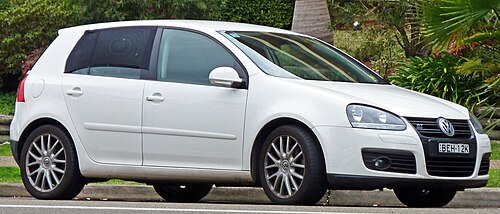
2008 Australian Golf GT Sport 1.4 TSI. Photo: OSX, Wikimedia Commons, Public domain; resized.
Selected cars and engines
Examples are selected rather than a complete production list. Engine and equipment specifications can vary with year and market.
CarWhy it mattersEvidenceBeetle / Type 1The air-cooled, rear-engined small car became one of the company's best-known models.Model referenceGolf GT 1.4 TSI (2006)The early 1,390 cc direct-injection petrol engine combined a mechanical supercharger and an exhaust turbocharger; not all 1.4 TSI engines are twincharged.Illustrated turbo historyGolf GTIVolkswagen's performance Golf line spans many generations and engine specifications.Model referenceCorrado G60 / Polo G40These performance versions used Volkswagen's belt-driven G-Lader scroll superchargers, different in principle from an exhaust turbo.Model reference
More models and representative engines
These are specific examples rather than every engine offered. Equipment, output and capacity can change with model year and market; identify the exact vehicle before ordering parts.
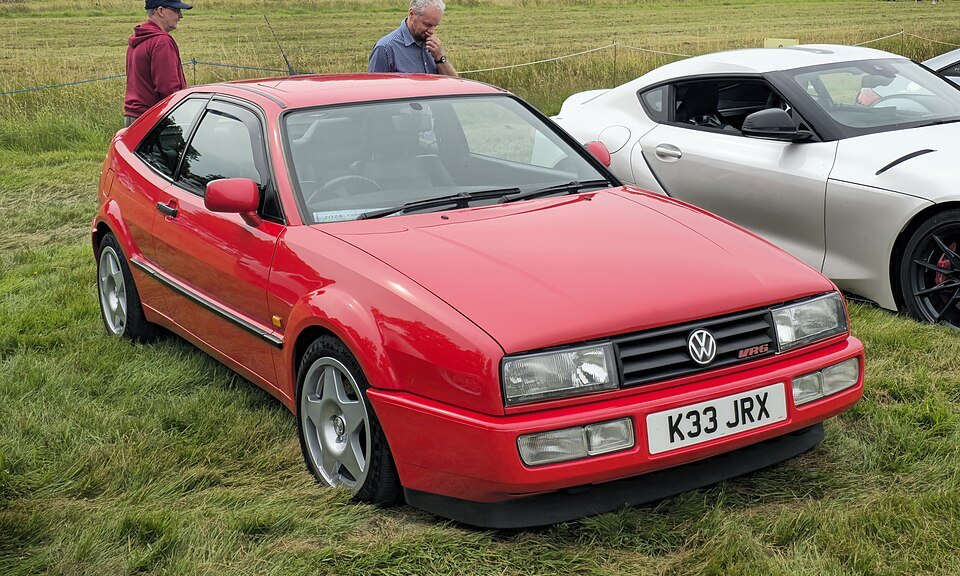
A Volkswagen Corrado VR6. Photo: Calreyn88, Wikimedia Commons, CC BY-SA 4.0; resized and re-encoded.
Model and versionEngine or powertrainEvidenceGolf GTI (Mk1, 1976)The original GTI used a 1.6-litre fuel-injected four-cylinder petrol engine; later Mk1 cars received a 1.8.Manufacturer sourcePolo G40 (Mk2)1.3-litre four-cylinder petrol engine with a mechanically driven G40 scroll supercharger.Manufacturer sourceCorrado VR6European 2.9-litre narrow-angle V6; different markets and years received different VR6 specifications.Manufacturer sourcePassat (B5) 1.9 TDIRepresentative B5 diesel models used a 1.9-litre turbocharged four-cylinder; several outputs and injection systems were offered.Manufacturer source
Identifying a car and engine
Use the VIN, market, model year and engine code when researching servicing, tuning or parts. A model badge may cover naturally aspirated, turbocharged, supercharged, hybrid or electric versions depending on the particular vehicle. Factory fitment and aftermarket conversions are distinguished in the linked guides.
Sources and related reading
Wikipedia: Volkswagen — marque history and further references.Tuning Wiki: illustrated turbocharged-car timeline.Tuning Wiki: supercharger types and Eaton guides.
Text is unchanged; formatting, links or images changed. Compare the rendered revisions below.
Rendered revisions
Open each version to inspect formatting, tables and photographs.
Volkswagen's origins lie in the development of a German people's car in the 1930s. After the Second World War the rear-engined Beetle became a major international model. Wikipedia: Volkswagen history.
The front-wheel-drive Golf marked a change of direction in the 1970s. Volkswagen later offered a wide range of turbocharged petrol and diesel engines, alongside hybrid and electric vehicles.
2008 Australian Golf GT Sport 1.4 TSI. Photo: OSX, Wikimedia Commons, Public domain; resized.
Selected cars and engines
Examples are selected rather than a complete production list. Engine and equipment specifications can vary with year and market.
The early 1,390 cc direct-injection petrol engine combined a mechanical supercharger and an exhaust turbocharger; not all 1.4 TSI engines are twincharged.
These are specific examples rather than every engine offered. Equipment, output and capacity can change with model year and market; identify the exact vehicle before ordering parts.
Use the VIN, market, model year and engine code when researching servicing, tuning or parts. A model badge may cover naturally aspirated, turbocharged, supercharged, hybrid or electric versions depending on the particular vehicle. Factory fitment and aftermarket conversions are distinguished in the linked guides.